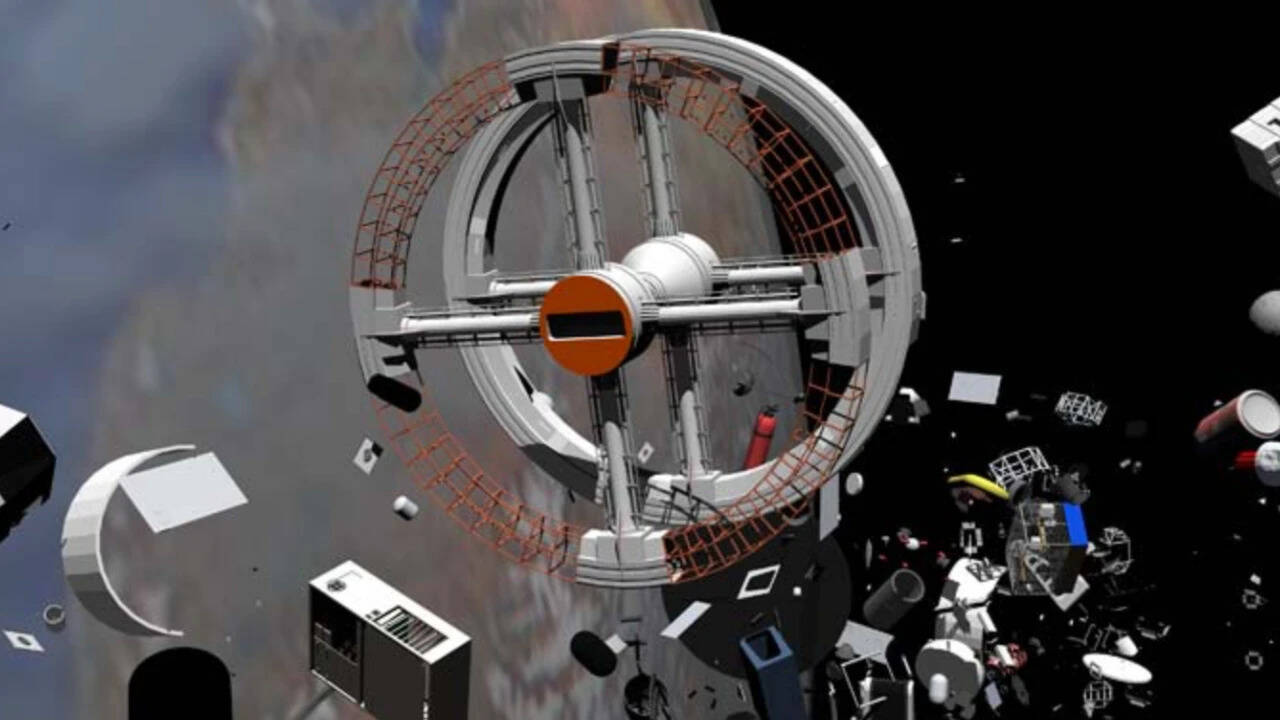
UK to Launch Robot Claw Spacecraft in 2029 to Clean Up Orbit Debris
The United Kingdom is planning to send a specialized spacecraft equipped with giant robotic claws into orbit to capture two defunct satellites and drag them down into Earth’s atmosphere to burn up.
The Tech TL;DR:
- The UK Active Debris Removal (UK ADR) programme plans to launch a refuelable spacecraft in 2029 to capture and de-orbit two dead satellites by 2032.
- The vehicle will use robotic claws to match movements and grapple with tumbling objects that were never built to be caught.
- The UK Space Agency has opened a public competition running until December 10, 2026, allowing citizens to suggest a name for the trash-disposal mission.
Spacecraft Design and Orbital Mechanics for Satellite Capture
Unlike conventional spacecraft built to carry operational equipment or crew, the vehicle designed by ClearSpace UK must approach and secure defunct hardware that may be tumbling through orbit. According to Robert Atchison, Managing Director of ClearSpace UK, the team designed a claw system because it provides the ability to pursue spacecraft of all shapes and sizes, coupled with a highly maneuverable chassis. The spacecraft must match the movement of its targets precisely before attempting to grapple them.
Once secured, the spacecraft will guide the targets toward a lower orbit, allowing Earth’s atmosphere to slow them down and generate the friction and heat required to cause complete disintegration during re-entry. The mission is slated to launch in 2029 and conclude by 2032, operating as part of a roughly $80 million initiative to prove that a single spacecraft can remove more than one dead satellite.
Growing Congestion in Low-Earth Orbit
Orbital congestion has intensified significantly over recent years. Jonathan McDowell, an astrophysicist who recently retired from the Center for Astrophysics, Harvard & Smithsonian, noted that while roughly 1,000 working satellites orbited Earth in 2019, active counts have skyrocketed. Tracker SatFleet Live figures place active satellites near 17,000, with SpaceX’s Starlink service accounting for approximately 11,000 of them.
Beyond functioning hardware, official orbital radar data shows nearly 32,000 trackable objects larger than about four inches, with approximately half consisting of space debris such as spent satellites, defunct rocket stages, and fragments dating back decades. U.K. Space Minister Liz Lloyd stated that backing this mission protects the operational satellites that underpin modern life, weather forecasting, and communications.

Public Naming Competition Details
Alongside engineering development, the UK Space Agency launched a public competition inviting citizens to suggest a name for the nation’s first nationally commissioned active debris-removal spacecraft. Entries remain open until December 10, 2026. The winning name will be displayed directly on the spacecraft.
Dr Alice Bunn, Co-Director of the UK Space Agency, emphasized that the undertaking targets broader capabilities for future servicing, assembly, and manufacturing in orbit. Such capabilities could eventually allow vehicles to inspect, repair, or refuel active satellites rather than discarding infrastructure after a single operational lifecycle.
More on Active Debris Removal
We're pleased to announce that we've selected @ClearSpaceToday to deliver the UK's first nationally commissioned active debris removal mission. 🛰️The mission: to remove two defunct UK satellites from low Earth orbit. 🌍Targeted for 2029.Read more 👇 https://t.co/B7gB4NTbjd
Britain's $81 million plan to clean up spaceThe UK Space Agency has selected aerospace company ClearSpace UK to develop a spacecraft specifically designed to remove dead satellites from orbit. The contract is valued at approximately $81 million. The project is part of… pic.twitter.com/d4nKbghkik