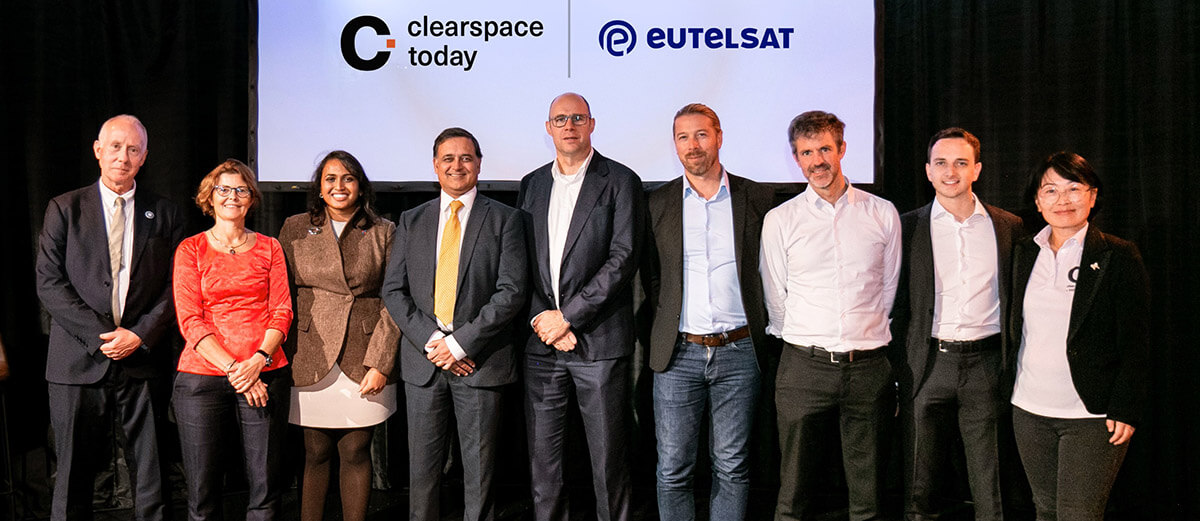
Eutelsat and ClearSpace Partner for GEO Satellite Life Extension
Eutelsat and ClearSpace signed a preliminary agreement, establishing a framework to cooperate on the Phoenix geostationary orbit life-extension mission and develop commercial in-orbit servicing.
Agreement Outlines Roadmap for Satellite Life Extension
The preliminary agreement outlines the technical, operational, and commercial foundations for extending the operational life of geostationary satellites. It creates a roadmap moving from the development of the Phoenix servicing vehicle to future commercial service contracts. Eutelsat will contribute operational expertise to help shape service requirements, mission design, and demonstration planning. The collaboration also lays the groundwork for potentially using an Eutelsat satellite in an on-orbit demonstration, pending a subsequent agreement.
Representatives from both companies highlighted the agreement during the Newtech in Space session at the NEO Space event held in Luxembourg on October 20. They discussed the Phoenix project and their shared vision for geostationary orbit life-extension services.
Life-Extension Services Maximize Value of Orbital Assets
For satellite operators, life-extension services offer increased flexibility in managing geostationary fleets, prolonging the utility of existing spacecraft and maximizing the value of assets already in orbit. Phoenix is currently under development to demonstrate the technologies required to offer these capabilities commercially.
Sabrina Andiappane, managing director of ClearSpace Luxembourg, said that Eutelsat provides a valuable perspective on how they design and deliver this capability. The agreement marks an important step in connecting their technological development with the operational needs of the market and consolidating a commercial in-orbit service business from Luxembourg, starting with Phoenix and subsequent services.
Frédéric Piro, engineering director at Eutelsat, said that their geostationary fleet provides essential broadcasting and connectivity services to customers worldwide. Life-extension technologies could help them offer these services for a longer period, providing more options for fleet planning and maximizing the value of their investment in satellites already in orbit.
ESA Framework Supports Phoenix Mission Development
The Phoenix mission advances under the European Space Agency Industrial Competitiveness framework, as part of the agency’s Advanced Research in Telecommunications Systems program. The project builds upon initial development work carried out within Luxembourg’s national space program. The core objective of the mission is to demonstrate safe rendezvous, docking, and control of a satellite in geostationary orbit, setting the stage for commercial life-extension operations.