
UCLA Grad’s chatgpt shout-Out Ignites AI in Education Debate
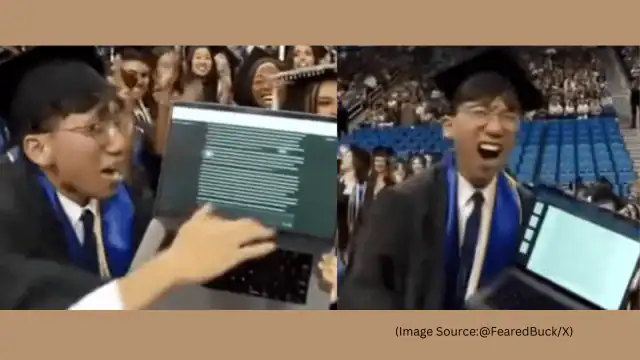
A University of California, Los Angeles (UCLA) graduate recently turned heads at their commencement ceremony, foregoing traditional displays of national pride or celebratory slogans to instead showcase their “most trusted study partner”: ChatGPT.The graduate’s open acknowledgment of using the AI tool to complete their final paper has ignited a global debate about the role and impact of artificial intelligence in education.
Graduate’s ChatGPT Display goes Viral
The incident, captured in a video shared on X (formerly Twitter) by user @FearedBuck, quickly amassed over 42 million views. The video shows the UCLA graduate approaching the stage with a laptop displaying the ChatGPT interface. The graduate made no attempt to hide the fact that the AI platform was instrumental in completing their academic work. The post was captioned, “UCLA graduate celebrates by showing off the ChatGPT he used for his final projects right before officially graduating 😭”
UCLA graduate celebrates by showing off the ChatGPT he used for his final projects right before officially graduating 😭 pic.twitter.com/hZAvrY1fJk
– FearBuck (@FearedBuck) June 18, 2025
Netizen Reactions: A Divided Response
The viral video triggered a wave of reactions, highlighting the complex and often conflicting perspectives on AI’s role in academia. Some expressed concerns about students becoming overly reliant on AI tools, potentially hindering their own intellectual development. One commenter sarcastically remarked, “Start a healthy diet and fitness quickly, becuase yoru future doctor may graduate like this.” Another lamented, “Where did we have ChatGPT when we graduate!” while another joked, “In the future, doctors will wear an AirPod, and open their chests and ask how to perform ChatGPT.”
Though, others defended the graduate’s honesty and openness. One netizen wrote, “Although many people are unhappy, he is at least honest enough. 98% of the graduates have used it,and the remaining 2% have not graduated at all.” This sentiment suggests a growing acceptance, or at least acknowledgment, of AI’s presence in higher education.
did you Know? According to a 2024 study by Bright.com, 60% of college students used ChatGPT for assignments, and 30% admitted to using it for cheating [intelligent.com].
MIT Study Links AI Use to Declining Cognitive Function
The UCLA graduate’s display coincides with recent research highlighting potential downsides to AI dependence. A study conducted by MIT Media Lab, Wellesley College, and MassArt explored the impact of AI on cognitive function. The research team divided students into three groups: one using ChatGPT, one using Google Search, and one relying solely on their own knowledge. Brain activity was monitored during writing experiments.
The results indicated that students using ChatGPT exhibited significantly less brain activity compared to the other groups. These students also demonstrated lower memory retention and weaker cognitive connections to the material. The researchers concluded that while AI can enhance writing efficiency, it may also foster intellectual laziness and a detachment from knowledge in the long term.
Key Findings of the MIT Study
| Group | Tool Used | Brain Activity | Memory Retention |
|---|---|---|---|
| 1 | ChatGPT | Significantly Lower | Lower |
| 2 | Google Search | Moderate | Moderate |
| 3 | Own Knowledge | higher | Higher |
Pro Tip: Encourage students to use AI tools as a supplement to their learning, not a replacement for critical thinking and independent research.
Balancing Innovation and Cognitive Development
The increasing prevalence of generative AI tools like ChatGPT presents a notable challenge to the education community. Educators and institutions must find ways to harness the efficiency and potential benefits of AI while safeguarding students’ cognitive development and critical thinking skills.The UCLA graduate’s seemingly simple act of displaying ChatGPT has sparked a crucial conversation about the future of learning in the age of artificial intelligence.
what strategies can educators implement to ensure AI enhances, rather than hinders, student learning? How can students leverage AI responsibly and ethically in their academic pursuits?
The Evolution of AI in Education
The integration of AI in education is not a new phenomenon, but the sophistication and accessibility of tools like ChatGPT have accelerated the trend. Early applications of AI in education focused on automated grading and personalized learning platforms. Today, AI is capable of generating text, answering complex questions, and providing detailed feedback, blurring the lines between human and machine assistance.
The debate surrounding AI in education mirrors similar discussions throughout history regarding new technologies. from the printing press to the internet, each innovation has been met with both excitement and apprehension. The key lies in understanding the potential benefits and risks, and developing strategies to mitigate the negative consequences while maximizing the positive impact.
Frequently Asked Questions About ChatGPT and Education
How can ChatGPT be used ethically in education?
ChatGPT can be used ethically by citing it as a source, using it for brainstorming and outlining, and focusing on using it to improve, not replace, original thought and work.
What are the benefits of using AI tools like ChatGPT in education?
AI tools like ChatGPT can provide students with personalized learning experiences, instant feedback, and access to a vast amount of information. They can also assist with tasks such as research, writing, and problem-solving.
What are the risks of relying too heavily on ChatGPT for academic work?
Over-reliance on ChatGPT can lead to a decline in critical thinking skills, reduced memory retention, and a lack of originality in student work. It can also raise concerns about academic integrity and plagiarism.
How can educators detect and prevent the misuse of ChatGPT in their classrooms?
Educators can use AI detection tools, design assignments that require critical thinking and personal reflection, and promote a culture of academic integrity in their classrooms.
What is the future of AI in education?
The future of AI in education is likely to involve a greater integration of AI tools into the curriculum,with a focus on personalized learning,adaptive assessment,and AI-powered tutoring systems. However, it is crucial to ensure that AI is used responsibly and ethically, and that students continue to develop essential skills such as critical thinking, creativity, and collaboration.
Share your thoughts! How do you think AI will shape the future of education? Leave a comment below and join the conversation.
