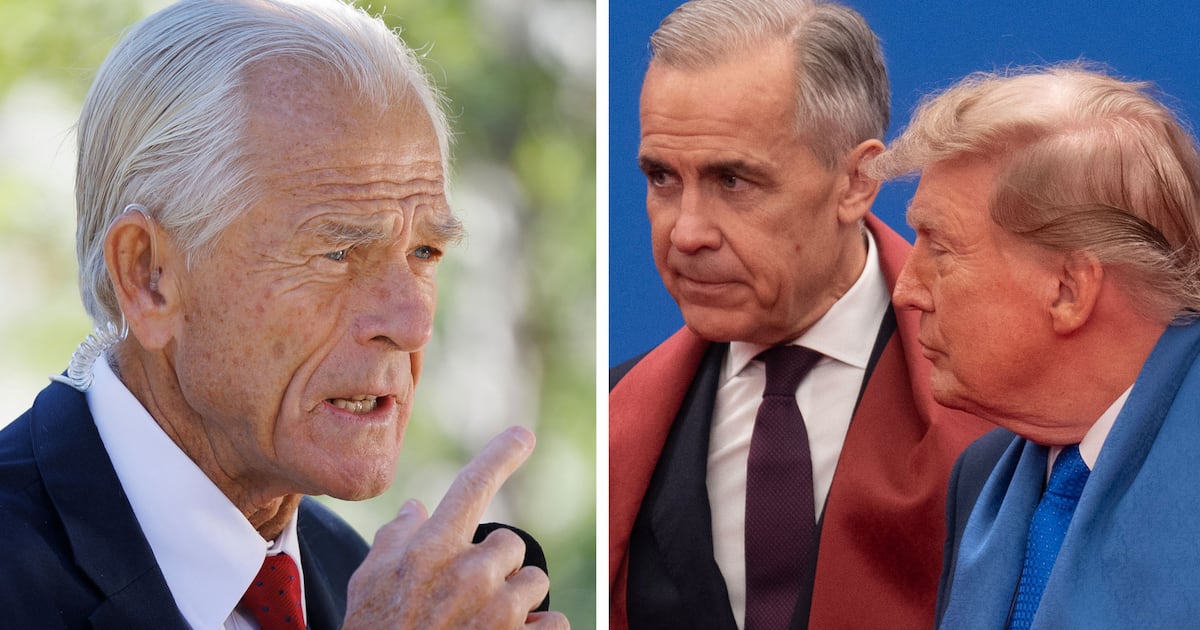
U.S. Trade Adviser Peter Navarro Slams Canada’s ‘Arrogance’ Amid Trade Negotiations
“They are like a high school team taking on the New York Knicks. That doesn’t end well for Canada.”
Peter Navarro, a senior trade adviser to U.S. President Donald Trump, wrote that on X on Thursday, November 19, as Canada-U.S. trade negotiations continue in Washington and Ottawa.
The post, reported by CTV News, accused the Canadian government of the “arrogance and dishonesty of Ottawa on trade” and said Canadian negotiators’ “misreading of their position is really something else.” The insults landed on the same day Prime Minister Mark Carney spoke with Trump about trade on the sidelines of the APEC summit in Shenzhen, China.
Why it matters: the White House declined to renew the Canada-United States-Mexico Agreement in July, talks stalled in August after Carney rejected a deal he said threatened Canada’s sovereignty, and both governments still want an agreement before the end of 2026.
Businesses on both sides of the border — from Windsor auto parts plants to softwood lumber shippers in British Columbia — remain caught between the two positions, and many are turning to international trade counsel and customs compliance advisers to untariff their supply chains while the outcome stays open.
Navarro’s short list of grievances
Navarro also posted a short interview clip on his X account on Thursday, CTV News reported. In it, he repeated longtime U.S. complaints about Canadian trade practices.

“Canada cheats us,” he said, naming lumber, dairy, steel and aluminum. He added that Canada had historically “cheated” the United States by “out-negotiating” it in the North American Free Trade Agreement and adding clauses that “really hurt” the U.S.
Those irritants have history. During his first term, Trump sought to terminate NAFTA over softwood lumber exports and access to Canada’s dairy supply management system. Canada, the U.S. and Mexico replaced NAFTA with CUSMA in 2020.
When the agreement came up for review, Trump’s administration chose not to renew CUSMA in July, CTV News reported. A month later, Carney rejected a proposed deal he said threatened Canada’s sovereignty and answered with counter-tariffs on U.S. goods. That is the standoff Navarro says Canada misreads.
What Ottawa’s negotiators told their advisers
Behind the public barbs, Canadian officials are weighing a harder calculation. On Tuesday, Canada-U.S. Dominic LeBlanc briefed an advisory committee on progress in the talks.
Four sources familiar with that discussion told CTV News that negotiators argued the government should seize the moment and strike a deal with the White House in the near term, warning against prolonging the economic pain by waiting out the final two years of the Trump administration.
The arrogance and dishonesty of Ottawa on trade and misreading of their position is really something else. They are like a high school team taking on the New York Knicks. That doesn’t end well for Canada. pic.twitter.com/rsb6zdQKBC
LeBlanc told Members of Parliament in Ottawa the same day that a trade deal remained possible. He cautioned, though, that there is no guarantee Canada can restore the terms of CUSMA.
Navarro’s harshness toward Carney predates the post. On Tuesday he sent a memo to the Prime Minister responding to Carney’s suggestion that Canada could welcome greater Chinese involvement in its domestic auto sector, CTV News reported.
Carney and Trump meet in Shenzhen
The tone from the leaders themselves was cooler. On Thursday in Shenzhen, Carney and Trump spoke about trade on the margins of the Asia-Pacific Economic Cooperation summit, alongside Malaysian Prime Minister Anwar Ibrahim and Chinese President Xi Jinping.
“The work underway to reach a mutually beneficial trade agreement that would create good jobs, boost affordability, and fully respect Canada’s languages, culture, and sovereignty.”
That is how the post-meeting readout described the discussion, which also, according to the readout, saw the two leaders “agree to continue the work and to stay in close contact.”
Carney’s trip stretched across Ireland, the Philippines, Cambodia and China. In Manila he discussed a free-trade agreement with his Philippine counterpart that is expected to be signed next year, and in his meeting with Xi the two leaders agreed to drop trade restrictions on more goods. CTV News reported that the trip affirms Carney’s plan to diversify trade and reduce Canada’s reliance on the U.S.
Freeland draws Navarro’s fire
The trade adviser saved some of his sharpest words for a Canadian no longer in office. On Thursday he criticized former deputy prime minister Chrystia Freeland over an essay she published in The New York Times on Tuesday under the title “Welcome Back America! It’s Your Turn to Be Sorry.”
“That former trade minister Chrystia Freeland went off on us yesterday in the Gray Lady. It’s like, what is she thinking?” Navarro said, per CTV News. In the essay, Freeland urged Canada and other democracies to embrace the U.S. midterm results and invited Washington “to rejoin us in a new, more balanced partnership.”
The midterm backdrop is doing quiet work in this dispute. Republicans lost control of both the House of Representatives and the Senate in last week’s elections amid voter concern about affordability and the impact of tariffs. Since then, CTV News reported, the Trump administration has softened its tone on trade with Canada, and advisers in recent weeks have suggested a deal could come before the end of 2026.
Where the two governments disagree
The disagreement runs along two lines. Navarro’s position, stated publicly on X, is that Canada holds a weak hand, cheats on lumber, dairy, steel and aluminum, and misjudges its bargaining power against a larger economy. Ottawa’s position, as reflected in Carney’s August rejection of the proposed deal, is that an agreement cannot come at the cost of Canadian sovereignty — and LeBlanc has warned that restoring full CUSMA terms is not assured even with a deal.
Both sides nonetheless describe the same goal: an agreement, possibly by the end of the year.
For firms exposed to the talks, the practical questions now are concrete: which counter-tariffs persist, whether steel and aluminum duties change, and how contracts priced under CUSMA terms get renegotiated. Importers and exporters are consulting trade lawyers and customs brokers in Toronto, Montreal and Detroit to map contingency plans until the negotiators land.
December is the deadline both sides circle
The sequence to watch runs from here to the end of December, when Trump’s advisers have suggested a deal could be reached. The same four sources who described the negotiators’ advice to the advisory committee told CTV News they warned against waiting out the remaining two years of the Trump administration — a clock that runs to early 2029.
CTV News’ report carries bylines from Graham Richardson and Luca Caruso-Moro, with files from The Canadian Press; cp24 carried the same report. Mention in this article’s case-file pages, for readers tracking tariff exposure from Windsor to Vancouver, that licensed customs brokers and cross-border trade law firms can review contract and duty exposure while the talks run.
Navarro, born in 1949, is an American economist who served as director of the White House National Trade Council and later the Office of Trade and Manufacturing Policy during Trump’s first term, returning in January 2025 as senior counselor for trade and manufacturing.
A professor emeritus of economics and public policy at the University of California, Irvine, he is the key figure behind the administration’s trade war with China and was sanctioned by China after leaving office.
Known for describing China as an existential threat to the United States, he wrote books including “The Coming China Wars” (2006) and “Death by China” (2011) — in several of which he quoted a fictional economist, “Ron Vara,” an anagram of his own surname, as a source.
“That doesn’t end well for Canada,” Navarro wrote on November 19.