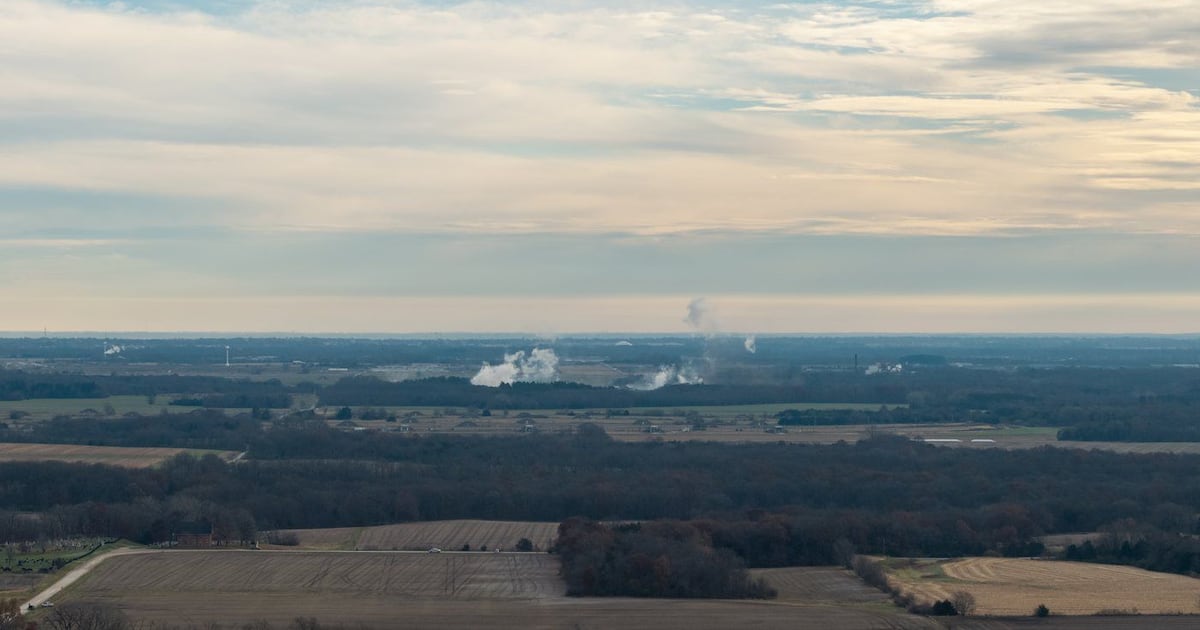
U.S. Army Detonated Lead Azide in Middletown, Iowa, Officials Report
The U.S. Army detonated nearly five tons of degraded lead azide outside Middletown, Iowa, on Wednesday morning, destroying 68 barrels containing 9,700 pounds of the volatile explosive compound to prevent an accidental disaster, CTV News reported.
The controlled blast at the Iowa Army Ammunition Plant proceeded after multiple legal challenges and last-minute delays over potential lead exposure in agricultural communities.
Federal officials defended the operation as the safest alternative to an uncontrolled explosion of the deteriorating material, which has been stored in a bunker for 17 years after seeing use since World War I. The agencies said officials have been “meticulously planning” the detonation since March and are prepared to take “the most extreme mitigation measures available” to protect the public and minimize disruptions.
Iowa Army Ammunition Plant detonates unstable lead azide in place creating toxic dust plumes that residents cannot fully avoid. On November 20, 2026, at approximately noon, the U. S. Army will conduct two controlled detonations of 68 barrels of degraded lead azide at the Iowa… pic.twitter.com/XLgK6fRqOZ
- The U.S. Army destroyed 9,700 pounds of lead azide in Middletown, Iowa, on Nov. 25, 2026.
- A federal appeals court lifted an administrative stay on Nov. 23, 2026, allowing the blast to proceed.
- President Trump criticized Iowa Gov.-elect Rob Sand on Nov. 25, 2026, accusing him of delaying the process.
“There is consensus across experts across the country that a controlled, mitigated detonation of the lead azide here at Iowa Army Ammunition Plant is far preferable to an uncontrolled, spontaneous detonation of that substance,” said Adam Telle, acting secretary of the US Army, according to The Guardian.
Environmental groups and local residents expressed alarm ahead of the operation, warning that the release of lead particles into the air could affect farmland and local communities.
A federal court temporarily paused the Army’s emergency EPA permit following a lawsuit from environmental advocates, but the U.S. Justice Department argued that immediate action was necessary to address the failing storage containers, as reported by The Conversation and the Iowa Capital Dispatch.
The controlled detonation at Iowa Army Ammunition Plant is now scheduled on Wednesday, November 25, 2026 to allow for optimal weather conditions and all mitigation measures to be emplaced. The Army and our interagency partners have been working around the clock to safeguard all…
“I have heard from many Iowans who are worried about their health and safety due to the potential risk of lead exposure as a result of the detonation,” Senator-elect Josh Turek said Thursday in calling for a delay.
Department of Justice Deems Controlled Detonation Necessary
Federal officials and military investigators concluded that attempting to treat the contents, move the drums to another disposal site, or build a protective structure using heavy equipment would endanger both workers and the surrounding community.
The U. S. Army successfully carried out the controlled detonation in Middletown, Iowa, this morning, with mitigation efforts exceeding expectations and showing zero initial detections of airborne lead. Our priority remains the safety of every Iowan affected. USDA is on the ground,…
Opposing the legal challenges brought by environmental advocates, the Department of Justice maintained in a court filing that a controlled detonation was necessary immediately to prevent an unmitigated explosion. The filing argued that Environmental Protection Agency regulations permitted the planned action without requiring a special permit.
Residents Tape Windows Worry Lead Exposure
Residents in Middletown taped up windows and covered air conditioners with tarps to keep lead particles out ahead of the blast. Local individuals also worried about potential lead exposure affecting children using playground equipment after the explosion.

Zach Lahn, the Republican candidate who ran for Iowa governor, told POLITICO that residents in the area had endured negative health impacts for decades. Meanwhile, the Army noted that the deteriorating explosive compound had been stored in a bunker since World War I.
Governor Issues Disaster Proclamation Deploys Soldiers
President Trump criticized incoming Iowa Governor Rob Sand on Wednesday, claiming the Democrat delayed the process and was “absolutely no help,” according to Yahoo News Canada. Conversely, Stephen Miller, the president’s chief of staff, thanked Sand, outgoing Governor Kim Reynolds, and other officials for their cooperation on X after the explosion.
President Trump has assembled the most exemplary team of leaders and patriots we have ever seen. I want to express my congratulations to Secretary Hegseth, the United States Army, and the entire stellar federal interagency — EPA Administrator Zeldin, FEMA Administrator…
Governor Reynolds issued a disaster emergency proclamation for Des Moines, Lee, and Van Buren counties, deploying up to 100 National Guard soldiers, The Guardian reported. The Federal Emergency Management Agency supported relocations for residents in Middletown and surrounding areas, while individuals living up to 20 miles away were advised to remain indoors with windows closed.
Operated by primary contractor American Ordnance LLC under the U.S. Army Joint Munitions Command, the 19,011-acre Iowa Army Ammunition Plant features 271 igloos and a storage capacity of 1,100,775 square feet across its facility in Middletown. Established as the Iowa Ordnance Plant in November 1940, the installation expanded production for World War II and subsequent conflicts before the U.S. Army assumed responsibility in 1975.
Previously, the plant also experienced an unplanned explosion on January 22, 2025, which resulted in no injuries.
Independent researchers and federal agencies mobilized to assess environmental impacts following the morning blast. Environmental Protection Administration chief Lee Zeldin told CNN shortly after the explosion that preliminary monitoring detected no lead in the air around the site, according to WIRED.
University researchers also deployed testing equipment to track potential fallout across the region, while agricultural experts noted that current crop harvesting schedules helped avoid direct residue on major corn and soybean yields.
Keeping Missourians safe also means keeping Missourians informed with facts. Tomorrow's federal operation at the Iowa Army Ammunition Plant is taking place to reduce the risk of an uncontrolled, spontaneous explosion. The federal multi-agency team planning the detonation is…
Earlier coverage: U.S. Army to Detonate Unstable Lead Azide in Iowa Wednesday After Monday Court Ruling
More on Middletown
Public safety is the Army’s top priority, and I have directed Army Materiel Command to postpone tomorrow’s controlled detonation at the Iowa Army Ammunition Plant in Middletown, Iowa until Monday, November 23. This will delay the detonation until the latest possible moment prior…
If you live near the site in Iowa, or love someone who does, here are practical ways to lower your family's risk. https://t.co/g5pqMpwD43
USDA is on the ground in Iowa, working with state agriculture officials to support farmers and ranchers who may be affected by the U. S. Army’s planned detonation in Middletown, slated for 9:00 AM CT. Under Secretary Richard Fordyce is coordinating with Iowa and Missouri… pic.twitter.com/BccLlFmcDE
To farmers and livestock producers in southeast Iowa and northeast Missouri: USDA is on the ground to help ahead of the U. S. Army’s planned detonation in Middletown, Iowa. Under @SecRollins’ leadership, USDA is coordinating with @IAGovernor, @MikeNaigIA and Missouri agriculture…
‼️The Army will set off two controlled detonations at the Iowa Army Ammunition Plant near Middletown on Friday, Nov. 20, to dispose of an old cache of lead azide. The Army found 68 barrels of the explosive that had been stored at the plant for more than 20 years. Lead azide… pic.twitter.com/BMWV9huBQ0