
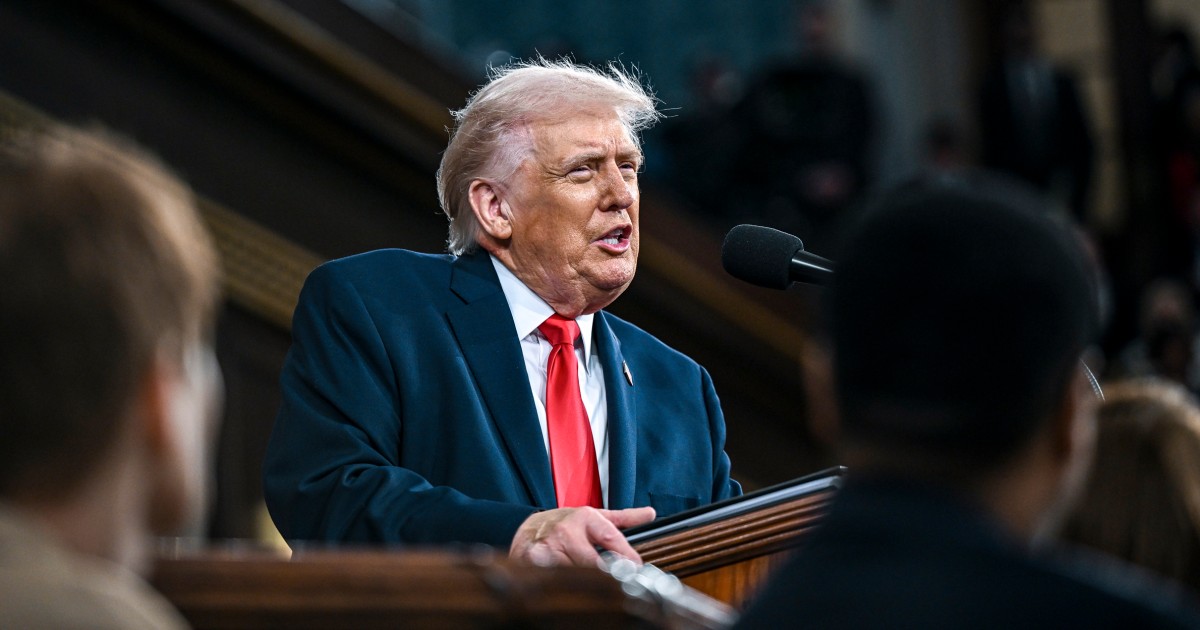
WASHINGTON — President Donald Trump delivered a record-length State of the Union address Tuesday night, using the platform to declare an “golden age of America” and directly challenge Democrats, even as his administration faces growing scrutiny over the economy and escalating international tensions. The speech, lasting over 1 hour and 47 minutes, was punctuated by frequent interruptions and visible displays of dissent from opposition lawmakers.
Trump’s address came at a moment of political vulnerability, with recent polls indicating a decline in public trust regarding his handling of the economy – a key pillar of his political support. NBC News reported that this marks the first time in his political career Americans have expressed diminished confidence in his economic policies. Despite this, Trump largely avoided outlining fresh policy initiatives, instead focusing on defending his existing agenda.
The President prominently touted his administration’s economic achievements, claiming the stock market was at “all-time highs.” He framed the current economic situation as a “transformation like no one has ever seen before,” even as largely dismissing concerns about rising costs and wage stagnation voiced by many Americans. He attributed any economic difficulties to his predecessor and Democratic policies.
Immigration was another central theme of the speech, with Trump taking credit for what he described as a significant reduction in illegal immigration and the establishment of “the strongest border in American history by far.” He highlighted cases of crimes committed by individuals in the U.S. Illegally, bringing family members of victims as guests to the address. This approach drew sharp criticism from some Democratic lawmakers.
Representative Norma Torres, D-Calif., held a sign displaying photos of Alex Pretti and Renee Good, American citizens killed by federal agents in Minneapolis, in response to Trump’s focus on crimes committed by undocumented individuals. Representatives Ilhan Omar, D-Minn., and Rashida Tlaib, D-Mich., repeatedly interrupted the President, shouting, “You have killed Americans,” according to NBC Los Angeles.
The address was marked by several contentious exchanges. Trump repeatedly blamed Democrats for economic challenges and accused them of supporting policies he characterized as detrimental to the country, including what he termed the “green new scam” and “open borders.” He accused Democrats of recently adopting the word “affordability” – a word he claimed they had been given – to deflect blame for problems they created.
Beyond the domestic policy focus, Trump briefly addressed international concerns, stating that Iran is working to build missiles capable of reaching the U.S. “soon.” However, a government report cited by NBC News estimates that such capabilities are not expected to materialize until at least 2035.
The Democratic response to the President’s address was delivered by Virginia Governor Abigail Spanberger, who spoke from Colonial Williamsburg. Meanwhile, more than two dozen congressional Democrats boycotted the State of the Union altogether, opting instead to participate in counter-programming events around Washington D.C. NBC Los Angeles reported that over a dozen House Democrats invited survivors of Jeffrey Epstein to the address as their guests.
Representative Al Green, D-Texas, was escorted out of the House chamber after displaying a sign reading “Black People Aren’t Apes,” a reference to a video Trump recently reposted on his Truth Social account depicting the Obamas as apes. The incident underscored the deep partisan divisions that characterized the evening. The gold-medal-winning U.S. Men’s Olympic hockey team was also present as guests of the President, receiving a standing ovation.
As the midterm elections approach, the impact of Trump’s address – and the sharp divisions it revealed – remains to be seen. The White House has yet to respond to requests for clarification on the timeline of Iran’s missile development program, leaving questions unanswered about the administration’s strategy for addressing the evolving geopolitical landscape.
