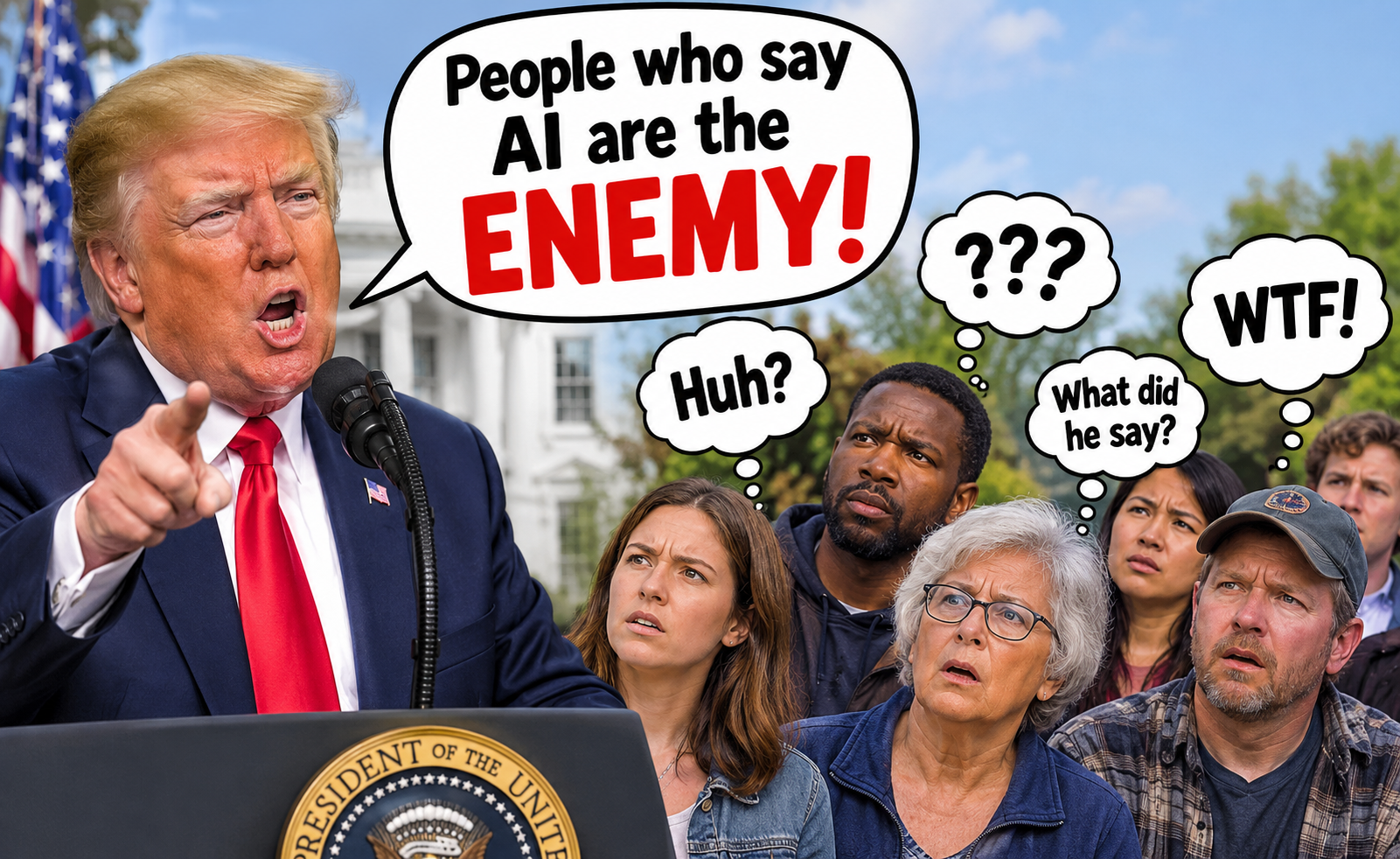
Trump says using term artificial intelligence marks someone as enemy
On October 8, 2026, President Donald Trump escalated his administration’s campaign to rebrand artificial intelligence by declaring on Truth Social that anyone continuing to use the established term is considered an enemy of the White House.
The Tech TL;DR:
- President Trump declared via social media on October 8, 2026, that using the term “artificial intelligence” instead of “super intelligence” marks someone as an administration enemy.
- The declaration follows a September executive order and a United Nations General Assembly address where the administration pushed for federal agencies to adopt the new terminology.
The White House Social Media Declaration and Prior Federal Actions
The presidential statement arrived not through a formal address or press briefing, but via a digital post on Truth Social. In his message, President Trump asserted that the White House considers individuals using the term “Artificial Intelligence” rather than “Super Intelligence” to be “THE ENEMY!” This digital escalation followed remarks delivered less than two weeks prior at the United Nations General Assembly, where the president argued that the word “artificial” makes current computational systems sound fake. According to Axios, the administration concurrently continued to utilize the term “artificial intelligence” in standard White House communications, highlighting an internal divergence between official messaging and the president’s stated vocabulary mandate.
Scientific Objections to Terminology Changes
Technical commentators and researchers have raised substantial objections regarding the scientific accuracy of replacing the established umbrella term. Artificial intelligence currently encompasses a broad spectrum of computational systems, including routine chatbots, image generators, and predictive algorithms, none of which inherently possess human-like consciousness or universal understanding. Conversely, as noted by technology analysts, “superintelligence” designates a hypothetical future threshold where machine capabilities surpass human intelligence across all domains. Applying that label indiscriminately to today’s software risks blurring critical distinctions between current engineering limitations and speculative milestones. A government administration can mandate preferred phrasing for official documents, but it cannot alter underlying technical realities merely by shifting nomenclature.

Potential Chilling Effects on Private Speech and Research
While the executive order signed in September successfully formalizes terminology changes for federal agencies, it does not legally prohibit private citizens, academic researchers, or commercial enterprises from using traditional vocabulary. Legal analysts point out that an inflammatory social media post does not automatically constitute an enforceable threat or a direct violation of First Amendment rights. However, public policy observers warn of a potential chilling effect.
# Example verification of terminology usage in enterprise codebases
# Checking configuration strings for deprecated naming conventions
import re

def audit_terminology(codebase_path):
    deprecated_pattern = re.compile(r"artificial_intelligence", re.IGNORECASE)
    # Enterprises must evaluate whether vocabulary mandates impact compliance logs
    matches = 0
    with open(codebase_path, 'r') as file:
        for line in file:
            if deprecated_pattern.search(line):
                matches += 1
    return matches
Voters Believe Government Fails to Address AI Risks
The terminology dispute intersects with changing political views on technological safety and economic disruption. A Reuters/Ipsos poll published on October 7, 2026, revealed that 57 percent of registered voters believe the Trump administration is failing to take AI risks seriously enough, while 54 percent expressed similar dissatisfaction with Congress. Additional data from the Pew Research Center, released in September, indicated that 56 percent of Democrats and Democratic-leaning independents view AI with greater concern than excitement, compared with 49 percent of Republicans.
AI Developers Fund Candidates Favoring Minimal Oversight
Underpinning the broader administrative push is an aggressive political strategy driven by major AI developers and financial backers. Industry-aligned political action committees have invested heavily to support candidates favoring rapid software deployment and minimal oversight, while targeting proponents of stricter regulation. As enterprise software deployment scales and public debate intensifies, independent researchers and corporate compliance teams must balance commercial imperatives against shifting governmental expectations. Organizations managing these complex regulatory shifts often consult with specialized legal and policy advisors to ensure compliance without compromising technical accuracy or scientific independence.
Disclaimer: The technical analyses and security protocols detailed in this article are for informational purposes only. Always consult with certified IT and cybersecurity professionals before altering enterprise networks or handling sensitive data.

- Stephen Hawking Biography Reveals Human Side of Scientific Genius
- Bruce Schneier says he caught and cooked a Boston squid
- Houthi Strikes on Riyadh Airport Kill Three as Trump Rules Out Pre-Midterm Action (archyde.com)
- The Trump administration imposed sweeping sanctions against the International Criminal Court on Oct (newsy-today.com)