Russia Launches Progress MS-36 Cargo Ship With Teledroid Robot to ISS
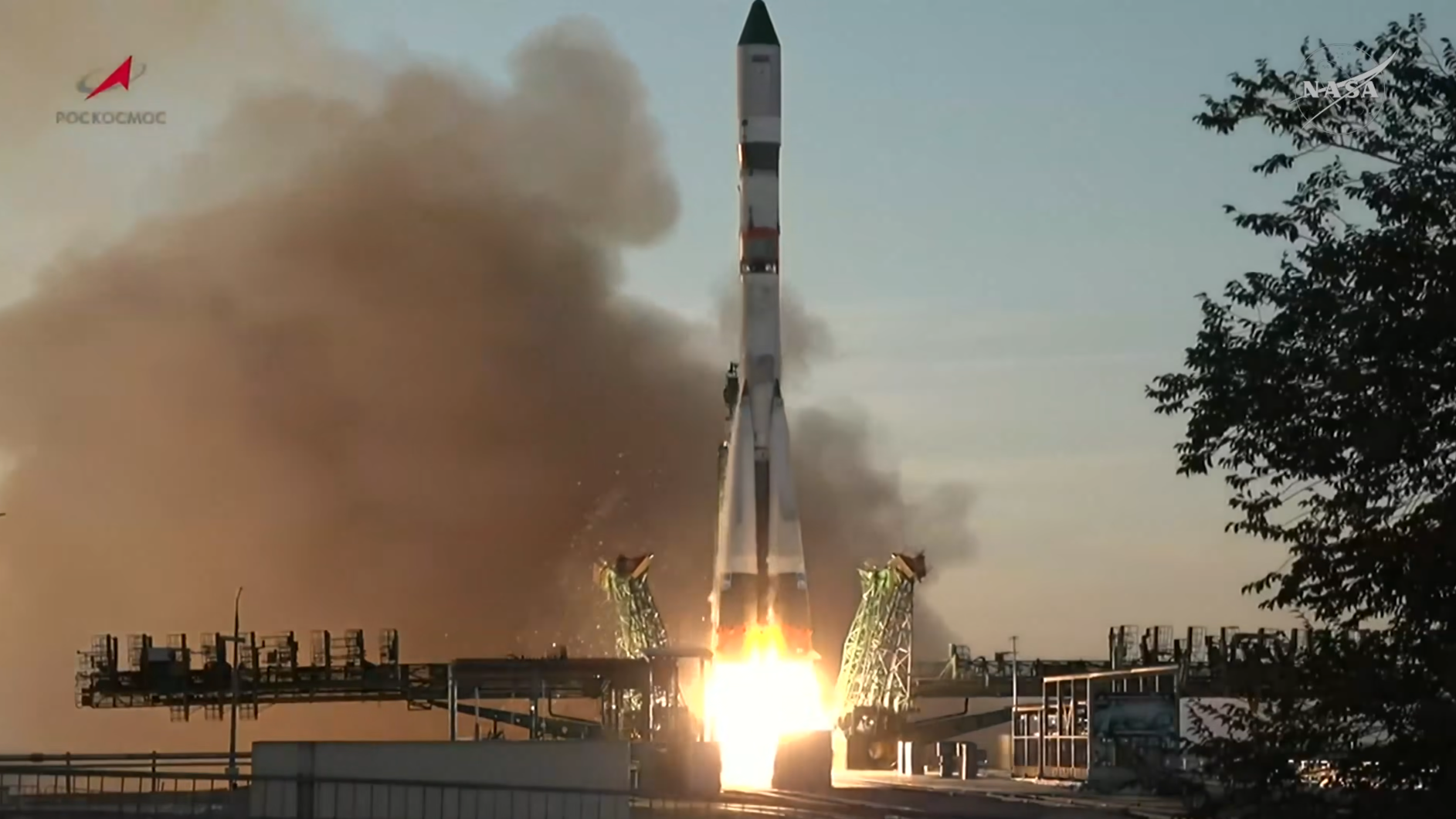
Russia’s Progress MS-36 cargo ship launched from the Baikonur Cosmodrome in Kazakhstan on Monday at 5:17 a.m. EST, beginning a two-day flight to the International Space Station.
The Soyuz-2.1b rocket lifted off from Site 31, which Russia spent roughly three months repairing after a service platform collapsed there in November 2025, Space reported. The freighter, designated Progress 97, separated from the launcher’s third stage and is on track to dock at the station’s Poisk module on Thursday, Nov. 26.
The spacecraft carries more than 2.4 metric tons of supplies, including 750 kilograms of propellant, 51 kilograms of oxygen, 420 kilograms of drinking water and 261 kilograms of food, according to TASS. The manifest also includes 657 kilograms of hardware for experiments such as “Challenge,” “Teledroid,” “Aseptic,” “Cascade” and “Orbita-MG.”
A primary payload is the control system for the Teledroid robot, developed by the Scientific Production Association Android Technics. The torso-type manipulator has 30 degrees of freedom and two arms designed to operate standard space tools while withstanding vacuum, radiation and extreme temperature swings, TASS reported. Its modular design allows cosmonauts to perform repairs aboard the station.
The experiment proceeds in three stages: virtual simulation, internal tests in a pressurized compartment, and external operations on a dedicated work table. Yevgeny Dudorov told TASS the mission is planned for approximately 40 sessions — up to 20 in the simulator and up to 20 inside and outside the modules. He said the technology is intended for use on the Russian orbital station and on the Moon.
Cosmonauts Pyotr Dubrov, Anna Kikina and Sergey Teteryatnikov will unload cargo through the Poisk hatch. The freighter will then relocate to the aft port of the PrK transfer tunnel leading to the Zvezda service module, a maneuver necessitated because the PrK tunnel has been sealed since an air leak was first documented in 2019, Space reported, citing Anatoly Zak of RussianSpaceWeb.com.
“Progress 97 is therefore the first cargo mission scheduled to unload its cargo and perform orbit corrections of the ISS at different docking ports,” Zak wrote on RussianSpaceWeb.com.
The vehicle is expected to remain attached for about six months before departing with trash to burn up in the atmosphere. Unlike SpaceX’s reusable Dragon capsule, the Progress, Japan’s HTV-X and Northrop Grumman’s Cygnus are expendable.