
Trump’s False Claims on Trade, Ukraine Aid, and Immigration Exposed at G7 Summit
Table of Contents
- Trump’s False Claims on Trade, Ukraine Aid, and Immigration Exposed at G7 Summit
- Trump’s Dubious Claims About Russia’s G8 Ouster
- Inaccurate Statements on Trade and Ukraine Aid
- Misleading Claims About Migrant Encounters
- Fact-Checking Organizations Respond
- Impact on International Relations
- The Importance of Fact-Checking in Political Discourse
- Frequently Asked questions About Political Misinformation
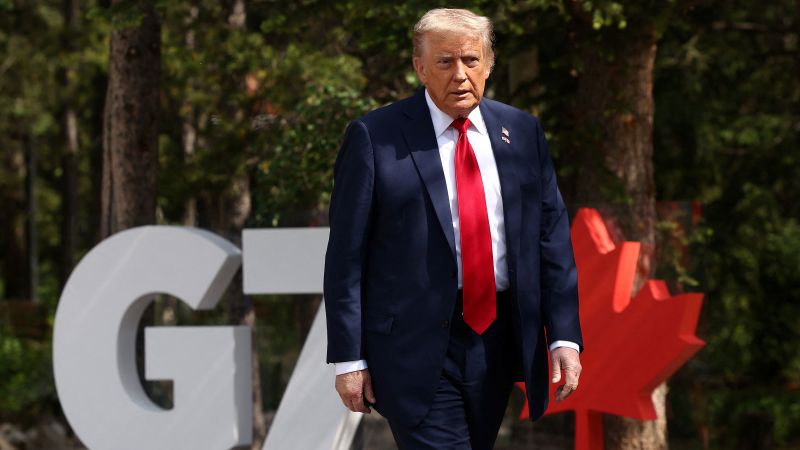
While attending the Group of 7 summit in Canada on Monday, President Donald Trump repeated several false claims regarding past events and current policies, drawing criticism and prompting fact-checking responses [[1]]. The inaccuracies spanned topics from trade deals to aid for Ukraine and immigration figures, raising questions about the accuracy of details presented on the international stage.
Trump’s Dubious Claims About Russia’s G8 Ouster
Trump falsely asserted that former Canadian Prime Minister Justin Trudeau was responsible for Russia’s expulsion from the Group of 8 (formerly G8). He stated that trudeau, along with Barack Obama, spearheaded the effort to remove Russia. Though, Trudeau did not become Prime Minister until November 2015 [[1]], well after Russia’s ouster in 2014, which was led by then-Prime Minister stephen Harper [[1]].
Did You Know? The G8 became the G7 after Russia’s expulsion in 2014 due to its annexation of Crimea.
Inaccurate Statements on Trade and Ukraine Aid
During a press conference with UK Prime Minister Keir starmer, Trump erroneously referred to his trade deal with the UK as a deal with the European Union, despite the UK no longer being a member [[1]].He also repeated the debunked claim that former president Joe Biden provided $350 billion in aid to Ukraine [[1]].
According to the Kiel institute for the World Economy, the U.S. committed approximately $138 billion in aid to Ukraine between late January 2022 and April 2025 [[1]]. The U.S. government inspector general overseeing the Ukraine response reports about $185 billion appropriated through March 2025, including funds spent within the U.S. or sent to other countries [[1]].
Misleading Claims About Migrant Encounters
Trump also reiterated the false assertion that “biden allowed 21 million people to come into our country.” U.S. Customs and border Protection (CBP) data shows fewer than 11 million migrant encounters through December 2024 [[1]]. Even when including estimated “gotaways,” the total falls far short of 21 million [[1]].
Pro tip: Always verify statistics from multiple sources to ensure accuracy.
Fact-Checking Organizations Respond
Several fact-checking organizations have addressed Trump’s recent statements,highlighting the discrepancies between his claims and available data. These organizations play a crucial role in informing the public and holding leaders accountable for the accuracy of their statements.
Impact on International Relations
The spread of misinformation can have significant consequences for international relations,perhaps undermining trust and complicating diplomatic efforts. Accurate information is essential for informed decision-making and effective collaboration on global challenges.
| Claim | Fact | Source |
|---|---|---|
| Trudeau ousted Russia from G8 | Harper led the effort in 2014 | CBC News |
| Trade deal with the EU | Deal with the UK | CNN |
| $350B in aid to Ukraine | ~$138B committed | Kiel Institute |
| 21M migrants entered the US | Under 11M migrant encounters | CBP |
What steps can be taken to combat the spread of misinformation on the global stage?
How can citizens better equip themselves to identify and verify information from political leaders?
The Importance of Fact-Checking in Political Discourse
In an era of rapid information dissemination, the role of fact-checking has become increasingly vital.Political leaders’ statements can have far-reaching consequences, and it is essential to ensure that these statements are based on accurate information. Fact-checking organizations provide a valuable service by scrutinizing claims made by politicians and providing the public with reliable assessments of their veracity.
The rise of social media has further complicated the information landscape, making it easier for misinformation to spread rapidly. This underscores the need for critical thinking skills and media literacy among citizens. By verifying information from multiple sources and being aware of potential biases, individuals can make more informed decisions and contribute to a more informed public discourse.
Frequently Asked questions About Political Misinformation
- Why is it vital to fact-check political statements?
- Fact-checking ensures that the public is informed with accurate information, which is crucial for making informed decisions and holding leaders accountable.
- What are the consequences of spreading misinformation?
- Spreading misinformation can erode public trust, polarize society, and undermine democratic processes.
- How can I identify misinformation?
- Look for credible sources, check multiple sources, be wary of emotionally charged content, and consult fact-checking organizations.
- what role do social media platforms play in combating misinformation?
- Social media platforms have a duty to moderate content, label misinformation, and promote accurate information.
- How can I contribute to a more informed public discourse?
- Share accurate information, engage in respectful dialog, and support fact-checking initiatives.
