
Scientists Release Stunning Images of Planet-Forming Disks Around Distant Stars
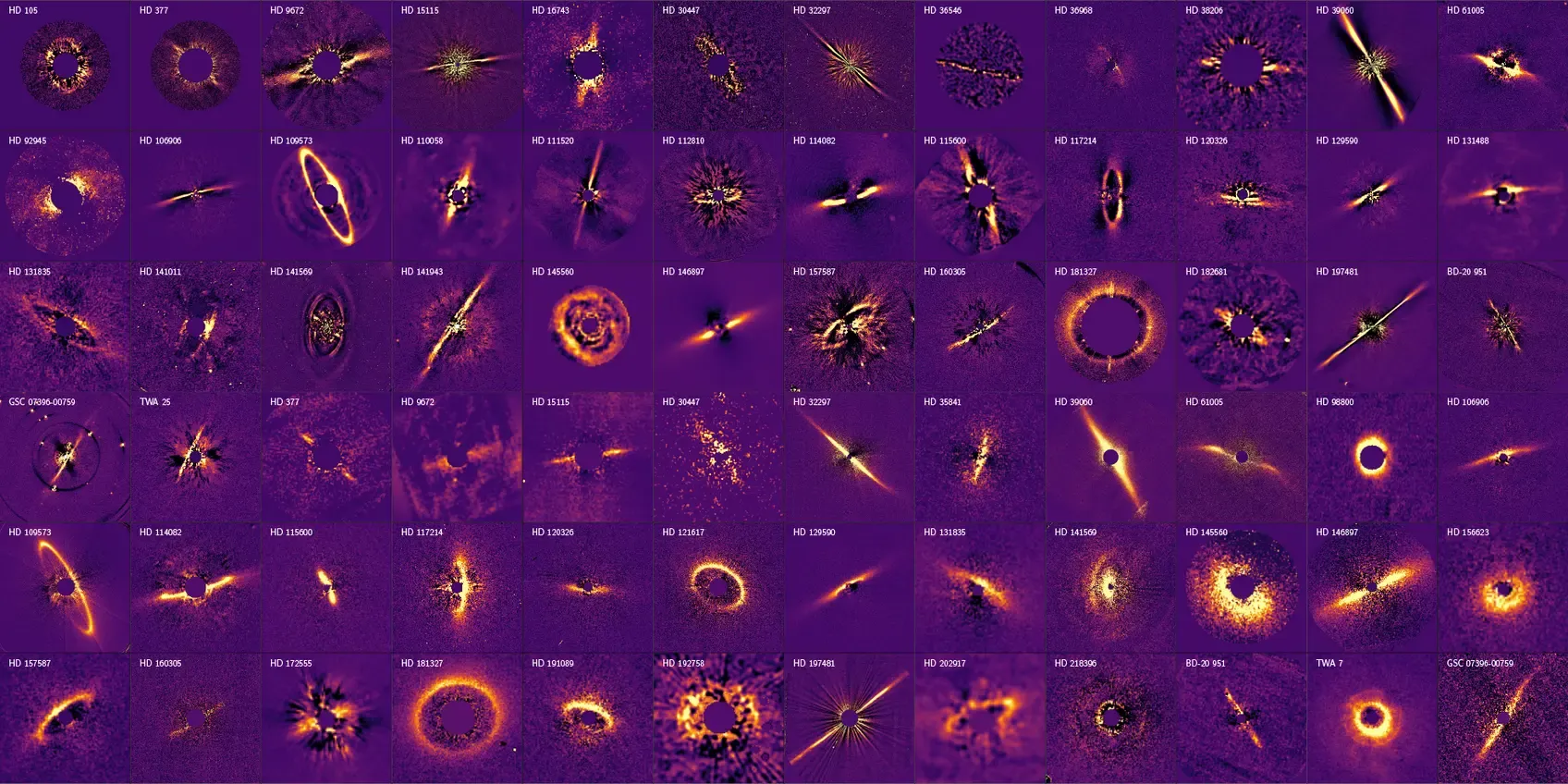
Dec. 6, 2025 - An international team of astronomers has unveiled 51 high-resolution images revealing the intricate structures of debris disks around young stars, offering unprecedented insights into the birth of planets. The images, captured by the SPHERE instrument on the European Southern Observatory’s Very Large Telescope, showcase a diverse range of disk morphologies, from sharply defined rings to chaotic, billowy structures.
The observations reveal how planets sculpt the material orbiting their host stars, much like Neptune shapes the Kuiper Belt in our own solar system. In many systems, dust congregates in sharply defined rings, hinting at the presence of unseen planets.Systems like HD 197481 and HD 39060 display streams of material, representing an edge-on view of these disks, while HD 109573 and 181327 exhibit nearly perfect circular debris rings, seen face-on.
Younger systems, such as HD 145560 and HD 156623, show more chaotic dust distributions, suggesting the material hasn’t yet been fully shaped by planets or cleared by collisions. Researchers found trends indicating more massive stars tend to host more massive disks,and disks with material concentrated farther from the star generally contain more mass.
“All of these belt structures appear to be associated with the presence of planets, specifically of giant planets, clearing their neighborhoods of smaller bodies,” researchers stated. Some images reveal features like sharp inner edges or disk asymmetries, hinting at undiscovered planets.
While some giant exoplanets have already been detected in these systems,the SPHERE survey provides a roadmap for future observations with instruments like the James Webb Space Telescope and ESO’s Extremely Large Telescope,which could directly image the exoplanets responsible for sculpting these disks.
The findings were published Dec. 3 in the journal Astronomy and Astrophysics.Researchers describe the data set as “an astronomical treasure” for understanding planet formation.
