
Unseen Fireworks: International Space Station Reveals Secrets of Transient Luminous Events
Table of Contents
- Unseen Fireworks: International Space Station Reveals Secrets of Transient Luminous Events
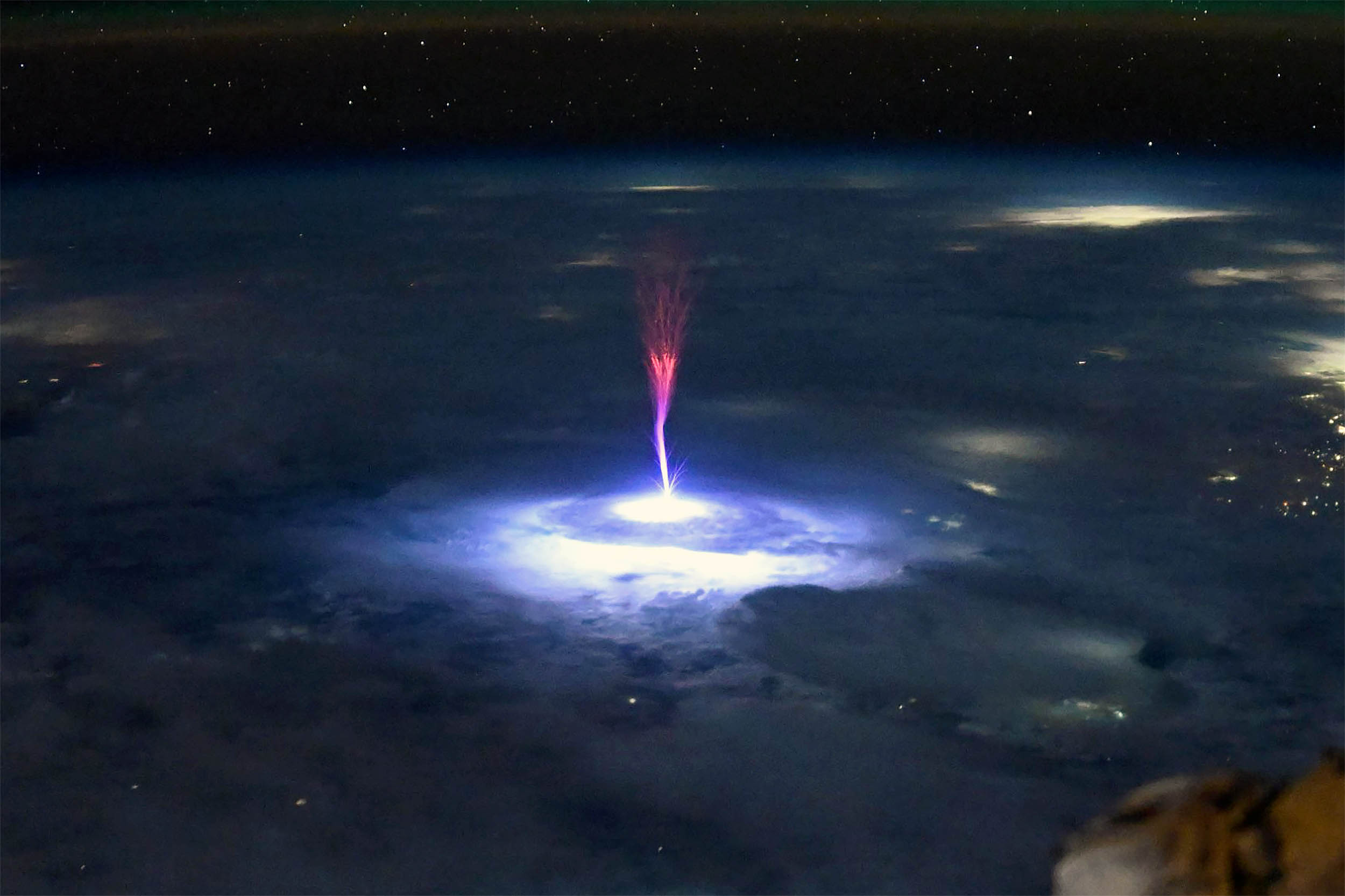
A new era of atmospheric research has begun, with scientists gaining unprecedented insight into the dazzling, yet elusive, electrical phenomena known as transient luminous events (TLEs). These brief, colorful displays occur high above thunderstorms, reaching altitudes of up too 55 miles, and are now being systematically studied thanks to observations from the International Space Station (ISS).
What are Transient luminous Events?
TLEs encompass a range of electrical discharges, including blue jets, red sprites, violet halos, and ultraviolet rings. For decades, these events were largely anecdotal, reported by pilots and captured in rare photographs. The ISS provides a unique vantage point, unobstructed by weather, allowing specialized cameras and sensors to record these fleeting sparks with remarkable clarity.
Researchers are discovering that TLEs are not merely visual spectacles. They can disrupt radio communications, pose potential risks to aircraft safety, and even alter the chemical composition of the upper atmosphere. What impact do these high-altitude electrical events have on our daily lives?
The Atmosphere-Space interactions Monitor (ASIM)
Central to this research is the Atmosphere-Space Interactions Monitor (ASIM), a scientific instrument developed by the European Space Agency (ESA) and deployed on the ISS in 2018. ASIM’s mission is to observe Earth and record flashes of light smaller than a fingernail and lasting less than a heartbeat. The monitor utilizes high-speed cameras and photometers to capture these events.
Data from ASIM has revealed that lightning-like discharges can inject electromagnetic energy into the ionosphere, creating enormous rings of ultraviolet light called ELVES. These rings can substantially boost ionospheric charge, possibly disrupting long-distance radio signals. ASIM has also documented ultra-brief corona discharges, providing insights into the processes that initiate full-blown lightning.
Decoding Red Sprites and Blue Jets
One of the most intriguing TLEs is the “red sprite,” a jellyfish-shaped discharge that appears in the mesosphere for mere milliseconds. Blue jets,which shoot upwards from cloud tops,are equally enigmatic.Capturing detailed observations of these events was previously nearly impossible.however, ASIM’s orbital outlook allows scientists to study them in unprecedented detail.
studies utilizing ASIM footage and ground-based instruments have pinpointed the altitude of blue jets, confirming that they extend beyond the typical weather layer. These measurements are crucial for refining storm-charging models and improving aviation safety guidelines.
Pro Tip: Understanding TLEs can help refine weather models and improve aviation safety protocols.
ISS Observations and Advanced Technology
The ISS cupola, with its seven windows, has become an integral part of this scientific endeavor. Through ESA’s Thor-Davis experiment, ISS crewmembers utilize a state-of-the-art camera to capture storms at up to one hundred thousand frames per second. The resulting slow-motion footage reveals electrical filaments behaving in ways previously unseen.
This high-speed imagery allows scientists to validate laboratory plasma tests against real-world events and may eventually improve algorithms used to protect power grids from severe lightning strikes.
Mapping Invisible Hazards: Gamma-Ray Flashes
Lightning also produces hidden dangers: terrestrial gamma-ray flashes, bursts of radiation capable of delivering a dose comparable to a chest X-ray to an aircraft.To map these hazards, the Japan Aerospace Exploration Agency (JAXA) deployed Light-1, a small CubeSat, from the ISS. Light-1 carries detectors specifically tuned to high-energy photons.
By correlating Light-1’s timestamps with global lightning networks, researchers aim to create a three-dimensional atlas of gamma-ray flash activity.
The Impact on Interaction and climate
TLEs and corona discharges can disrupt the charged layers of the atmosphere that carry radio waves and relay signals to submarines, potentially causing communication failures.Understanding the occurrence of blue jets and gamma-ray flashes is crucial for enhancing aviation safety, particularly on polar and equatorial routes.
Furthermore, TLEs influence atmospheric chemistry by shuffling nitrogen oxides and other chemicals between layers, impacting ozone levels and radiative balance. Incorporating these processes into climate models can improve the accuracy of future warming predictions.
Did You Know? TLEs can influence atmospheric chemistry and potentially impact climate models.
Future of TLE Research
With the ISS expected to remain operational for the foreseeable future, ASIM and its successors will continue to gather data on these elusive events. Engineers are developing next-generation detectors with faster recording speeds and broader spectral ranges. A fleet of CubeSats, similar to Light-1, could provide real-time alerts to weather agencies and satellite operators whenever a gamma flash or mega-sprite occurs.
The ISS demonstrates that a comprehensive understanding of Earth’s weather requires observation from above. Each orbit adds valuable data to our growing knowledge of lightning’s hidden complexities, bringing us closer to predicting and mitigating the electrical surprises that storms unleash.
| Instrument | Agency | Launch Date | Key Capabilities |
|---|---|---|---|
| ASIM | ESA | April 2018 | High-speed cameras, photometers for TLE observation |
| Light-1 | JAXA | January 2024 | Detection of terrestrial gamma-ray flashes |
| Thor-Davis | ESA | Ongoing | High-frame-rate storm imaging from ISS cupola |
Looking Ahead: The Future of TLE Research
Research into transient luminous events is still in its early stages, but the data collected by the ISS and its instruments is already revolutionizing our understanding of these phenomena. Future missions and advancements in sensor technology promise to reveal even more about the complex interactions between thunderstorms and the upper atmosphere. This knowledge will be crucial for improving weather forecasting, protecting critical infrastructure, and ensuring the safety of air travel.
frequently Asked Questions about transient Luminous Events
- what exactly are Transient Luminous Events (TLEs)? TLEs are brief, colorful electrical discharges that occur high above thunderstorms, including phenomena like red sprites and blue jets.
- Are TLEs hazardous? While not directly harmful to people on the ground, TLEs can disrupt radio communications and potentially pose risks to aircraft.
- How is the ISS helping to study TLEs? The ISS provides an unobstructed view of storms, allowing scientists to capture detailed observations of TLEs with specialized cameras and sensors.
- What is ASIM and what dose it do? ASIM (Atmosphere-Space Interactions Monitor) is an instrument on the ISS designed to observe and record TLEs.
- Do TLEs affect climate change? tles can influence atmospheric chemistry and radiative balance, potentially impacting climate models.
