
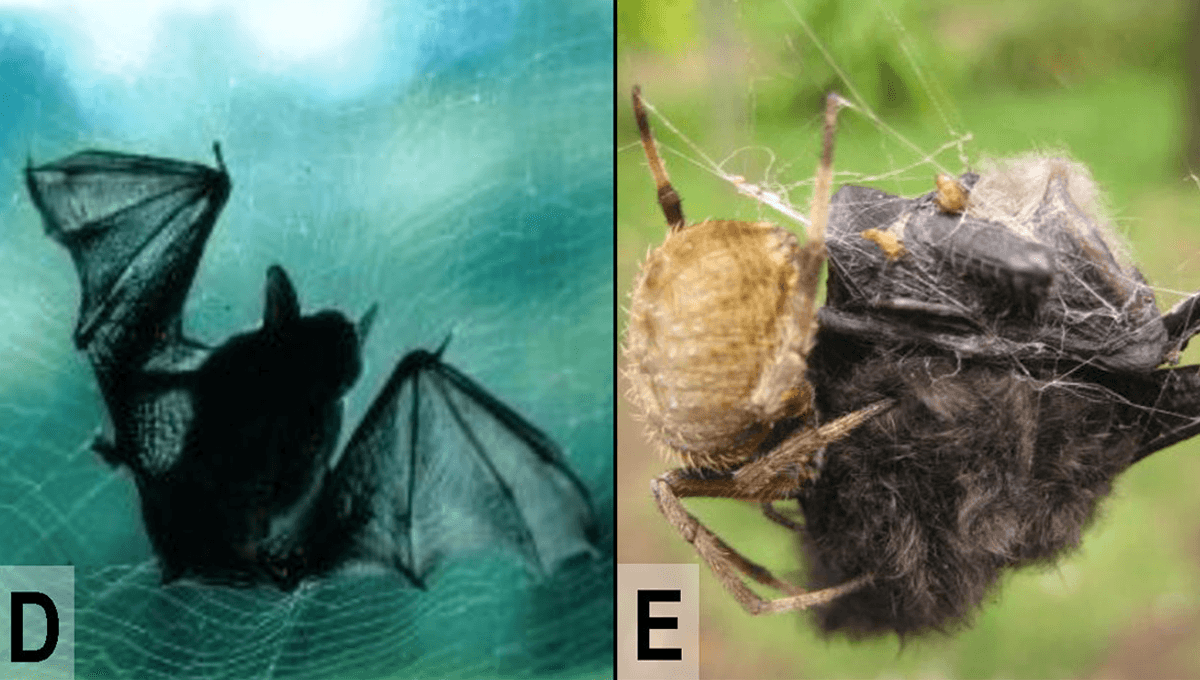
Spiders Have Been Documented Consuming Bats in Over 50 Instances
Recent research has compiled evidence of spiders preying on bats, documenting at least 53 incidents of capture and consumption. The study highlights the giant orb-weavers of the genus Nephila (Nephilidae) as particularly notable bat predators, a finding likely linked to the remarkable strength of their webs.
According to genevieve Kerr from the University of the Sunshine Coast, golden orb spiders create remarkably tough silk. “We found that golden orb spiders produce particularly tough silk and the larger spiders from the rainforest, which can grow up to 20cm in diameter, produce the strongest yet thinnest silks,” she told australian Geographic. This strength stems from “dragline silk,” made from major ampullate silk, possessing “a unique combination of strength and extensibility resulting in a fibre that is tougher than any man-made material.”
These robust webs enable certain Nephila species to capture bats. The research paper notes that of the 15 known Nephila species, onyl Nephila clavipes and Nephila pilipes have been definitively observed catching bats, but suggests othre species likely engage in this behavior as well. “on certain locations, where females aggregate, several webs are built connected to each other, which may result in a web area of many square meters.”
however, Nephila aren’t the only spiders documented consuming bats. Tarantulas and hunting spiders have also been observed doing so. Researchers also noted instances of bats becoming entangled in webs and dying without being eaten, raising questions about whether all encounters are predatory.
“Some of the bats entangled in spider webs are actively killed and consumed by the spiders (i.e., predation), whereas in other instances the entangled bats are not consumed by the spiders (i.e., non-predation deaths),” the research team explained. determining predation can be difficult, particularly when bats are found desiccated in webs.
There have also been documented, though unsuccessful, predation attempts. Such as, a large fishing spider (Dolomedes triton of the Pisauridae family) was witnessed attempting to kill a bat pup under a bridge in Indiana, USA, but abandoned the attempt, likely due to the presence of observers.
More recently, a false widow spider in the UK was found to have killed and consumed a small bat pup.
The researchers emphasize that while surprising, spiders preying on vertebrates isn’t unprecedented. “The observation of bat-catching by spiders is not that peculiar if we consider the fact that a number of larger-sized spiders are known to supplement their arthropod diet by occasionally preying on vertebrates. Fishing spiders (Pisauridae) have been reported capturing and devouring fish and frogs.”
