
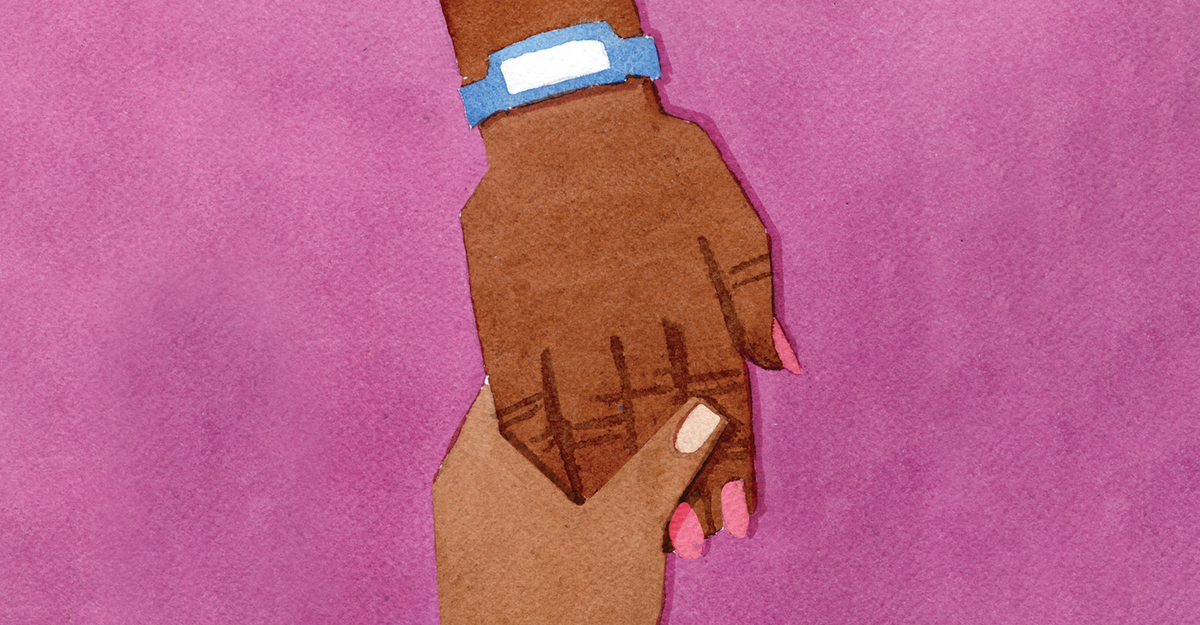
The voicemail arrived the day after Thanksgiving. A doctor at the University of Louisville hospital identified herself and said, “I believe I may have one of your family members here.” The message was garbled, and with most of my family residing in Kentucky, I wasn’t sure who she meant. Repeated attempts to reach the hospital resulted in endless hold times. Finally, I called my aunt, but she didn’t answer.
Hours later, her son contacted me. My aunt was the patient. She’d suffered an aneurysm on the right side of her brain, and it had ruptured. Doctors struggled to secure a drainage tube to relieve the pressure, requiring three attempts before it held. Only then could they proceed with surgery. My cousin FaceTimed me from the ICU, angling the camera down to reveal my aunt’s shaved head, crisscrossed with staples, and a network of IVs connected to her arms. A machine assisted her breathing. She was unable to speak, and her eyes rolled unfocused. I began to cry.
I flew from Washington, D.C., to Kentucky a few days later, joining my family at the hospital. We’d always known my aunt as “The Glamourina.” She favored feathered hats, sparkly shirts, and ever-changing hairstyles – a butterscotch-blond crop, an afro, a bob with highlights. She’d given me my first professional manicure in high school, and we’d even drawn fake beauty marks above our lips with eyeliner, mimicking Marilyn Monroe.
Now 58, she’d raised two children as a single mother. She’d always treated me as one of her own, and I often felt I resembled her more than my mother. Just a week before her hospitalization, she’d asked me to play “I’m So Proud of You” by Julie Anne Vargas, a song we both loved.
Her older son was deeply disturbed by the speed of her decline and wanted a detailed explanation from the doctors. But an older relative cautioned against pressing them, fearing that making demands could jeopardize her care. “She don’t have a lick of health insurance,” the relative said, reflecting a pervasive anxiety about navigating the healthcare system without financial resources.
We knew the hospital was legally obligated to provide care, but we understood the precarious position of those without adequate coverage. My aunt had worked as a hair stylist for years, and more recently as an overnight caregiver for an elderly woman, but she’d declined her employer’s health insurance due to the cost. She’d had intermittent coverage in the past, but it never fully guaranteed access to affordable healthcare. She once recounted her frustration trying to fill a prescription at Walgreens, only to discover an issue with her insurance that required a $134.89 out-of-pocket payment. She described being trapped in endless loops with insurance agents and overwhelmed by the complexity of the plans.
Her financial situation fluctuated. Some years, she might have qualified for Medicaid, but not recently; the income threshold for a single individual in Kentucky is $1,835 per month. She’d occasionally purchased coverage through the Affordable Care Act’s exchanges, but eventually found it too expensive. This decision mirrored a growing trend. In 2025, a Republican-controlled Congress allowed Biden-era subsidies that had helped approximately 22 million people afford coverage to expire. Within two weeks of the cutoff, enrollment dropped by 1 million people, with families facing premium increases of $200, $300, or even $1,000 per month, and some premiums doubling.
In January, former President Trump proposed a “Great Healthcare Plan,” suggesting that savings from the expired subsidies could be distributed directly to “eligible” Americans. However, the proposal offered no details about who would qualify and made no mention of the millions currently uninsured. In February, the Trump administration released a list of 43 prescription drugs available at reduced prices, but these represented a small fraction of the medications Americans need, and did not include the prescription my aunt couldn’t afford.
As I sat with my aunt in the ICU, I noticed her eyebrows were perfectly waxed, and her nails sported a crisp, white French tip. She’d texted me about getting a pedicure just the week before: “Woo this pedi feels good. I haven’t had one since last year.” The nurses complimented her grooming, noting that she clearly took pride in her appearance. This attention, however small, signaled to them that she was someone deserving of care and respect.
Later that week, I visited her house with her younger son to locate her financial information. We found notebooks filled with meticulous records of her expenses, a complex web of numbers and confirmation codes. Tucked inside one notebook was a pawn-shop notice, confirming their ownership of an item she’d traded in. For years, financial insecurity had taken a toll on her health. She’d texted about severe back and breast pain, and a “knot” in her breast, fearing it might be a polyp. She’d lost weight and admitted to feeling depressed. When I suggested seeing a psychiatrist, she responded, “That cost. That’s why I need insurance.” She was exhausted by the pretense of being okay. After covering her mortgage, utilities, car insurance, and other necessities, she was often left with nothing. She openly shared her struggles, sending photos of bills with disconnect notices and screenshots of a checking account balance showing a negative $59.70. Shutoffs had resumed. She experienced small victories, like paying off her car, but continued to rely on payday loans.
I felt a pang of guilt as I sat by her bedside. I’d provided financial assistance when she asked, but not always. I’d listened to her struggles and then resumed my own life. I was grateful for my financial stability, but frustrated by the dynamic of being the family rescuer, and the transactional nature of those relationships. But I hadn’t fully appreciated the extent of her generosity. She consistently celebrated my accomplishments on Facebook, no matter how small. She filled emotional voids, acting as a cheerleader and a second mother. In 2014, she used all her savings to fly to New York to attend my Columbia University graduation, the only family member present. When my name was called, she cried, and someone handed her a tissue.
A few months ago, my son turned four, and my aunt was determined to send him a gift. A manila envelope arrived containing five individually wrapped Hot Wheels cars and a Spider-Man birthday card. I recorded a video of my son opening the envelope, exclaiming over each toy. She responded at 2 a.m.: “Up looking at videos over n over. He was so excited.” She consistently prioritized giving to others, even when she had little for herself.
As individuals, and as a country, we often only recognize the consequences of inadequate healthcare access when it’s too late. The debate over healthcare spending often overlooks the fact that preventive care not only saves lives but as well reduces costs. My aunt’s hospitalization might have been avoided if she’d been able to consult a doctor and schedule an appointment, a privilege many capture for granted. What is a life like my aunt’s worth in America?
My aunt remains unable to sit up or speak, and her prognosis is uncertain. In January, she was transferred from the hospital to a nursing home. A discharge is planned, but her family is ill-equipped to provide the round-the-clock care she requires. Ironically, now that she’s completely disabled, she qualifies for Medicaid.
