Targeted sFlt-1 Removal: A New Therapy for Preterm Pre-eclampsia
The clinical management of preterm pre-eclampsia has long been a race against time, where the only definitive cure—delivery of the placenta—often comes at the cost of extreme neonatal prematurity. A landmark first-in-human trial published in Nature Medicine on May 11, 2026, suggests a paradigm shift is underway, moving from passive symptom management toward the selective molecular removal of the proteins driving the disease.
Key Clinical Takeaways:
- Researchers have successfully conducted a first-in-human trial focusing on the selective removal of sFlt-1, a placental protein linked to pre-eclampsia.
- The study provides critical safety data, establishing a foundation for targeted therapies that may stabilize maternal health without immediate delivery.
- This approach targets the underlying angiogenic imbalance, potentially offering a way to prolong pregnancy in high-risk, preterm cases.
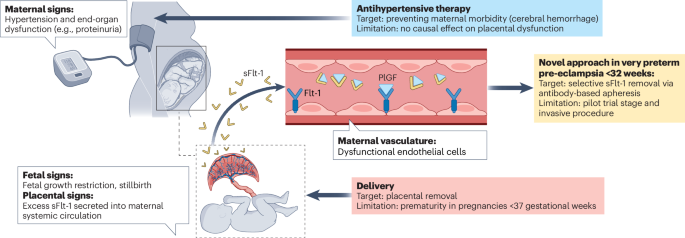
Pre-eclampsia is not a single-organ failure but a systemic vascular crisis. The pathogenesis centers on placental insufficiency, where the placenta releases an excess of soluble fms-like tyrosine kinase-1 (sFlt-1) into the maternal bloodstream. This protein acts as a “decoy” receptor, binding to and neutralizing vascular endothelial growth factor (VEGF) and placental growth factor (PlGF). When these growth factors are neutralized, the maternal endothelium—the lining of the blood vessels—begins to fail, leading to the hallmark symptoms of hypertension, proteinuria, and end-organ damage.
For decades, the standard of care has been limited to blood pressure control and the administration of corticosteroids to accelerate fetal lung maturity before an inevitable, often premature, delivery. The clinical gap has always been the lack of a mechanism to treat the mother while keeping the fetus in utero. This is where the research detailed in Nature Medicine (doi:10.1038/s41591-026-04400-y) enters the landscape, shifting the focus from managing the symptoms of vascular collapse to removing the molecular trigger of the collapse itself.
The Mechanism of Selective sFlt-1 Removal
The core innovation of this trial lies in its precision. Rather than utilizing broad-spectrum immunosuppressants or general plasma exchange—which can remove essential clotting factors and antibodies—this targeted therapy focuses specifically on the sFlt-1 protein. By selectively filtering this anti-angiogenic protein from the maternal circulation, the therapy aims to restore the balance of VEGF and PlGF, effectively “unblocking” the pathways that maintain vascular health.
From a clinical perspective, this is an attempt to reverse the systemic endothelial dysfunction that characterizes the disease. If the levels of sFlt-1 can be lowered sufficiently, the maternal vasculature may regain stability, reducing the immediate risk of eclampsia or HELLP syndrome. For patients presenting with severe symptoms, this window of stability is precious, potentially moving a delivery date from 28 weeks to 32 or 34 weeks, which drastically improves neonatal morbidity and mortality rates.
Managing such complex cases requires a multidisciplinary approach. Patients identified with high sFlt-1/PlGF ratios should be under the immediate care of board-certified maternal-fetal medicine specialists who can navigate the narrow corridor between maternal safety and fetal viability.
“The ability to selectively target a single pathogenic protein in the bloodstream represents a transition from supportive care to precision medicine in obstetrics. If safety data continues to hold, we are looking at a future where we treat the placenta as a transient endocrine organ that can be modulated to save both mother and child.”
Evaluating the Clinical Shift: Standard Care vs. Targeted Therapy
The transition from traditional management to targeted protein removal alters the clinical trajectory of preterm pre-eclampsia. The following table outlines the divergence in approach based on the emerging data from the Nature Medicine trial.
| Clinical Feature | Traditional Standard of Care | Targeted sFlt-1 Removal Approach |
|---|---|---|
| Primary Objective | Symptom control and delivery timing | Restoration of angiogenic balance |
| Mechanism | Antihypertensives & Steroids | Selective molecular filtration of sFlt-1 |
| Maternal Impact | Management of hypertension/edema | Reduction of systemic endothelial stress |
| Fetal Outcome | Risk of extreme prematurity | Potential for extended gestation |
| Intervention Goal | Preventing maternal seizure/stroke | Stabilizing the maternal-placental unit |
While the first-in-human trial focused heavily on safety data, the implications for healthcare infrastructure are significant. The implementation of such therapies would require advanced apheresis or filtration equipment and precise diagnostic monitoring. Diagnostic centers capable of high-sensitivity protein assays will become the frontline of this triage process. Facilities looking to integrate these protocols should consult with healthcare compliance attorneys to ensure that the use of emerging, first-in-human therapies adheres to evolving regulatory frameworks and institutional review board (IRB) mandates.
Addressing the Regulatory and Clinical Hurdles
Despite the promise of the safety data, the path to widespread clinical adoption remains rigorous. Targeted therapy for a pregnancy complication must meet an exceptionally high safety threshold, as the intervention affects two patients simultaneously. The research team’s focus on “critical safety data” in this initial phase is a necessary step to rule out contraindications or adverse reactions that could compromise the fetal environment.
Funding for such pioneering work is typically provided through a combination of academic grants and specialized biomedical research funds, ensuring that the pursuit of “targeted therapy” remains grounded in peer-reviewed evidence rather than commercial haste. The transparency of these trials is paramount, as the medical community must verify that the removal of sFlt-1 does not inadvertently disrupt other essential angiogenic processes necessary for placental growth.
For clinicians, the immediate priority is early detection. The use of sFlt-1 and PlGF ratios as biomarkers is already gaining traction, but the ability to act on those biomarkers—rather than simply using them to predict delivery—is the true breakthrough. We are moving toward a model of “molecular triage,” where the protein profile of the mother determines the specific intervention strategy.
The Future of Precision Obstetrics
The success of this first-in-human trial marks the beginning of a new era. By proving that the selective removal of a placental protein is safe, the researchers have opened the door for other targeted interventions in reproductive health. We may soon see similar approaches applied to other placental-mediated disorders or severe fetal growth restriction.
However, this technology will not replace the need for expert clinical judgment. The decision to attempt pregnancy prolongation via protein filtration must be balanced against the risks of continuing a failing pregnancy. This requires the highest level of expertise in high-risk obstetrics. Expectant mothers facing these complications should seek care at accredited high-risk pregnancy clinics that possess the diagnostic tools and specialist teams necessary to manage these cutting-edge protocols.
As we await larger-scale trials to confirm efficacy and optimal dosing, the medical community should view this as a beacon of progress. The shift from “delivery as the only cure” to “molecular stabilization” could save thousands of lives annually, reducing the burden of neonatal intensive care and improving long-term maternal health outcomes.
Disclaimer: The information provided in this article is for educational and scientific communication purposes only and does not constitute medical advice. Always consult with a qualified healthcare provider regarding any medical condition, diagnosis, or treatment plan.