
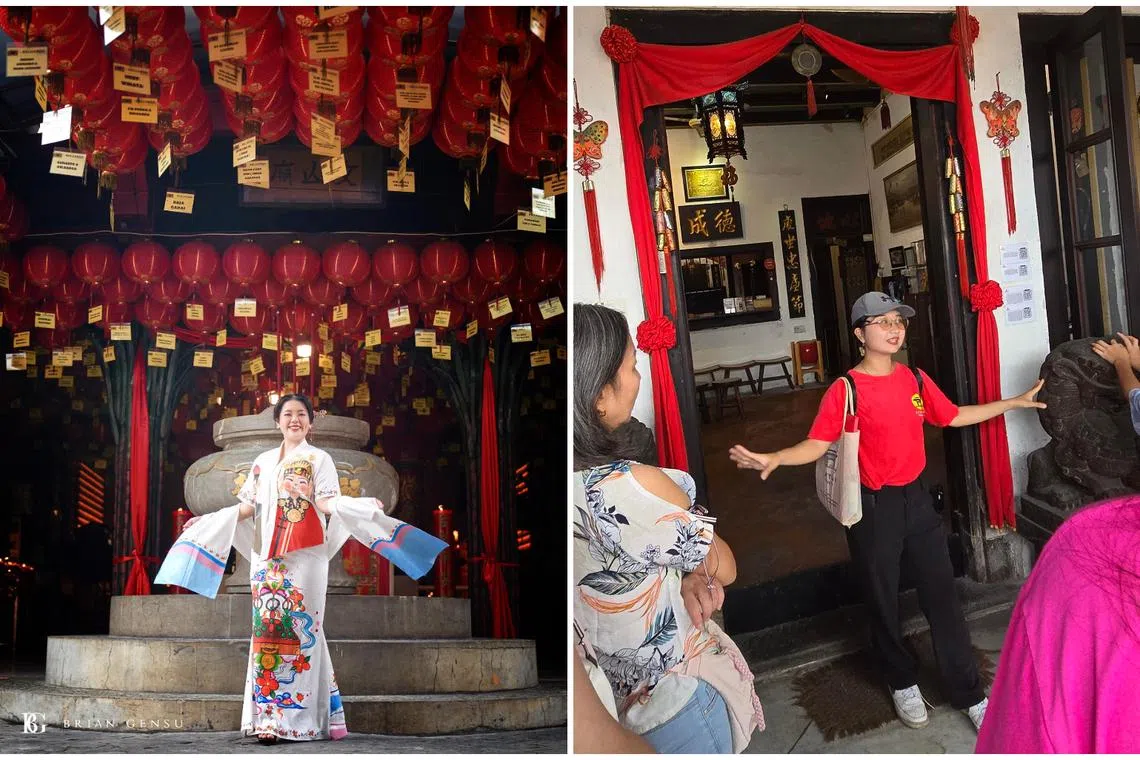
TANGERANG, Java – The rain had recently stopped along the Cisadane River as Elsa Novia Sena, 28, gathered a small group of visitors on the riverbank. “There used to be a Dutch fort here,” she began, referring to the fort built by the Vereenigde Oostindische Compagnie, or Dutch East India Company, in the 1670s. Though the fort is long gone, the residents of Tangerang, on the western outskirts of Jakarta, still identify as Orang Benteng, or “people of the fort.” Among them are the Benteng Chinese – Cina Benteng in Indonesian, or Ciben – descendants of Chinese traders who settled along the river centuries ago and intermarried with local Sundanese women.
Over generations, a unique hybrid culture emerged, blending languages, customs, and cuisine. Some trace their ancestry back to the 15th-century voyages of Ming Dynasty admiral Zheng He, whose sailors are believed to have established settlements along Java’s north coast. While precise demographic figures are unavailable, community studies suggest the Benteng Chinese form a significant indigenous Chinese-Indonesian subgroup concentrated in Tangerang and surrounding areas.
For years, this heritage remained largely unknown outside the region. Now, a growing movement led by young Cibens is working to reclaim their Peranakan pride through initiatives like walking tours, cultural heritage projects, and reinterpretations of traditional fashion.
Ms. Sena, whose parents are Benteng Chinese, launched her Benteng Walking Tour two years ago. The tour guides visitors through Pasar Lama – Tangerang’s Old Market district, designated a cultural heritage site in 2018 – as well as a local soya sauce factory, historic shophouses, and the Boen Tek Bio Temple, Tangerang’s oldest Chinese place of worship, founded in 1684. A small museum along the route houses a collection of cultural artifacts, including dragon figurines and guardian lions.
Ms. Sena, who also creates content about Benteng Chinese history on Instagram and TikTok, said the idea for the tour arose from a realization that the local story was fading. “I thought it could become a tourism idea,” she explained. Unlike tours originating from Jakarta, hers is led by a Tangerang resident, informed by extensive research and conversations with locals.
The tour blends historical narratives with everyday details. At the soya sauce factory, Ms. Sena explains the origins of kecap manis, Indonesia’s sweet soy sauce, noting that while traditional Chinese soy sauce is salty, the abundance of sugarcane plantations in Tangerang led to the development of the sweeter blend now produced by brands like SH, Istana, and Bango.
Ms. Sena acknowledges the complexities of identity within the community. “Some even jokingly call themselves ‘hitachi’ – short for hitam tapi Cina, meaning ‘tan but Chinese’,” she shared with her tour group, eliciting laughter. She noted that the Benteng Chinese often face questions of belonging from both mainstream Chinese Indonesians and the broader Indonesian population.
“It can feel like an identity crisis,” Ms. Sena said, explaining that some Chinese Indonesians view Cibens as outsiders due to their darker skin and lack of fluency in Chinese dialects. “Some ‘totok’ Chinese… say we have lost our Chinese identity because we do not speak the language and our skin is darker. Indigenous Indonesians still see us as too Chinese.” This sense of cultural ambiguity was particularly acute during the 32-year rule of former president Suharto, when public expressions of Chinese culture were restricted.
While some younger Chinese Indonesians look to China for cultural reference points, Ms. Sena emphasizes that the Benteng Chinese identity has been shaped primarily by local influences – West Java’s language, food, and social norms. “I will continue to find ways to introduce people to my heritage,” she said.
Alongside Ms. Sena’s efforts to preserve the past through storytelling and place, 26-year-old Merry Andayani is reinterpreting it through fashion. Ms. Andayani, a member of the Cide Kode Benteng Foundation, created MAGIC – Make A Good Impression, Closer: A Tale Woven In Fashion – a project that uses clothing as a means of cultural expression. “This encouraged me to speak about Benteng Chinese not as an object of nostalgia, but as a living identity,” she said. “Not all stories need to be told through words. Some are stronger when expressed visually.”
MAGIC garments, produced in collaboration with young people from diverse backgrounds, are showcased in fashion shows that bring the community’s stories to a wider audience. Designs often combine traditional elements, such as the kebaya encim – a Peranakan blouse – with contemporary silhouettes. One recurring motif is Sembahyang Samkai, the opening prayer ritual in the Cio Tao tradition, a Benteng Chinese belief system that blends ancestor worship and folk practices.
“I want to show that tradition does not have to remain confined to ritual spaces. It can be worn and seen,” Ms. Andayani said. She highlighted the subtle but significant ways in which Benteng Chinese culture is practiced daily, such as the thorough cleaning of homes and careful sifting of incense ash at family altars before Chinese New Year – symbolic acts of clearing the past and renewing ties with ancestors. “These quiet narratives form the foundation of our identity,” she said. “It may not always be loud, but it is strong in meaning.”
