
Tadej Pogačar’s Milan-San Remo Win: Did His Crash Help Him?
When Tadej Pogačar hit the asphalt with less than an hour remaining in Saturday’s Milan-San Remo, the cycling world collectively held its breath. The UAE Team Emirates-XRG rider, considered a joint favorite alongside Mathieu van der Poel, appeared to have jeopardized his chances at the prestigious one-day race.
Footage from the team car captured the initial shock within the UAE Emirates-XRG support staff. “Tadej crashed, Tadej crashed,” a voice reported over the radio, prompting stunned silence from directeur sportifs Andrej Hauptman and Maxtin Joxean Fernandez, according to team sources.
Pogačar, despite the fall, quickly remounted, though he acknowledged the impact. “I hit my knee pretty bad,” he said immediately after the incident.
The crash occurred with approximately 33 kilometers to go, forcing Pogačar into a chase to rejoin the peloton. Assisted by teammates Florian Vermeersch and Felix Grossschartner, he successfully bridged the gap at the base of the Cipressa climb. Brandon McNulty then took control, driving a relentless pace that propelled Pogačar through the bunch and into the lead two kilometers later.
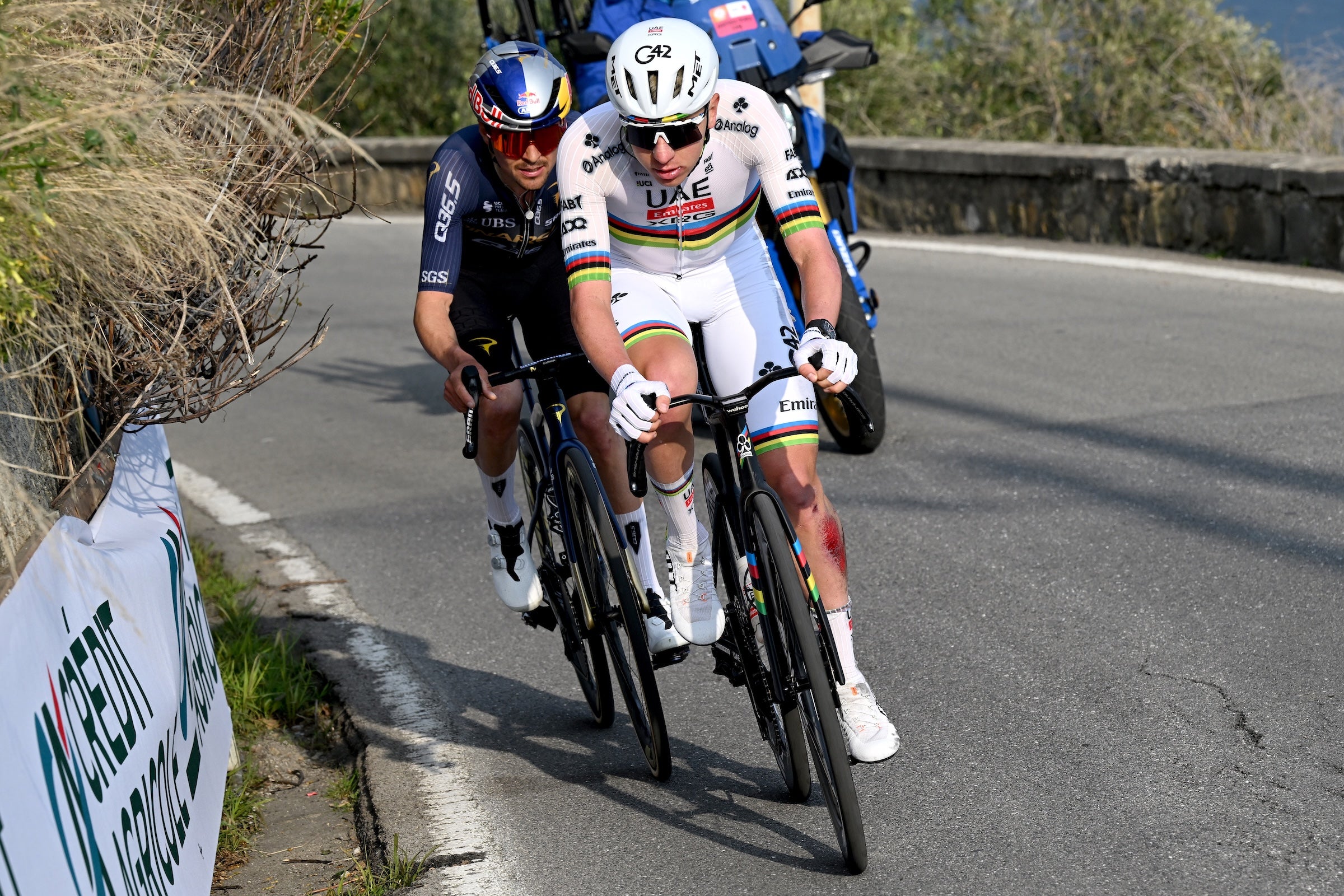
McNulty’s strong performance continued, increasing the tempo and shedding riders. Isaac Del Toro briefly led before Pogačar launched his own attack, narrowing the contenders to himself, Tom Pidcock (Pinarello Q36.5 Pro Cycling), and Mathieu van der Poel (Alpecin-Premier Tech).
The trio descended and rode together on the flat roads leading to the Poggio, where Pogačar, potentially hampered by the lingering effects of his crash, immediately pressured Van der Poel, and Pidcock. Although he couldn’t immediately shake Pidcock, a feat he has accomplished in previous races like Strade Bianche, he forced a grueling pace.
The final sprint proved exceptionally tight, with Pogačar ultimately prevailing by a mere four centimeters, as reported by Pidcock. The narrow margin raises a compelling question: did the crash, despite its initial setback, ultimately contribute to his victory?
Pogačar’s performance on the Cipressa offers a key piece of the puzzle. He reportedly ascended the climb in 8 minutes and 47 or 48 seconds, surpassing last year’s fastest time—and the fastest ascent ever—by several seconds, despite having to chase back to the peloton after his fall. According to Climbing-Records.com, Pogačar’s time was significantly faster than Van der Poel’s 8 minutes and 55 seconds.
Had Pogačar not crashed, a scenario considered by many analysts, he likely would have been positioned at the front of the peloton, potentially even faster, and capable of dropping both Pidcock and Van der Poel on the Cipressa. A solo effort over the summit, with a 22-kilometer time trial to San Remo, would have been the likely outcome.
Pogačar himself acknowledged the challenges a solo break would have faced, citing a headwind. “When we were turning, I was really happy everybody worked,” he said post-race. “It was a bit of a headwind, not ideal like last year. It was a bit harder in the middle part.”
Instead, Pogačar, Pidcock, and Van der Poel entered the Poggio with only an eight-second advantage over the chasing group. Had Pogačar been solo, and with the combined forces of the Pinarello Q36.5 Pro Cycling and Alpecin-Premier Tech teams pursuing him, his lead could have been quickly eroded.
The crash, while initially detrimental, may have inadvertently created a more favorable dynamic. By forcing him to expend energy rejoining the peloton, it resulted in a scenario where he had strong companions on the Poggio, sharing the workload and ultimately contributing to a narrow, but decisive, victory. The collaborative effort, and the pulls contributed by Pidcock, were critical to holding off the chasing bunch, securing Pogačar’s win by a scant four seconds over Wout Van Aert.