
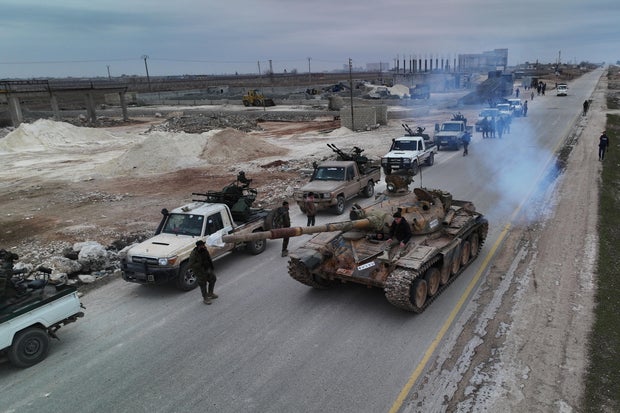
Syrian government forces have entered the northern towns of Deir Hafer and Maskana following the announced withdrawal of Kurdish-led fighters, a move intended to avoid further conflict. The recent developments signal a significant shift in control within the region and raise questions about the future of Kurdish autonomy in Syria.
Escalating Tensions and Government Advance
The Syrian military’s advance comes after a period of escalating tensions with the Syrian Democratic Forces (SDF), a U.S.-backed alliance primarily composed of Kurdish fighters. Earlier this month, clashes erupted in Aleppo, Syria’s largest city, resulting in the evacuation of Kurdish fighters from three neighborhoods overtaken by government forces [1]. The recent fighting near Deir Hafer resulted in casualties on both sides, with state media reporting two soldiers killed and others wounded [1].
On Saturday, January 17, 2026, an Associated Press reporter observed Syrian government tanks, armored personnel carriers, and armed vehicles entering Deir Hafer after barriers were removed. The military confirmed full control of Deir Hafer and the nearby Jarrah air base, initiating a process of clearing mines and explosives. The advance continued towards Maskana,where a military convoy was also observed arriving [1].
Withdrawal Agreement and Alleged Violations
The SDF stated that their withdrawal was predicated on an agreement stipulating that Syrian forces would enter Deir Hafer and Maskana only after the Kurdish-led forces had fully retreated. However, the SDF accused Damascus of violating this agreement by entering the towns prematurely, creating a “highly risky situation” [1].
SANA,the Syrian state news agency,countered this claim,alleging that SDF fighters initiated the conflict by targeting an army patrol near Maskana,resulting in the deaths of two soldiers and injuries to others.Following this incident, government forces reportedly advanced eastward, reaching villages in the Raqqa province [1].
Civilian Displacement and SDF Response
The escalating conflict prompted a mass exodus of civilians, with over 11,000 people fleeing Deir Hafer and Maskana over the past two days, seeking refuge in government-controlled areas [1]. This displacement underscores the humanitarian impact of the ongoing clashes.
On Friday evening, SDF commander Mazloum Abdi announced the group’s withdrawal from contested areas in northern syria via X, stating that fighters would relocate east of the Euphrates River starting at 7 a.m. local time on Saturday [2]. This decision followed discussions between U.S. military officials and SDF representatives in Deir Hafer, with the United States urging de-escalation.
Kurdish Rights and Political Context
the SDF’s decision to withdraw coincided with a decree issued by Syria’s interim President Ahmed al-Sharaa aimed at enhancing the rights of the country’s Kurdish population, which constituted approximately 10% of Syria’s 23 million residents before the 2011 conflict [1]. The decree recognized Kurdish as a national language alongside Arabic and officially recognized the Newroz festival, a significant cultural celebration for Kurds [1].
Though, the Kurdish-led authority in northeast Syria expressed reservations about the decree, arguing that genuine protection of Kurdish rights requires constitutional recognition rather then temporary measures.They emphasized that a decree alone does not guarantee the long-term security and rights of Syria’s ethnic groups [1].
Looking Ahead: U.S.Role and Regional Implications
Mazloum Abdi is scheduled to meet with U.S. special envoy to Syria, Tom Barrack, in Irbil, northern Iraq, on Saturday to discuss the evolving situation [1]. The United States’ role in mediating the conflict and ensuring the stability of the region remains crucial. The recent developments highlight the complex interplay of political, military, and ethnic factors in Syria, and the ongoing struggle for control and autonomy in the aftermath of years of civil war. The withdrawal of SDF forces and the Syrian government’s subsequent advance represent a significant turning point, with potential long-term implications for the future of Syria and the broader region.
Recent reports from January 23, 2026, indicate a continued, albeit cautious, consolidation of Syrian government control in areas previously held by the SDF [3].The SDF’s withdrawal from Aleppo province, as reported by the Long War Journal, further demonstrates this trend [3]. The situation remains fluid, and continued diplomatic efforts are essential to prevent further escalation and protect civilian populations.
