
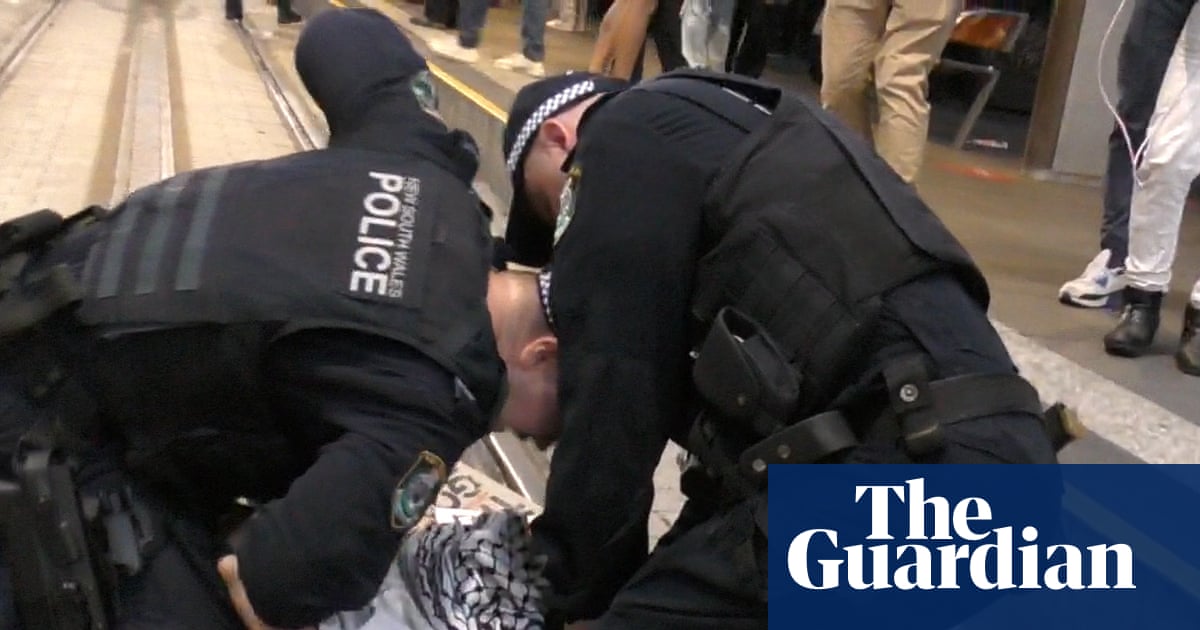
Footage showing New South Wales police repeatedly punching protesters and deploying pepper spray at close range during a demonstration against Israeli President Isaac Herzog’s visit to Australia has prompted criticism from legal experts and calls for an investigation by the state’s police watchdog.
The clashes occurred Monday outside Sydney’s Town Hall, where approximately 6,000 people gathered to protest Herzog’s Australian tour. Twenty-seven people were arrested, including ten accused of assaulting police, according to NSW Police.
Law professor Luke McNamara, who attended the rally, described the police response as “disappointing” and argued that the violence was a “direct consequence” of what he called “unreasonable conditions” imposed by the NSW government. These conditions effectively prevented protesters from marching from Town Hall to state parliament.
“When some of those present decided to push the limits of the police willingness to allow them to engage in a procession, it seems to me that’s when the confrontation started,” McNamara said. “Those events are likely never to have happened if police had permitted, indeed if the government had permitted, protesters to exercise their lawful right to protest.” McNamara, a policing specialist at the University of NSW’s faculty of law and justice, emphasized that physical force should be used “extremely rarely” during protests, only when a crowd is actively violent or threatening violence.
McNamara cited specific instances of excessive force, including video footage showing a man repeatedly punched in the body by officers and a group of Muslims praying being “dragged away” by police. He stated there appeared to be “no reason” for the level of force used in those instances.
NSW Premier Chris Minns defended the police actions Tuesday, characterizing the response as “proportionate” and urging caution against judging officers based on “15-second social media posts” without full context. Assistant Commissioner Peter McKenna stated that officers were “threatened, jostled and assaulted” during “a number of melees, rolling fights” and “violent behaviour.”
Associate Professor Vicki Sentas, also a policing expert at UNSW, expressed concern over the available footage, describing it as depicting “a case study in disturbing and unnecessary police violence.” She questioned whether the police response met the legal criteria for lawful use of force and suggested the Law Enforcement Conduct Commission (Lecc) investigate “credible allegations of excessive police force.”
The NSW Police use of force manual, which details when and how officers can deploy weapons and use physical force, is not publicly available. However, a copy published by the Lecc in 2023 states that officers “should use no more force than is reasonably necessary to exercise your policing functions” and that they “must not use force to inflict punishment.”
Vincent Hurley, a former NSW police senior detective and current criminology lecturer at Macquarie University, cautioned against drawing conclusions based solely on short video clips, stating the need to examine the “30 seconds before” each incident. However, he acknowledged that “on the surface of it… I think I can see how the police believed they were justified in using that force.”
A 2022 Supreme Court decision highlighted the concept of “a red mist of rage” in assessing police use of force, referring to a loss of self-control stemming from frustration and anger. The case involved an officer accused of excessive baton strikes against a 16-year-old boy, with the prosecution arguing that some of the strikes were not “reasonably necessary.” The officer was ultimately cleared of the charge.
The Public Assembly Restriction Declaration (PARD) and Major Events Act were used to restrict the protest, preventing demonstrators from marching to NSW Parliament. The government’s decision to invoke these powers has been criticized by civil liberties groups and protest organizers as an attempt to suppress dissent.
