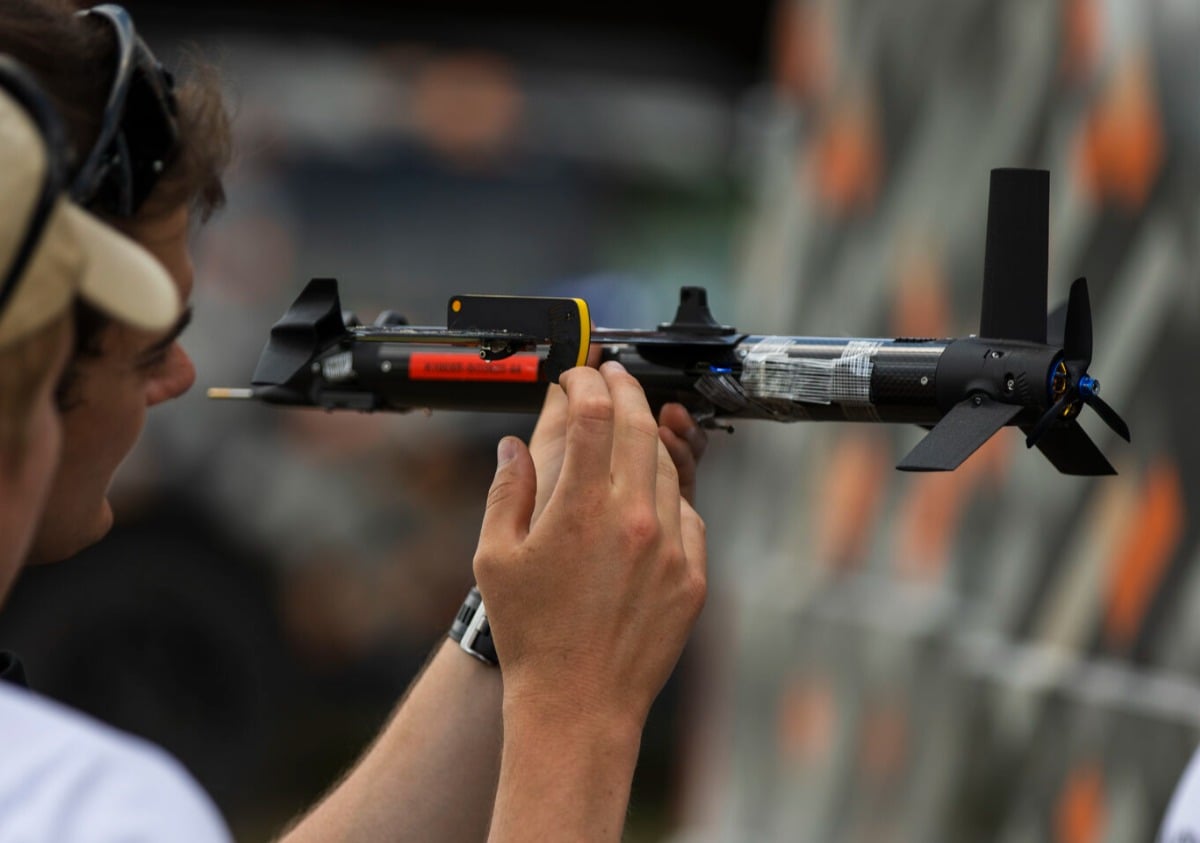
Swedish Nordic Air Defence Launches K200 Interceptor to Ukraine for Field Testing
Stockholm-based Nordic Air Defence unveiled the K200 interceptor drone on Friday launching the system toward Ukraine for immediate field testing against Russian jet-powered attack drones.
The autonomous aircraft, designed to replace the earlier Kreuger 100XR, carries a 500-gram warhead to intercept high-speed threats at a lower cost than traditional missiles.
Nordic Air Defence has established a staffed office in Ukraine to facilitate the trials of the K200, according to The Defence Blog – Military and Defense News. The company said that these real-world trials are intended to shape the future development of the interceptor. DroneNews reported that the Armed Forces of Ukraine will manage the testing and evaluation process for the new Swedish technology.
The K200 is a fixed-wing, single-propeller aircraft. It uses ground-based radar and electro-optical and infrared cameras to steer toward incoming targets. During the final approach, an onboard infrared camera assumes control to finalize the interception. If the drone fails to hit its target, it is programmed to automatically circle back for a second attempt.
The urgency for this technology stems from a sharp increase in the use of jet-powered munitions. During the first few months of 2026, Russia launched approximately 1,400 Geran-series drones, a significant rise from the 180 recorded throughout all of 2025, according to The Defence Blog – Military and Defense News. The Geran-3 model specifically travels at speeds between 350 and 550 km/h.
| Drone Capability | Specification |
|---|---|
| Geran-3 Speed | 350 to 550 km/h |
| K200 Warhead | 500 grams (1.1 pounds) |
| 2026 Geran Launches | Approximately 1,400 (early 2026) |
Defending against these low-cost drones with conventional surface-to-air missiles creates an unsustainable financial burden. “Defenders cannot keep using expensive missiles against drones that cost a fraction of the price,” said Karl Rosander, CEO and co-founder of Nordic Air Defence, in comments provided to The Defence Blog – Military and Defense News. He added that Europe requires interceptors “that can keep pace and be produced in volume.”
The system is designed for versatility, with launchers capable of being mounted on vehicles, ships, or fixed ground sites. By integrating with existing air defense networks, the K200 aims to provide a scalable solution for infrastructure protection.
The K200 follows the Kreuger 100XR, which was demonstrated earlier this year when it successfully destroyed a target drone during a live exercise. Nordic Air Defence has previously collaborated with Volvo Defense on truck-mounted anti-drone systems, showing a broader strategy to deploy these interceptors across various mobile platforms.
The current testing phase in Ukraine serves as a proving ground for the system’s performance against actual combat threats. “Testing in Ukraine will help us improve the system against real threats and bring those lessons to customers across multiple markets,” Rosander told The Defence Blog – Military and Defense News.
The ongoing development of these autonomous interceptors reflects a shift toward agile, decentralized defense strategies.
The trials are expected to provide the data required to refine the K200’s performance metrics and operational range.