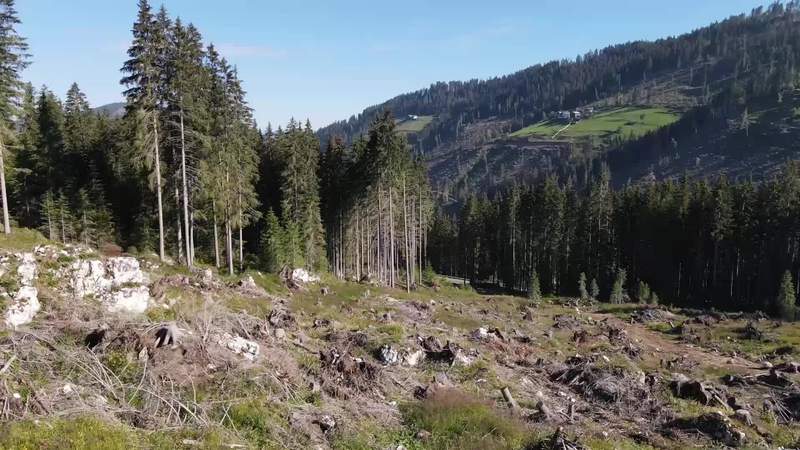
Storm Vaia: Northeast Italy balances forest recovery and beetle threat
Eight years after Storm Vaia tore through the Italian Northeast, the region is balancing a complex recovery between forest restoration and the ongoing threat of secondary ecological damage. The storm, which struck between late October and early November 2018, brought wind gusts exceeding 200 kilometers per hour, toppling millions of trees across the Belluno area, the Agordino, and the Sette Comuni plateau. The calamity also damaged roads and infrastructure, putting entire communities in difficulty.
Eight Years of Forest Regeneration and Infrastructure Recovery
The devastation of 2018 affected more than 42,000 hectares of forest across Veneto, Trentino-Alto Adige, Lombardy, and Friuli Venezia Giulia, according to GreenMe. The Serrai di Sottoguda canyon in Rocca Pietore, a symbolic site of the catastrophe, has since undergone extensive reconstruction. Following its reopening, the site has seen record visitor numbers, serving as a tangible example of the mountain’s resilience. Local efforts have successfully recovered more than 500 tons of fallen timber, while over 200,000 new trees have been planted to replace those lost to the winds.
The Persistent Threat of the Bark Beetle
While the physical landscape shows signs of healing, the ecosystem remains fragile. The primary challenge currently facing the region is the widespread infestation of the bark beetle, or bostrico. This insect has targeted spruce trees that were already weakened by the storm. Experts emphasize that the current objective is not only to rebuild forests but to ensure they are resilient enough to withstand future extreme weather events, which have become a constant concern for the territory.
Innovation in Environmental Sustainability
The recovery process has spurred new economic models focused on circularity. The B Corp VAIA, established in 2019, helped this transition by transforming wood salvaged from the storm into design objects. According to GreenMe, the company’s model links product sales directly to reforestation efforts. For every VAIA Cube or Focus sold, a new tree is planted in the storm-affected zones of the Dolomites. The product range also includes the VAIA Cover, which is crafted from salvaged fir wood.
Federico Stefani, co-founder and President of VAIA, stated that the October 2018 storm remains a deep wound for the mountains, whose vulnerabilities are still evident today. He mentioned that in these years, VAIA has worked to build a path connecting people, skills, and different realities, creating a community capable of transforming resource recovery into new possibilities for the territory. For us, every anniversary is a moment to look at what we have built, but above all to ask ourselves what we can still do to give back more than we take,
Stefani added.

Expanding Restoration Beyond the Dolomites
The model developed in response to Storm Vaia is now being applied to other environmental crises in Italy. VAIA has extended its operations to Puglia to address the decline of olive trees caused by the Xylella pathogen. By creating a biocomposite material called Olive Matter from the wood of diseased trees, the initiative aims to regenerate 20,000 square meters of land with Mediterranean scrub. Specifically, for every VAIA Cover sold, the company regenerates one square meter of Mediterranean scrub in the municipality of Specchia, located in the lower Salento region. This expansion shows that the focus has moved from immediate disaster recovery to long-term land management and material innovation.
Addressing Future Environmental Risks
The long-term impact of the 2018 catastrophe highlights the necessity for ongoing maintenance of mountain infrastructure and forest health. As the region marks this eight-year milestone, the focus remains on the synthesis of traditional craftsmanship and modern ecological protection, ensuring that the lessons learned from the storm inform the management of increasingly volatile mountain environments. The recovery efforts reflect a move from the initial emergency response toward a model of permanent territorial regeneration.