
Ancient Stone Tools Hint at Mysterious Island Colonizers
Sulawesi Discovery Pushes Back Timeline of Human Presence in Wallacea
Archaeologists unearthed ancient stone tools on Indonesia’s Sulawesi island, adding crucial data to the evolutionary puzzle of early humans in the Wallacea region. This discovery suggests a much earlier human presence than previously thought.
Unearthing Millennia-Old Technology
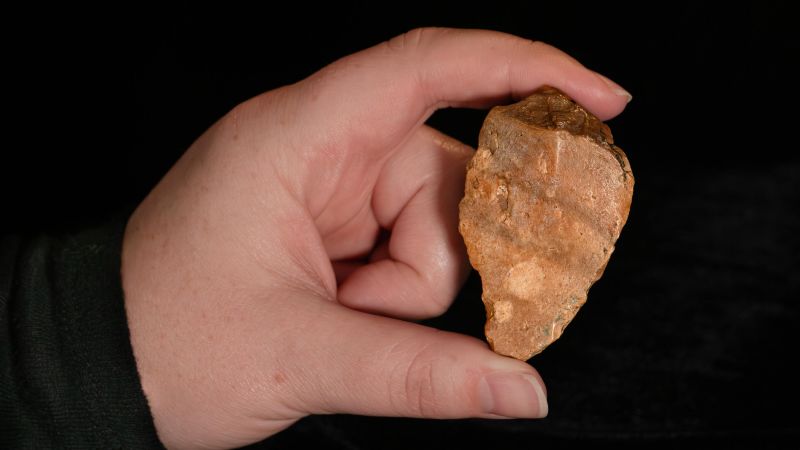
Sharp-edged stone tools found in Sulawesi date between 1.04 million and 1.48 million years old, marking the earliest evidence of hominin activity on the island. The findings, published in the journal Nature, suggest hominins inhabited Sulawesi around the same time or even before the nearby island of Flores.
The research team, led by archaeologist Dr. Adam Brumm of Griffith University, discovered seven stone tools at the Calio site. These implements, likely fashioned from riverbed pebbles, show evidence of precise flaking, indicating a developed skill set among their makers.
Previously, stone tools on Flores were dated to approximately 1.02 million years ago. The new Sulawesi findings potentially link populations across these islands and raise the possibility that Sulawesi served as a crucial stepping stone for early hominins reaching Flores.
“We have long suspected that the Homo floresiensis lineage of Flores, which probably represents a dwarfed variant of early Asian Homo erectus, came originally from Sulawesi to the north, so the discovery of this very old stone technology on Sulawesi adds further weight to this possibility,”
—Dr. Adam Brumm, Professor of Archaeology at Griffith University’s Australian Research Centre for Human Evolution
Unraveling the Mystery of Island Migration
A significant question remains: how did these early humans, likely *Homo erectus* or a related species, reach islands like Sulawesi, which would have required crossing oceans? Researchers theorize these migrations may have occurred accidentally, perhaps on natural rafts of vegetation.
“Getting to Sulawesi from the adjacent Asian mainland would not have been easy for a non-flying land mammal like us, but it’s clear that early hominins were doing it somehow,” Dr. Brumm explained. “Most probably they made overwater dispersals completely by accident, in the same way rodents and monkeys are suspected to have done it, by ‘rafting’ (i.e., floating haplessly) on natural vegetation mats.”
The identity of the toolmakers remains unknown, as no hominin fossils have yet been found at the Calio site. However, the tools themselves are compared to early hominin technology found in Africa and other parts of Indonesia.
John Shea, an anthropology professor at Stony Brook University, commented on the study’s importance, noting that while *Homo sapiens* have clear evidence of watercraft use, earlier hominins would have needed a means of crossing significant bodies of water. “If you have ever paddled a canoe or crewed in a sailboat, then you know that putting more than one person in a boat and navigating it successfully requires spoken language,” Shea stated, adding that survival of these early groups is not guaranteed, with extinction being a common outcome.
A Continent of Questions
Sulawesi, a vast island with diverse ecosystems, presents a unique environment for studying human evolution. Its size and ecological complexity could have led to different evolutionary paths compared to smaller islands like Flores.
“Sulawesi is a bit of a wild card. It is essentially like a mini-continent in of itself,” Dr. Brumm mused. “If Homo erectus became isolated on this island it might not necessarily have evolved into something like the strange new form found on the much smaller Wallacean island of Flores to the south.”
The ongoing research at Calio and other Sulawesi sites aims to uncover hominin fossils, which could shed light on the evolutionary journey of species like *Homo erectus* and potentially reveal the identity of the island’s earliest inhabitants. The possibility of dwarfism evolving in multiple locations across the region due to island isolation is also being considered.
“I really hope hominin fossils are eventually found on Sulawesi,” Dr. Brumm concluded, “because I think there’s a truly fascinating story waiting to be told on that island.”
