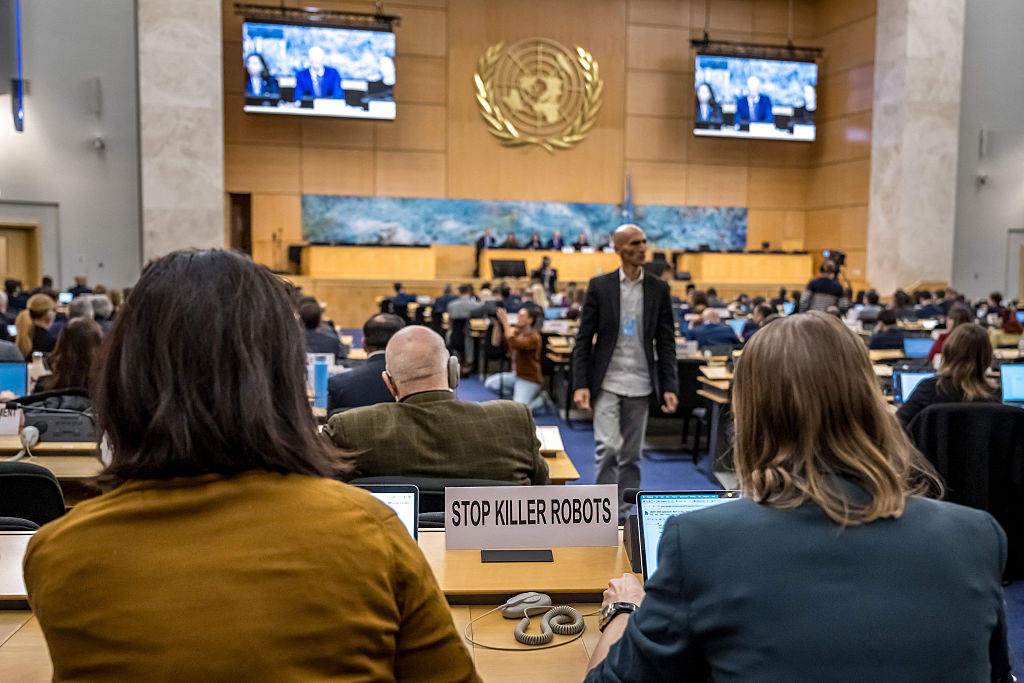
States Fail to Launch Negotiations on Global Autonomous Weapons Treaty
“Agreement to continue discussions for a further two years without a clear legal objective on the regulation of autonomous weapon systems falls shamefully short of what is needed to meet the reality of the moment,” said Erika Guevara Rosas, Senior Director of Research Advocacy, Policy and Campaigns at Amnesty International.
States failed to launch negotiations on a global autonomous weapons treaty on Saturday. Negotiators meeting at the seventh Review Conference of High Contracting Parties to the Convention on Certain Conventional Weapons adopted a watered-down mandate instead.
The new mandate focuses on developing an instrument with ambiguous legal status.
That decision extends discussions for another two years without setting a clear legal objective.
The meeting served as a final test after 13 years of talks at the forum. Amnesty International reported that the forum failed to set the rules for using autonomous weapons systems.
A majority of states supported establishing a global treaty on autonomous weapons systems. The Convention on Certain Conventional Weapons operates on consensus, which allowed spoiler states to block progress.
Amnesty International said that this deadlock carries catastrophic consequences for civilians caught up in armed conflict. The organization participates in the Stop Killer Robots campaign, an international coalition of over 330 civil society organizations across 78 countries.
Autonomous weapon systems select and strike targets without human intervention once activated. Developers build these machines at breathtaking speed.
Ceding control of lethal force to machines on the battlefield threatens a dystopian, dehumanizing future. Unrestricted use could lead to a disastrous escalation in automated killing and undermine human dignity.
“If states are truly committed to tackling the risks of increasing autonomy in warfare, they must redouble their efforts to ensure that agreed norms are integrated into a robust, global legally binding treaty, probably outside the Convention on Certain Conventional Weapons,” Guevara Rosas told Amnesty.
States must push for a ban on autonomous weapons systems that target humans alongside ensuring meaningful human control. Past multilateral efforts succeeded outside this framework.
Negotiators rapidly established the Anti-Personnel Mine Ban and the Cluster Munitions Convention after previous failures to make progress in the Convention on Certain Conventional Weapons.
Those treaties built strong international norms against the production, stockpiling, transfer, and use of inhumane weapons.
“After 13 years of talks at this forum, this week’s meeting was the final test of whether the Convention on Certain Conventional Weapons can face one of the most consequential challenges of our time: the urgent need for a robust, global legally binding treaty setting out the rules on using autonomous weapons systems,” Guevara Rosas told Amnesty. “It failed.”
Amnesty International, founded in London in 1961 by lawyer Peter Benenson after he read of two Portuguese students jailed for toasting freedom, grew from a campaign for “prisoners of conscience” into a global movement with more than ten million members and supporters.
It was awarded the Nobel Peace Prize in 1977 for its work against torture and injustice, and now campaigns worldwide on issues including the arms trade and autonomous weapons through coalitions such as Stop Killer Robots.