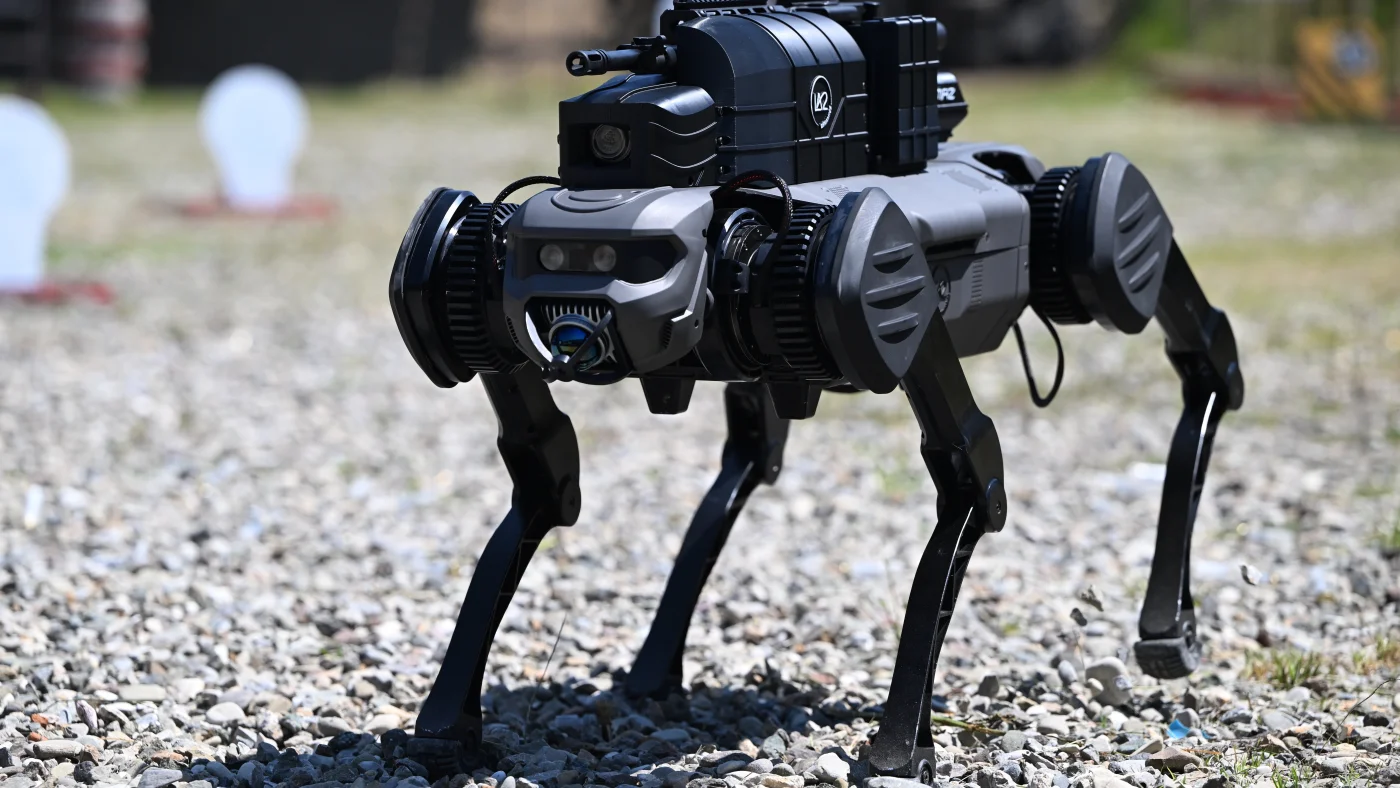
UN Weapons Conference Extends Killer Robot Talks Two Years, No Binding Rules
Negotiators at a United Nations-backed weapons conference in Geneva agreed on Saturday to extend discussions on lethal autonomous weapons systems for two more years without adopting binding rules.
The Tech TL;DR:
- U.N. talks in Geneva ended with a softened agreement to elaborate a possible accord on lethal autonomous weapons by 2028.
- Major military powers including Russia and the United States were accused by activists of blocking stronger language and binding restrictions.
- Negotiations centered on the Convention on Certain Conventional Weapons, where decisions require consensus among 128 ratifying countries.
Scores of countries concluded the week-long conference by agreeing to elaborate a possible framework on such systems by 2028, according to reporting by NHPR. However, the delegations stopped short of committing to the legally binding rules advocated by U.N. Secretary-General António Guterres and various humanitarian groups.
The outcome highlighted ongoing difficulties in achieving concrete disarmament results amid geopolitical competition. Izumi Nakamitsu, the U.N. high representative for disarmament affairs, hailed the agreement as a significant achievement while conceding a glass half full or half empty scenario regarding Guterres’ original push for a treaty this year, as reported by GPB.

Advocacy groups pointed directly to major military powers for the lack of stringent mandates. Activists accused Russia and the United States of obstructing stronger language to preserve operational flexibility for high-tech defense systems.
“States have agreed it is sufficient to just talk about the issue, for the 14th year, while these weapons enable atrocities,” said Max Tegmark, a machine learning specialist at the Massachusetts Institute of Technology and founder of the Future of Life Institute, according to NPR.
Prior to the conference, a coalition of seven nations proposed launching formal negotiations on a rulebook to limit machines from selecting and engaging targets without human oversight. That push fell short under the consensus rules of the Convention on Certain Conventional Weapons.
“Technology is moving faster than diplomacy,” said Ambassador Frederico Meyer of Brazil, whose delegation co-sponsored the proposal alongside Austria, Belgium, Ireland, Mexico, New Zealand, and Panama, as reported by
Humanitarian organizations and religious leaders, including Pope Leo XIV, have framed the proliferation of autonomous drones as an existential debate requiring immediate guardrails. Analysts note that while armed drones capable of independent targeting have appeared in select conflict zones, widespread military deployment remains limited.

“Pushing the can down the road for two more years,” is how Beatrice Fihn, founder of international law advocacy group Lex International, described the Geneva outcome to NPR. Stop Killer Robots similarly criticized the mandate as watered down.
With Guterres leaving office at the end of the year, the 2026 deadline he established for initiating binding talks has passed without a treaty. Discussions remain anchored to the 128-nation Convention on Certain Conventional Weapons, where any single member state holds veto power.