States Cap Insulin Costs for Private Plans, But Laws Miss Self-Funded Employer Plans
Nearly 29 million U.S. adults have diagnosed diabetes and 32% use insulin, yet federal cost-sharing caps cover only Medicare enrollees, KFF reported.
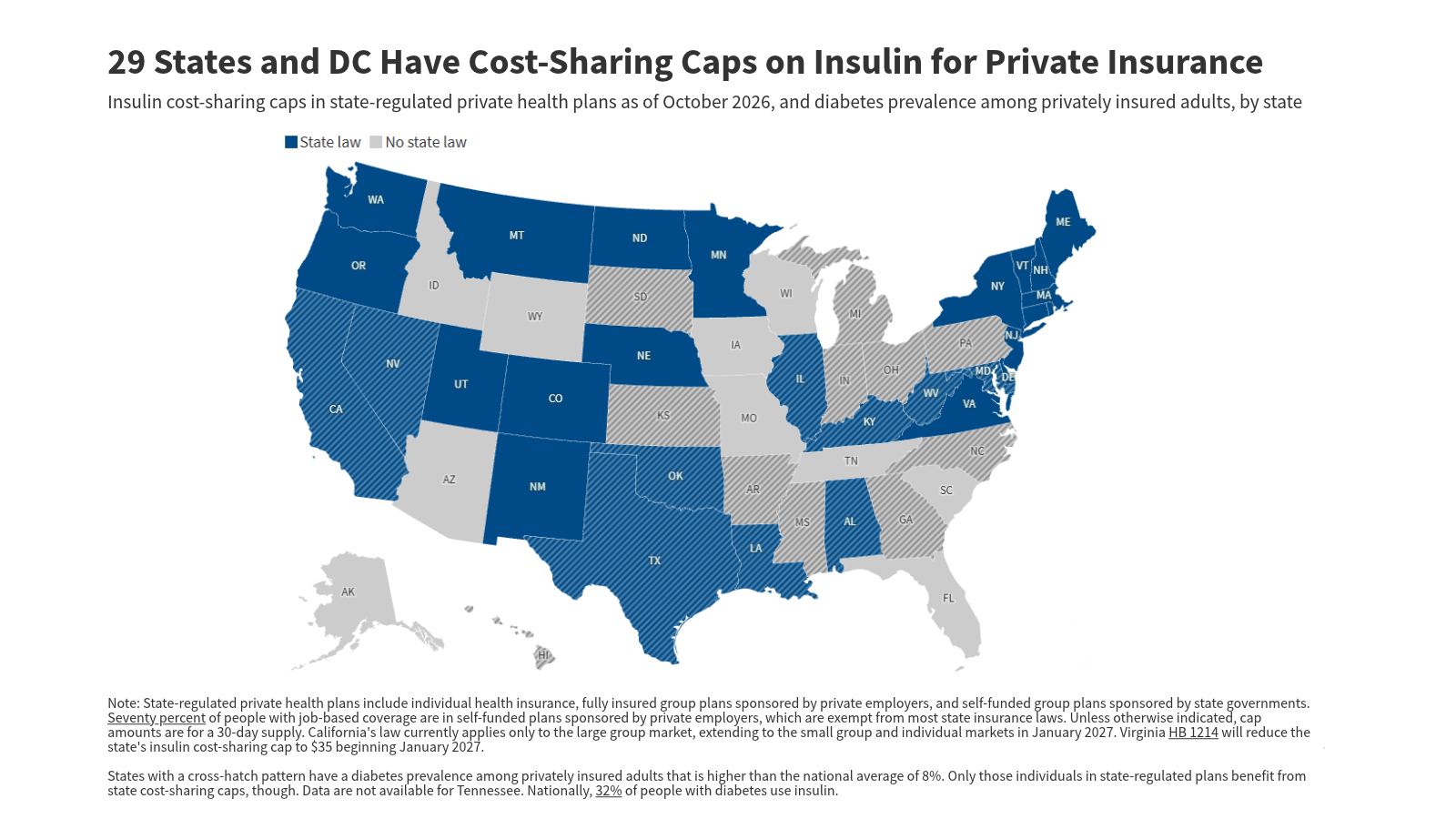
A 2024 KFF poll found three in four adults support extending the $35 monthly cap to private plans, with 84% of Democrats and 70% of Republicans in favor. Since 2019, an increasing number of state laws have limited cost-sharing for insulin in state-regulated plans, though caps range from $0 in New York and Massachusetts to $100 in four states, and most laws do not reach self-funded employer plans that cover most workers.
| Cap amount | States |
|---|---|
| $0 | New York, Massachusetts (generic only) |
| $25–$35 | About three-quarters of states with caps |
| Above $35 | Alabama, Colorado, Delaware, Vermont ($100); Virginia ($35 effective Jan. 2027) |
The Inflation Reduction Act established a $35 monthly cap for Medicare Part D enrollees starting in 2023, cutting their out-of-pocket insulin costs by half between 2020 and 2024, a KFF analysis found. Earlier IRA drafts included the same cap for private coverage but it was dropped before passage.
“Cost-sharing caps don’t help the uninsured and don’t address the underlying problem of high insulin prices,” said Kao-Ping Chua, a pediatrician and researcher at C.S. Mott Children’s Hospital and the University of Michigan Medical School. “However, our study shows that caps could be a useful stop-gap measure to improve insulin affordability until more comprehensive reforms are implemented.”
Chua’s team analyzed more than 12,000 privately insured children and young adults under 21 with type 1 diabetes, finding they paid an average $494 out-of-pocket for insulin in 2018, with one in eight spending over $1,000. A national $25 cap would have lowered costs for about 60% of patients, saving nearly $480 annually on average; a $100 cap would have helped 18%, saving roughly $560. Three-quarters of those in high-deductible plans would benefit from a $25 cap versus half in other plans, the University of Michigan Institute for Healthcare Policy and Innovation reported. In March 2023, Eli Lilly, Novo Nordisk and Sanofi voluntarily cut list prices on certain insulins and capped patient cost-sharing at $35 monthly at select retail pharmacies, a move KFF attributed largely to a change in how Medicaid rebates are calculated.
The Federal Trade Commission sued the three largest pharmacy benefit managers — CVS Caremark, Express Scripts and Optum Rx — in September 2024, alleging they systematically favored high-list-price insulins with large rebates. In 2026, the FTC settled with Express Scripts and CVS Caremark, requiring changes to pricing and rebate practices by 2028, including broader access to programs capping insulin out-of-pocket costs as low as $25 per month. It is not clear whether and how the provision counting cash payments via TrumpRx coupons toward deductibles will be implemented, KFF noted. State attorneys general in both Republican- and Democratic-led states have filed antitrust and consumer-protection lawsuits against insulin manufacturers and PBMs, many consolidated in federal court. No major court decisions or settlements have been issued.
Alternative pathways are expanding. California’s CalRx program now produces its own biosimilar glargine insulin for cash purchase at lower cost. PBMs and other third parties are manufacturing private-label biosimilars, though their long-term impact on patient costs is unclear. Direct-to-consumer sales through online pharmacies and discount platforms like GoodRx and TrumpRx offer additional cash-pay options, while manufacturer assistance programs serve some low-income patients.
A Peterson-KFF Health System Tracker analysis of 2018 claims data found a $35 cap would have financially benefited at least one in five privately insured enrollees using insulin. The 2026 KFF Employer Health Benefits Survey showed 29% of covered workers are in HSA-qualified high-deductible plans, which may access insulin pre-deductible under IRS guidance.
KFF’s own pages establish that it publishes policy analysis, polling and journalism on health-care issues, with much of its work concerning those especially vulnerable to health-care costs, and that it is well known for public opinion research documenting public views and experiences on health issues — often in partnership with major news organizations.