
Seoul, South Korea – Former South Korean President Yoon Suk Yeol was sentenced to life imprisonment with labour on Thursday after being found guilty of leading an insurrection stemming from his declaration of martial law in December 2024. The Seoul Central District Court’s decision marks the first time a democratically elected South Korean head of state has received the maximum custodial sentence.
The court determined that Yoon’s imposition of martial law on December 3, 2024, constituted a deliberate attempt to undermine the constitutional order. Presiding Judge Jee Gwi-yeon stated the declaration was intended “to send troops to the national assembly to blockade the assembly hall and arrest key figures, including the assembly speaker and party leaders, thereby preventing lawmakers from gathering to deliberate or vote.”
While prosecutors had requested the death penalty, arguing Yoon committed a “grave destruction of constitutional order” by mobilizing troops and attempting to arrest political opponents during the six-hour crisis, the court opted for life imprisonment. The judge cited Yoon’s lack of remorse, his refusal to attend hearings, and the significant social costs inflicted on South Korean society as factors in the sentencing. The court also noted that Yoon’s planning did not appear meticulous, he had attempted to limit the use of physical force, and most of his plans ultimately failed.
The court’s ruling detailed how the martial law declaration damaged the political neutrality of the military and police, and diminished South Korea’s international standing, leaving society “politically divided and experiencing extreme confrontation.” In a historical reference, Judge Jee cited the 17th-century execution of England’s Charles I, who led troops into parliament, to illustrate that even heads of state can be held accountable for insurrection against the legislature.
The verdict was broadcast live nationally, showing Yoon briefly smiling upon arrival at the court and displaying no visible reaction as the sentence was delivered. Under South Korean law, insurrection carries penalties of death, life imprisonment with labour, or life imprisonment without labour.
The events leading to the sentencing began on the night of December 3, 2024, when Yoon claimed he was acting to root out “anti-state forces” and alleged election fraud without providing evidence. Within hours, 190 lawmakers breached military and police cordons to pass an emergency resolution lifting the martial law. The National Assembly impeached Yoon eleven days later, and the Constitutional Court removed him from office four months after that.
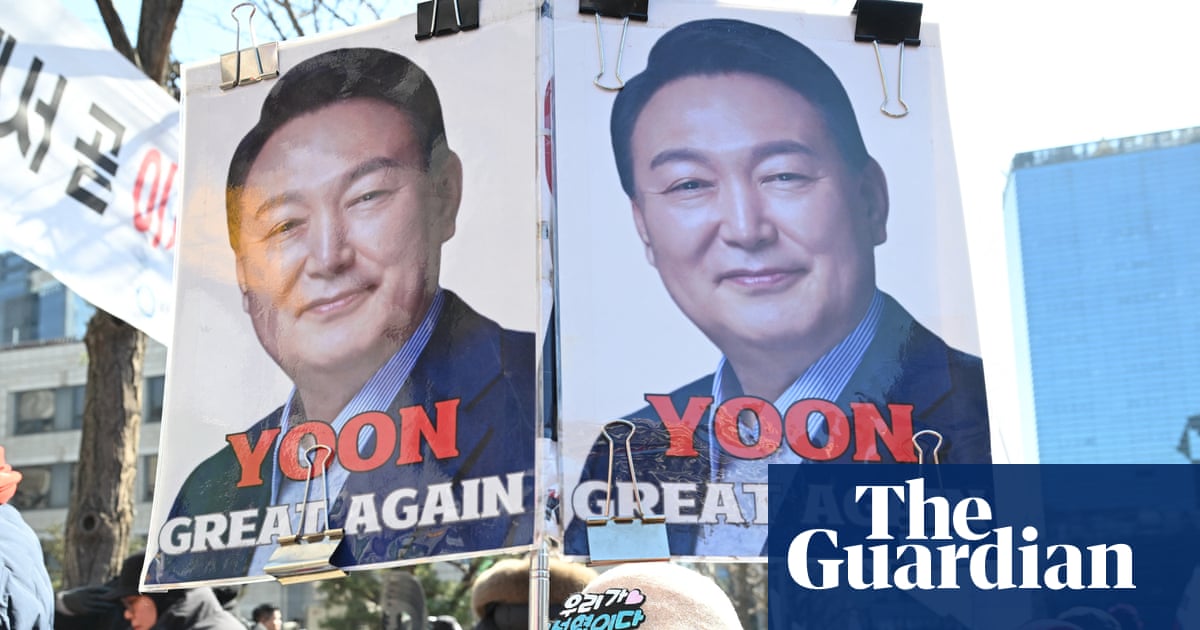
Outside the courthouse, reactions were sharply divided. Hundreds of Yoon supporters, waving South Korean and US flags, initially cheered at the dismissal of some prosecution evidence but turned hostile as the ruling progressed, shouting at the judge and journalists. Some supporters expressed despair, crying “the country is finished” upon hearing the sentence. Simultaneously, progressive groups approximately 500 metres away celebrated, though some expressed disappointment that the death penalty was not imposed.
Yoon faces six additional criminal trials, including a treason charge alleging he ordered drone incursions into North Korean airspace to provoke a confrontation. He has already been sentenced to five years’ imprisonment for obstructing his own arrest. Former Prime Minister Han Duck-soo was sentenced to 23 years in prison in January for his role in the attempted power grab, with the court describing it as a “self-coup.” Former Interior Minister Lee Sang-min was jailed for seven years on February 12 for relaying Yoon’s orders to cut power and water to media outlets.
Seven co-defendants also received sentences: former Defence Minister Kim Yong-hyun was sentenced to 30 years; Noh Sang-won, a former intelligence commander, to 18 years; Cho Ji-ho, the former police chief, to 12 years; Kim Bong-sik, the former Seoul police chief, to 10 years; Mok Hyun-tae, a police commander, to three years. Two defendants, Kim Yong-geun and Yoon Seung-young, were acquitted.
Yoon’s legal team released a statement calling the verdict “a predetermined conclusion” and a “show trial,” accusing the judiciary of being swayed by public opinion and political pressure. They cited the suspended trial of President Lee Jae Myung and acquittals of opposition politicians as evidence of double standards. The team vowed to appeal, stating they believe “truth will eventually be revealed in the court of history.”
Life imprisonment in South Korea carries no fixed release date, with parole theoretically possible after 20 years, contingent on fine conduct and demonstration of remorse. Previous South Korean presidents who served prison sentences, including Park Geun-hye, have ultimately been pardoned. Military dictators Chun Doo-hwan and Roh Tae-woo also received death and lengthy sentences, respectively, for their roles in a 1979 coup, but those sentences were later reduced and they were eventually pardoned.
