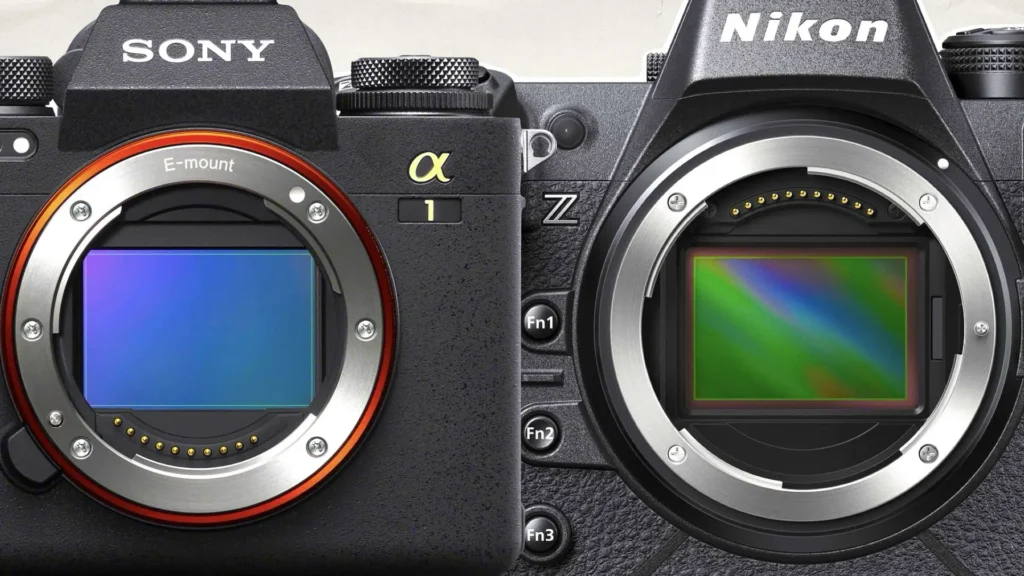
Sony Alpha 1 and Nikon Z9 Flagship Cameras Compared
The Sony Alpha 1 and the Nikon Z9 occupy a nearly identical pricing tier on Amazon as of October 9, 2026, forcing a direct choice between two very different professional flagship cameras. The Sony Alpha 1 lists at $5,698, representing an eight percent reduction from its $6,199.99 price, while the Nikon Z9 lists at $5,296.95. With only $401.05 separating the two full-frame mirrorless bodies, the decision hinges entirely on whether a production demands the compact speed of Sony’s 50.1-megapixel hybrid or the integrated ergonomics and internal RAW video capabilities of Nikon’s larger body.
Introduced in 2021, both flagships were built for demanding professional assignments by combining stacked sensors, advanced autofocus, high-speed photography, and 8K video recording. Yet their physical builds and internal processing diverge sharply. The Sony Alpha 1 weighs approximately 737 grams with its battery and memory card. The Nikon Z9 tips the scales at approximately 1,340 grams, carrying a built-in vertical grip and a larger battery system that adds roughly 603 grams before mounting a lens.
Sony Alpha 1 Outperforms Nikon Z9 in RAW Burst Speeds
For professional still photographers, the Sony Alpha 1 provides distinct advantages through its 50.1-megapixel stacked CMOS sensor and continuous RAW shooting at up to 30 frames per second. That configuration targets sports, wildlife, and commercial work where high resolution must accompany rapid action capture.
The Nikon Z9 utilizes a 45.7-megapixel stacked CMOS sensor. It captures full-resolution RAW images at up to 20 frames per second, though it can reach 30 frames per second only in JPEG mode. Despite the lower raw burst ceiling, the Z9 remains a formidable stills instrument. Its shutterless design, integrated vertical grip, and larger battery suit extended assignments where handling heavy telephoto glass matters more than saving space in a travel bag.

Nikon Z9 Supports Internal RAW Recording over Sony Alpha 1
The operational divide widens significantly when moving from still photography to cinema production. While the Sony Alpha 1 handles 8K up to 30p and 4K up to 120p with 10-bit recording, S-Log3, and S-Cinetone, it lacks internal RAW recording. Sony users rely on 16-bit RAW output sent over HDMI to a compatible external recorder.
The Nikon Z9 bypasses external recorders for many high-end workflows by supporting internal 12-bit N-RAW recording at up to 8.3K 60p, ProRes RAW HQ up to 4.1K 60p, and internal ProRes 422 HQ recording. For cinematographers requiring extensive grading flexibility and direct-to-card RAW acquisition without rigging external monitors, the Nikon offers a more complete internal suite at a lower purchase price.

| Specification | Sony Alpha 1 | Nikon Z9 |
|---|---|---|
| Sensor | 50.1MP stacked CMOS | 45.7MP stacked CMOS |
| Full-Resolution RAW Burst | Up to 30 fps | Up to 20 fps |
| Maximum 8K Video | 8K 30p | 8.3K 60p RAW |
| Maximum 4K Video | 4K 120p | 4K 120p |
| Internal Video RAW | No | 12-bit N-RAW, ProRes RAW HQ |
| Mechanical Shutter | Yes | No |
| Integrated Vertical Grip | No | Yes |
| Weight with Battery | Approx. 737g | Approx. 1,340g |
| Amazon Price | $5,698 | $5,296.95 |
Physical size heavily dictates which camera fits a specific production style. The lighter Sony body suits handheld shooting, travel days, lightweight rigs, and gimbal setups. Conversely, the substantial build of the Z9 handles prolonged shooting sessions, heavy telephoto lenses, and rigorous weather conditions without requiring an external battery grip attachment. Beyond the camera bodies, existing glass investments also restrict movement; switching between Sony E-mount and Nikon Z-mount ecosystems generally incurs costs that far exceed the $401 price gap between the two flagships.
Production teams weighing these options must determine whether their primary deliverables demand the high-resolution hybrid speed of the Alpha 1 or the self-contained RAW video workflows and durable ergonomics of the Z9.
Disclaimer: The views and cultural analyses presented in this article are for informational and entertainment purposes only. Information regarding legal disputes or financial data is based on available public records.