
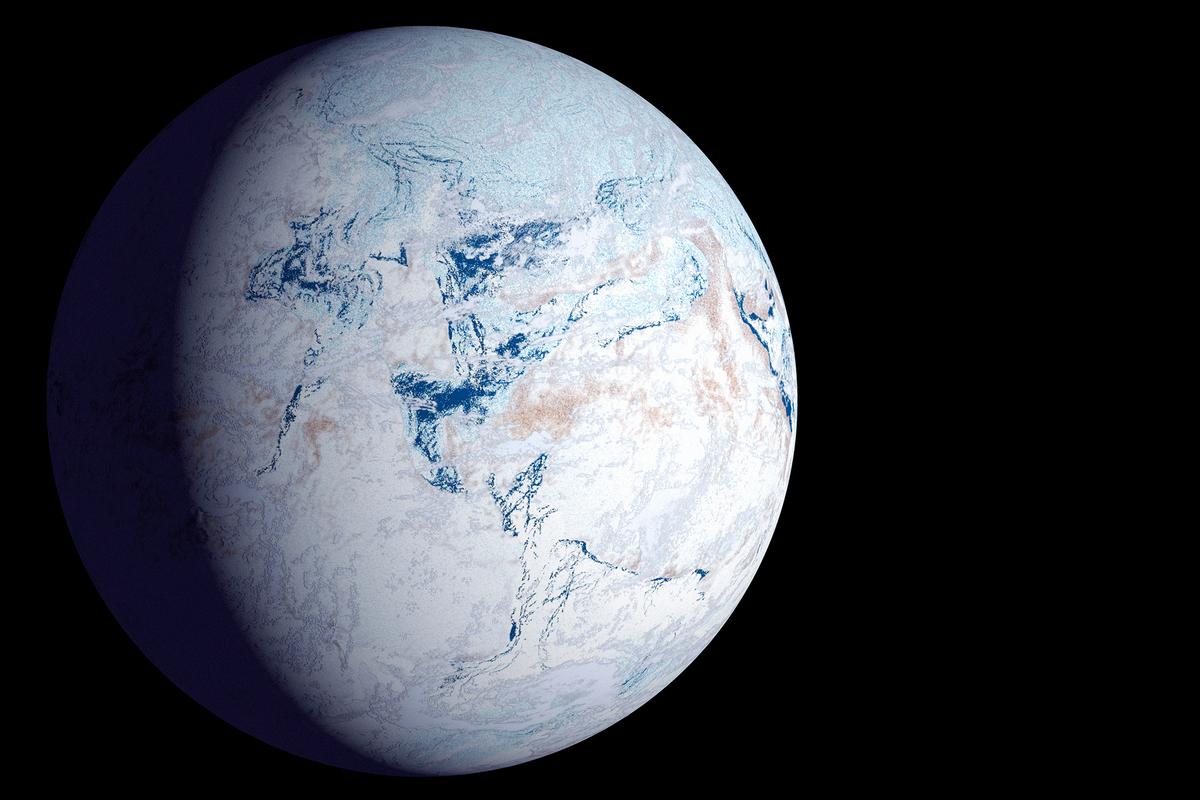
The Atlantic swell crashed against the rocks as a research team approached the Garvellachs archipelago, a remote and uninhabited island chain off the west coast of Scotland. These islands, accessible only during the brief Scottish summer, hold a geological record of a pivotal moment in Earth’s history: the transition from a warm, life-sustaining environment to a planet encased in ice.
Scientists now widely agree that Earth experienced at least two periods of “Snowball Earth” between 717 and 635 million years ago, where glaciers extended from the poles to the equator. Once considered an impossibility, the evidence for these global glaciations has become increasingly compelling, challenging long-held assumptions about the planet’s past and the origins of complex life. The Garvellachs, specifically the rocks of the Port Askaig formation, are believed to contain the most complete record of the onset of this deep freeze.
The prevailing theory suggests that the breakup of the supercontinent Rodinia around 720 million years ago played a crucial role in triggering the Snowball Earth events. As Rodinia fractured, volcanic activity increased, releasing lava that, upon weathering, absorbed atmospheric carbon dioxide. This process, known as the “fire and ice” hypothesis, led to a cooling effect. Whereas, the unique circumstances surrounding Rodinia’s breakup, and why similar events haven’t triggered subsequent glaciations, remain a subject of ongoing research.
The rocks on the Garvellach islands offer a unique window into this period. Unlike other glacial sites where erosion has obscured the evidence, the Scottish outcrops preserve a detailed sedimentary record of the transition to ice age conditions. Increasing numbers of ‘dropstones’ – rocks carried by icebergs – and frost-shattered ground indicate a progressively colder and drier environment. Layers of rock, contorted by the immense weight of glaciers kilometers thick, reveal the scale of the ice sheets that once covered the region. These glaciers carried debris, including massive chunks of carbonate rock, now known as “The Bubble,” gouged from the underlying seafloor.
The harsh environment of the Garvellachs has not deterred human presence throughout history. In the 6th century, Saint Brendan, a renowned navigator, established a monastery on the islands, and the remains of beehive huts – stone structures built by generations of monks – can still be found, constructed from glacial moraine dating back to the Snowball Earth period.
The completeness of the Garvellach sedimentary record has led to proposals to designate the site as a Global Boundary Stratotype Section and Point (GSSP), effectively establishing it as the official starting point for the Cryogenian period. A vote on this designation is scheduled for 2026 by the International Union of Geological Sciences. The Cryogenian period, lasting approximately 70 million years, was characterized by extreme cold punctuated by brief intervals of warmth.
Beyond the geological significance, the Cryogenian period is increasingly understood as a critical juncture in the evolution of life. The extreme climatic swings – from intense cold to periods of warmth – created a series of evolutionary bottlenecks, driving adaptation and ultimately paving the way for the emergence of complex multicellular organisms. The fluctuating oxygen levels during this period, linked to changes in organic matter burial, likely played a key role in this process.
Research suggests that even during the deep freeze, life persisted in isolated pockets, such as cryoconite holes – small pools of water formed on ice surfaces – harboring diverse microbial communities. The ability of organisms to adapt to extreme conditions during the Cryogenian may have laid the foundation for the Cambrian explosion of animal life that followed. The ancestors of modern animals likely navigated these harsh conditions, and the subsequent rapid warming and sea-level rise at the end of the Cryogenian presented a new set of challenges that ultimately shaped the course of evolution.
Analysis of carbon isotopes in the Garvellach rocks supports the idea that the transition to glacial conditions was linked to changes in organic matter burial. Increased burial of organic carbon removed carbon dioxide from the atmosphere, contributing to cooling. This process, coupled with the breakup of Rodinia, created a feedback loop that ultimately led to the Snowball Earth events. The sedimentary layer marking this transition is currently being considered as the official starting point of the Cryogenian period.
