Sex-Specific Biological Aging Clocks Reveal Organ-Level Differences in Men and Women
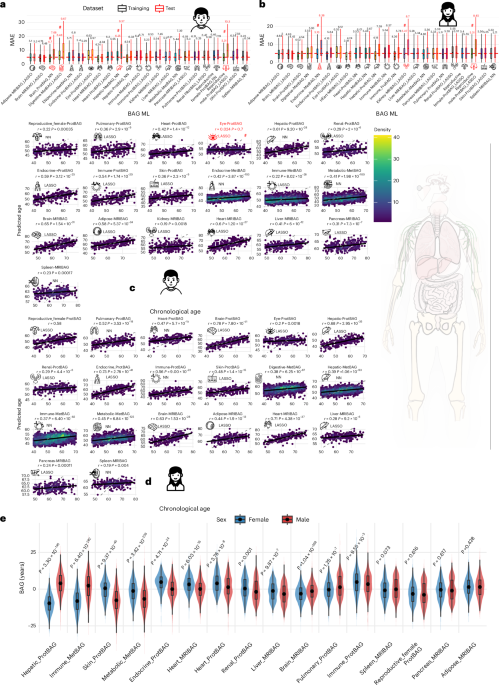
Biological aging clocks spanning multiple organs and molecular layers reveal that male and female aging trajectories diverge in distinct, disease-relevant patterns. Published on September 16, 2026, in Nature Medicine, the large-scale investigation constructs sex-stratified biological aging clocks using genomic, epigenomic, proteomic, and metabolomic data. Rather than following a uniform whole-body aging rate, human tissues age at different speeds depending on biological sex, providing a concrete molecular framework for long-standing epidemiological disparities in cardiovascular disease, autoimmunity, and neurodegeneration.
- Male and female biological aging rates diverge significantly across specific organs rather than proceeding at a uniform, sex-neutral speed.
- The multi-omics investigation analyzed genomic, epigenomic, proteomic, and metabolomic data to map organ-level tissue decay against known sex-biased disease risks.
- These findings challenge traditional sex-neutral aging biomarkers, suggesting that future longevity interventions and clinical trials require sex-stratified models.
Mapping Multi-Omics Divergence Across Organ Systems
The assumption that men and women age at identical speeds is giving way to a more granular model of human senescence. The same internal structure might show marked sex divergence in protein aging while displaying relatively similar epigenetic aging patterns. This complexity underscores why traditional whole-body scalar models miss critical tissue vulnerabilities.
Biological age measures the functional status of physiological systems relative to population averages, reflecting internal tissue health shaped by genetics and environmental exposures. Chronological age, by contrast, merely counts calendar years. By tracking molecular shifts such as cytosine-phosphate-guanine (CpG) methylation, researchers can estimate how fast specific tissues degrade. As detailed in the Los Angeles Times, these epigenetic clocks analyze chemical alterations on DNA molecules where small methyl groups attach to genomic loci without altering the underlying genetic sequence.
Clinical Implications for Disease Pathogenesis and Prevention
The identification of sex-specific organ aging rates provides a plausible molecular scaffold for epidemiological patterns that have puzzled clinicians for decades. Conditions such as autoimmune disorders predominantly affect women, whereas cardiovascular incidents often manifest differently across biological sexes. By deploying multi-organ biological aging clocks, medical researchers can better map these clinical realities to underlying molecular mechanisms.

Limitations and Future Research Directions
Despite the robust scale of the Nature Medicine study, investigators point out notable limitations that guide current clinical interpretation. Large multi-omics studies frequently rely on cross-sectional cohorts, which makes definitive causal inference challenging. Furthermore, biological clock accuracy can vary depending on tissue availability, and replication across ancestrally diverse populations remains an essential next step for the field.

For biopharmaceutical developers and clinical trial designers, these methodological hurdles demand rigorous oversight.
Ultimately, reframing biological aging as an organ-level, sex-specific phenomenon changes how longevity interventions will be designed, tested, and deployed in clinical practice. As precision medicine evolves past sex-neutral paradigms, clinicians will increasingly rely on granular, multi-omics assessments to catch physiological decline long before clinical symptoms emerge.