
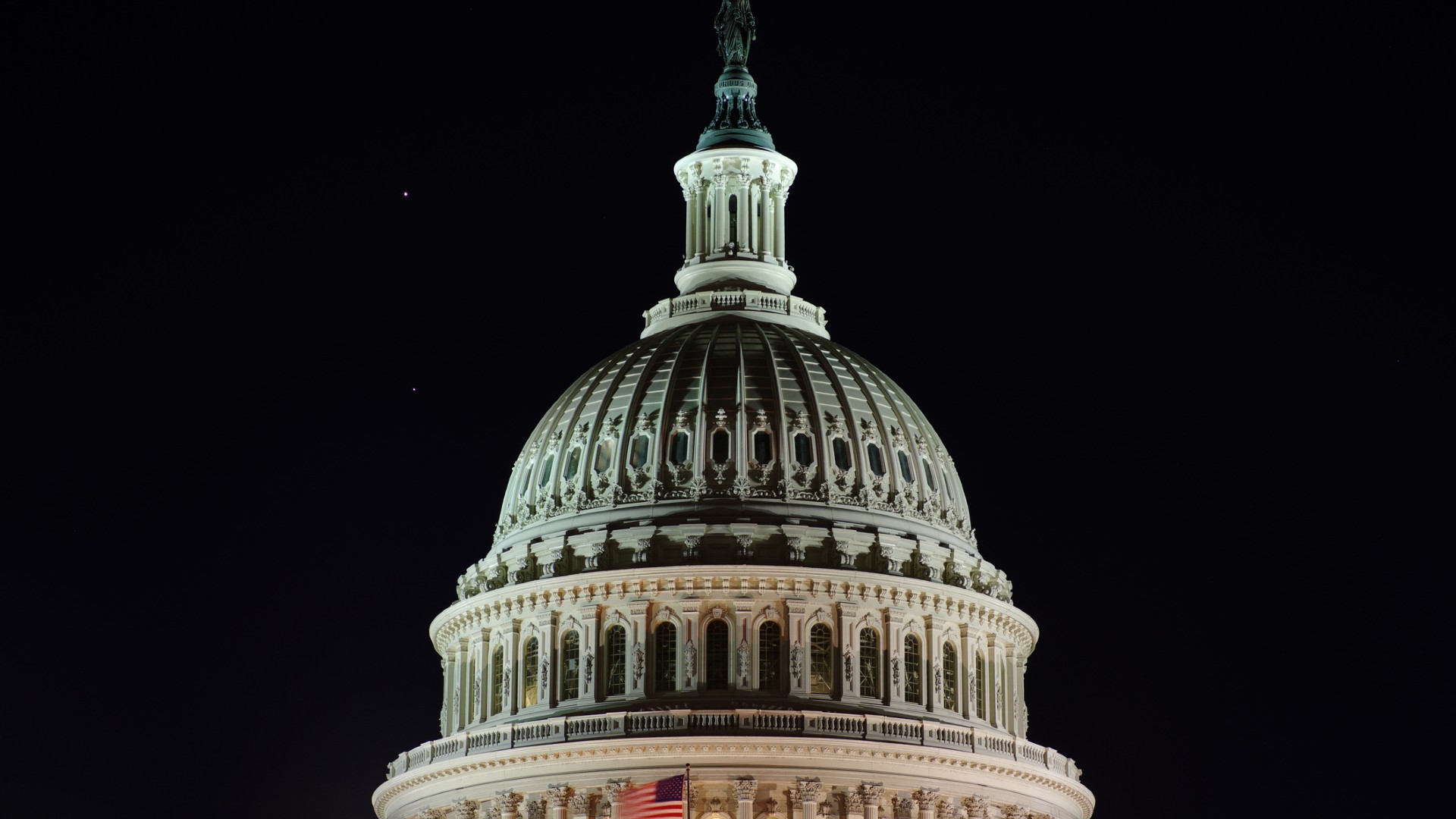
Senate Panel OKs NASA Funding, Defying Proposed Cuts
Bipartisan support aims to protect key science missions and Artemis program.
A U.S. Senate appropriations committee has approved a bill allocating $7.3 billion for NASA’s science programs, pushing back against the **Trump** administration’s proposed budget cuts of 47%. However, the bill was withdrawn and a future vote is planned.
Senate Bill Highlights
The bipartisan bill, championed by **Jerry Moran** (R-Kansas) and **Chris Van Hollen** (D-Maryland), seeks to provide $24.9 billion for NASA. This figure is slightly higher than the fiscal year 2025 levels and is intended to boost the exploration of the solar system, advance climate change understanding, and promote innovation in aeronautics.
**Van Hollen** stated that the bill rejects significant cuts that would devastate NASA’s science programs and terminate numerous operating and planned missions.
Many missions were targeted by **Trump**’s 2026 budget proposal. These include the Jupiter-orbiting Juno mission, the New Horizons Pluto spacecraft, the DaVinci Venus probe, and the OSIRIS-APEX asteroid-sampling spacecraft.
Widespread Opposition to Cuts
Experts in the scientific community have voiced strong opposition to **Trump**’s budget proposal, which seeks a 24% overall budget cut for NASA and the layoff of about a third of its staff. Opposition includes all seven former NASA science chiefs and the bipartisan U.S. Planetary Science Caucus chairs.
“For NASA, the bill reflects an ambitious approach to space exploration, prioritizing the agency’s flagship program Artemis, and rejecting premature terminations of systems like SLS and Orion before commercial replacements are ready,”
said **Sen. Moran** during the meeting.
**Sen. Moran** emphasized the importance of accelerating plans to land Americans on the lunar surface before China, as well as investing in technologies for landing astronauts on Mars. Since its inception, the Artemis program has received bipartisan support (Planetary Society, 2024).
Support for Other Agencies
The bill extends support beyond NASA, including the National Science Foundation (NSF). Instead of the proposed 57% cut, the bill asks to cut the agency’s funding by only $60 million, about a 0.67% decrease.
“The bill provides $9 billion for the National Science Foundation, sparing it from the proposed 57% cut advanced in the President’s budget request,”
**Sen. Van Hollen** said. “This bill protects key science missions that are fundamental to furthering our understanding of the Earth and [making us] better stewards of our natural resources, and supports critical programs … to safeguard the Earth from natural disasters.”
The National Weather Service (NWS) will also remain “fully funded” to protect public well being, according to **Sen. Moran**.
The bill also supports the National Oceanic and Atmospheric Administration (NOAA), which has recently experienced staff layoffs and potential building closures.
“We maintain the current, next-generation satellites that track severe weather, promote and support American businesses and exports and spur economic development nationwide,”
said **Van Hollen**. He added that such work also helps to “create cybersecurity and AI standards, promote economic development nationwide and enable sustainable management of ocean resources, conduct periodic censuses …. and much more.”
Future Steps
Even with Senate passage, the budget bills must also pass the House of Representatives and be signed by the president to take effect, leaving no guarantee of an easy agreement.
