
Milky Way‘s Sleeping Giant: Black Hole Sagittarius A Poised for a Dramatic Wake-Up Call in 2 Billion Years
By Rachel Kim, world-Today-News.com – November 16, 2023
For millennia, the supermassive black hole at the center of our Milky Way galaxy, known as Sagittarius A (Sgr A), has remained relatively quiet.But new research suggests this cosmic slumber won’t last forever. An international team of astronomers predicts Sgr A will dramatically “wake up” and enter a period of intense activity in approximately 2 billion years, triggered by a galactic collision.
Sgr A, boasting a mass equivalent to four million suns, currently resides 25,000 light-years from Earth in the constellation Sagittarius.While it’s our closest supermassive black hole, its energy output is surprisingly low – hundreds of times less than other, more active galactic cores. This tranquility, though, is expected to be disrupted by the impending collision with the Large Magellanic Cloud (LMC), a dwarf galaxy currently 200,000 light-years away.
Galactic Collision Fuels the Beast
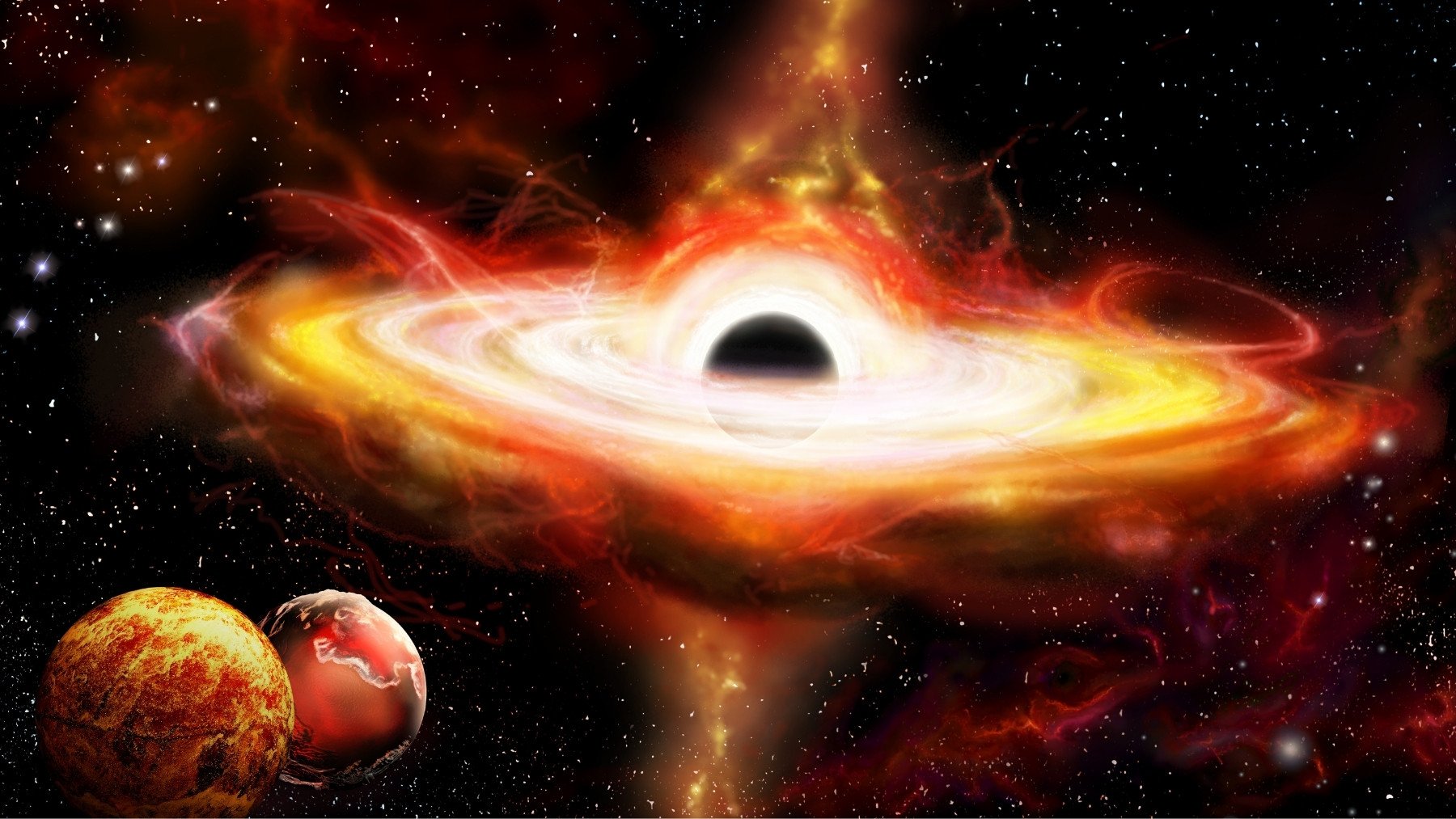
The gravitational interaction resulting from the Milky Way-LMC collision will funnel a massive influx of gas towards the galactic center. This surge of material will reignite Sgr A, transforming it into an active galactic nucleus. As gas and dust spiral into the black hole, they will form a superheated accretion disk, reaching temperatures of millions of degrees and rotating at near-light speed. This process will unleash tremendous amounts of radiation across the electromagnetic spectrum, from infrared to X-rays.
“This type of scenario not onyl helps us understand the future of our galaxy,but also how supermassive black holes condition the evolution of the cosmos,” explains the research team.
Looking Back in Time with the James Webb Space Telescope
Understanding thes future events is being aided by groundbreaking observations from the James Webb Space Telescope (JWST). JWST recently detected a galaxy dubbed “The Sparkler,” located a staggering 9 billion light-years away. this distant galaxy offers a glimpse into the Milky Way’s youth.
The Sparkler, though significantly smaller than our galaxy (only 3% of the Milky Way’s mass), is surrounded by approximately 24 globular clusters – dense collections of stars. The milky Way currently hosts around 200 such clusters.
“The origin of globular clusters is an old mystery, and we are excited that JWST can look back in time to see them in their youth,” says astronomer Aaron Romanowsky, co-author of the study analyzing The Sparkler.
The Connection between Black Holes and Galaxy Evolution
The similarities between The Sparkler and the Milky Way are shedding light on the intricate relationship between star formation and the activity of supermassive black holes. When these galactic behemoths are dormant, their influence on galactic dynamics is minimal. However, when they become active, devouring surrounding matter, they profoundly impact their host galaxies.
Astrophysicist Nathalie Degenaar of the University of Amsterdam summarizes the process: “We can see the heat radiation that emits matter as v…” (the source text ends abruptly here, but the implication is clear: the radiation emitted provides valuable data).
The 2020 Nobel Prize in Physics, awarded to Roger Penrose, Reinhard Genzel, and Andrea ghez, recognized the groundbreaking research that first confirmed the existence of Sgr A. Now, with tools like JWST and ongoing research, scientists are poised to unlock even more secrets about these enigmatic cosmic engines and their role in shaping the universe.
Keywords: Sagittarius A, Supermassive Black Hole, Milky Way, large Magellanic Cloud, James Webb Space Telescope, JWST, Galactic Collision, Astronomy, Astrophysics, Black Hole Activity, The Sparkler, Galaxy Evolution.
