
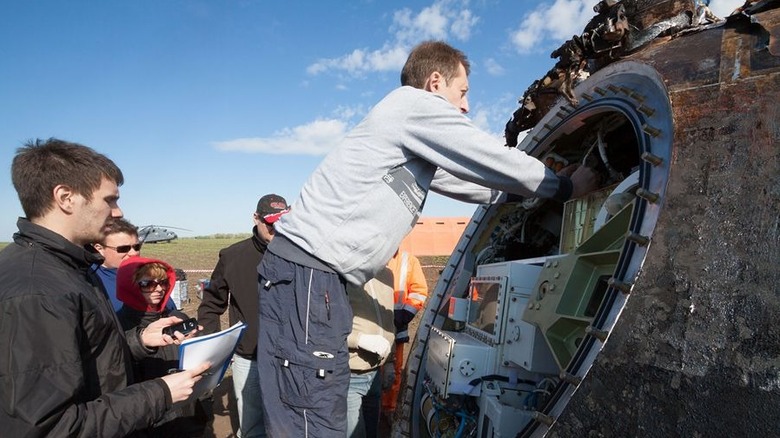
Russia Returns ‘Space Zoo’ of Mice and Flies After Month-Long Orbital experiment
BAIKONUR COSMODROME, KAZAKHSTAN – A Russian spacecraft carrying 75 mice and 1,500 fruit flies safely returned to Earth on Sunday, concluding a month-long biological experiment designed to bolster future long-duration human spaceflight. The mission, dubbed a “space zoo” by researchers, aimed to study the effects of prolonged weightlessness and cosmic radiation on living organisms, and to test a controversial theory about the origins of life.
The experiment, conducted by the Institute of Biomedical Problems, isn’t solely focused on animal research.Data gathered from the mice and flies will be crucial in developing advanced life support systems capable of sustaining human crews during extended missions, and in improving radiation shielding for spacecraft. simultaneously, a separate experiment investigated the viability of bacteria transported on basalt rocks, testing the panspermia hypothesis – the idea that life on Earth originated from microorganisms delivered via asteroids.results from the bacterial survival study are pending.
This mission arrives at a critical juncture for international space collaboration. Roscosmos, russias space agency, faces increasing challenges following geopolitical shifts and reduced partnerships with western institutions. The agency’s future capabilities are uncertain as global space ambitions intensify, notably with China’s accelerating lunar program.
The animals underwent comprehensive health evaluations upon their return, and researchers will analyze physiological and genetic changes observed during their time in orbit. The data will inform strategies to mitigate the health risks associated with long-term space travel, including bone density loss, muscle atrophy, and immune system dysfunction.
Beyond human health, the experiment explored the behavioral adaptations of the mice and flies in a microgravity surroundings.Understanding how thes organisms respond to space conditions could contribute to the advancement of closed-loop ecological systems for future space habitats, possibly enabling self-sustaining life support.
