
Infant RSV Prevention: Australian Catch-Up Program and Vaccine Eligibility
Table of Contents
As winter tightens its grip, Australian parents are navigating the complexities of infant RSV prevention. A catch-up program offering crucial protection is underway in the ACT and NSW, but eligibility criteria are causing confusion and concern among healthcare professionals and families alike.
RSV Threat to Infants
Respiratory syncytial Virus (RSV) poses a significant threat to young children, notably those under six months. This highly contagious virus is the primary reason for hospitalizations in children under five years old,with up to 25% of those hospitalized requiring intensive care. Infants are especially vulnerable to severe symptoms, including serious lung infections like pneumonia and bronchiolitis.
Sarah and Chris Fogarty from Canberra experienced this firsthand when their six-month-old daughter, Zoe, contracted RSV. Although they managed to avoid hospitalization, the experience highlighted the need for accessible preventative measures.”Our doctor told us to take shifts to watch her breathing, to make sure she was okay,” Sarah said, underscoring the severity of the situation.
Did You know? …
Each year, RSV leads to approximately 58,000 hospitalizations among children younger then 5 years old in the United States alone, according to the Centers for Disease Control and Prevention (CDC).
Catch-Up Program Details
The ACT and NSW have implemented a catch-up program utilizing nirsevimab (Beyfortus), a monoclonal antibody, to protect infants born on or after January 1, 2025. This program targets babies whose mothers did not receive the RSV vaccine during pregnancy. the treatment is administered through maternity services, often before newborns leave the hospital.
Though, eligibility is not worldwide. Children born between October 1,2024,and January 1,2025,can only access Beyfortus if they meet specific criteria,such as being born prematurely (before 37 weeks),having Aboriginal or Torres Strait Islander heritage,or possessing a pre-existing condition that elevates their risk of severe RSV.
Furthermore, Beyfortus is available for children up to two years old entering their second RSV season if they were born before 32 weeks or have high-risk conditions like cystic fibrosis, Down Syndrome, or congenital heart disease.
For those who do not meet these criteria, neither the vaccine nor the antibody treatment is accessible, regardless of their willingness to pay.
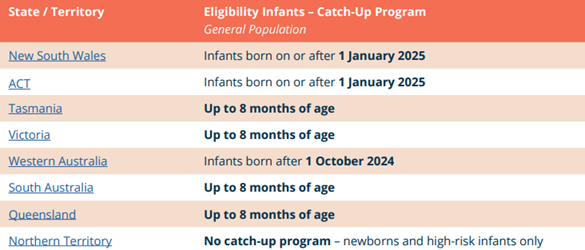
Eligibility by State/Territory
| State/Territory | Eligibility Criteria |
|---|---|
| ACT | Infants born on or after January 1,2025 (previously march 17,2025) |
| NSW | infants born on or after january 1,2025 (previously March 17,2025) |
| Other States/Territories | Limited eligibility based on prematurity,Indigenous heritage,or high-risk conditions |
Calls for Broader access
The royal Australian College of GPs (RACGP) and the Immunisation Foundation of Australia (IFA) are urging federal,state,and territory governments to expand free RSV vaccination to all at-risk groups recommended in the Australian Immunisation Handbook. This includes individuals over 75 and Aboriginal or Torres Strait Islander people over 60 with medical risk factors like diabetes, lung disease, and heart disease.
RACGP president Dr. Michael Wright acknowledges the complexity surrounding eligibility, stating, “These treatments are still quite new… as there’s been a number of changes to the eligibility for the vaccine, it’s also sometimes unclear what’s recommended, who’s eligible and then what’s subsidised by the government.”
Canberra doctor Emily Rushton describes the current situation as “an absolute mess,” particularly concerning the lack of subsidized RSV prevention for older adults, who face costs between $300 and $350 for protection. “The only patients I’m seeing to get the vaccination are those who have the disposable income to pay for it,” she notes.
Pro Tip: …
Consult the Australian Immunisation Handbook for the most up-to-date recommendations and guidelines on RSV vaccination.
Gaps in Protection
Dr. Rushton also expresses concern for young children whose mothers were not vaccinated against RSV during pregnancy but who do not qualify for the monoclonal antibody treatment. While increased vaccination among pregnant women should improve overall protection, “some kids are falling through the gaps,” she warns.
Both Dr. Rushton and IFA founder Catherine Hughes emphasize the importance of consulting with a GP to clarify eligibility and explore available options. Hughes highlights the potential impact of widespread immunization, stating, “It’s only the start of winter and we know that with strong uptake of RSV immunisations [by those eligible] we can prevent up to 10,000 hospitalisations each year.”
An ACT Health spokesperson confirmed that the government will review the 2025 RSV prevention program to inform future decisions, adding that “Evaluations of RSV programs are occurring both locally and nationally.”
Understanding RSV: An evergreen Perspective
RSV was first identified in 1956 and has since been recognized as a major cause of lower respiratory tract infections,especially in infants and young children. The virus typically circulates during the fall and winter months, causing seasonal epidemics. Historically, management of RSV has focused on supportive care, such as oxygen therapy and hydration, but recent advancements in prevention, including maternal vaccines and monoclonal antibodies, offer new strategies to reduce the burden of disease.
The progress of nirsevimab represents a significant step forward in RSV prevention. Unlike vaccines that require the body to produce its own antibodies, nirsevimab provides immediate protection by directly delivering antibodies to the infant. This is particularly beneficial for newborns who may not have a fully developed immune system.
Frequently Asked questions About RSV Prevention
- What are the long-term effects of RSV infection in infants?
- While most children recover fully from RSV, some may experience recurrent wheezing or an increased risk of developing asthma later in life.More research is needed to fully understand the long-term consequences of RSV infection.
- How can I protect my baby from RSV if they are not eligible for the catch-up program?
- Practicing good hygiene, such as frequent handwashing and avoiding close contact with sick individuals, can help reduce the risk of RSV transmission. Breastfeeding can also provide some protection due to the transfer of maternal antibodies.
- Are there any side effects associated with the RSV vaccine or nirsevimab?
- The RSV vaccine for pregnant women and nirsevimab for infants are generally considered safe.Common side effects may include mild pain or swelling at the injection site.Serious side effects are rare.
- How effective is the RSV vaccine in preventing severe illness in infants?
- Clinical trials have shown that the RSV vaccine given to pregnant women is highly effective in preventing severe RSV illness in their infants during the first few months of life. Nirsevimab has also demonstrated high efficacy in preventing RSV-related hospitalizations.
- What is the role of ongoing research in improving RSV prevention strategies?
- Ongoing research is crucial for developing new and improved RSV vaccines and treatments. Scientists are also working to better understand the epidemiology of RSV and identify factors that contribute to severe disease.
Disclaimer: This article provides general information and should not be considered medical advice. Consult with a healthcare professional for personalized guidance on RSV prevention.
Are you concerned about RSV this winter? What steps are you taking to protect your family?
Share this article to help other parents stay informed!
