
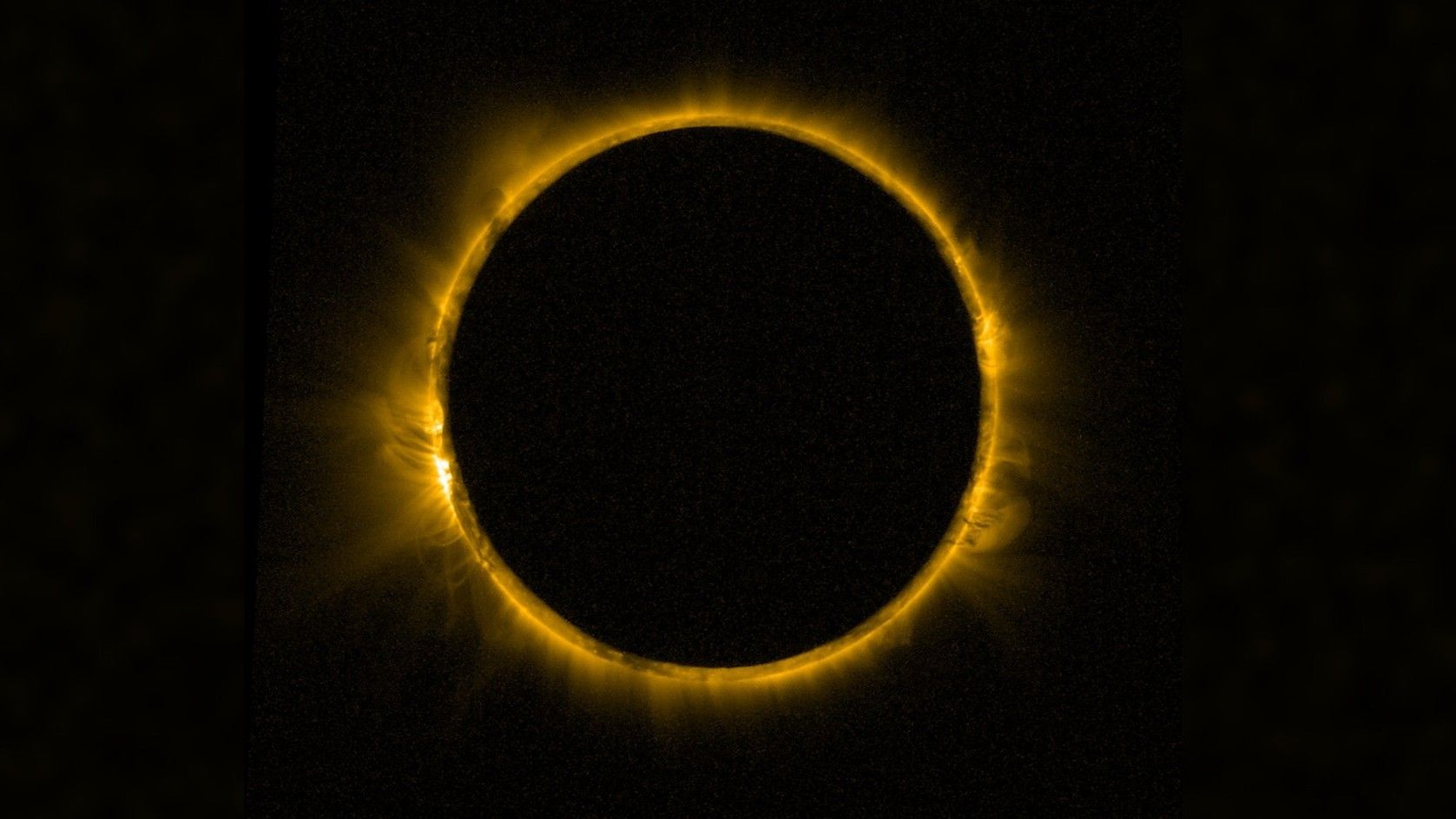
A spectacular “ring of fire” annular solar eclipse was captured in stunning detail on February 17, 2026, not by observers on Earth, but by the European Space Agency’s (ESA) Proba-2 satellite. The eclipse occurred as the Moon passed directly between the Earth and the Sun, though at a distance that prevented complete coverage of the solar disk.
From its orbital vantage point, Proba-2 observed the eclipse four times as it crossed the eclipse zone, including a particularly clear view at 11:31 GMT (6:31 a.m. EST) when the Moon occulted over 93% of the Sun. The images were captured by the satellite’s SWAP (Solar Wind Anisotropy) instrument, which records the Sun in extreme ultraviolet light, revealing intricate details of the Sun’s corona – its outermost atmospheric layer.
An annular eclipse occurs when the Moon is at a greater distance from Earth in its elliptical orbit, causing it to appear smaller in the sky. This prevents the Moon from fully obscuring the Sun, resulting in a bright ring of sunlight surrounding the Moon’s silhouette. While the phenomenon is visually striking, the full annular phase of this eclipse was only visible from Antarctica, limiting terrestrial viewing to researchers stationed at remote scientific outposts.
Partial phases of the eclipse were visible from the southern tips of Chile and Argentina, as well as parts of southern Africa, according to reports. However, Proba-2’s unique position allowed for multiple observations, unhindered by atmospheric conditions or geographical limitations. The satellite’s sun-synchronous orbit facilitated these repeated views of the event.
The images captured by Proba-2 provide valuable data for solar research, offering insights into the Sun’s corona during an unusual event. The ESA’s Proba-2 satellite continues to operate, providing ongoing observations of the Sun and the space environment.
