
Heat Flow ‘Switch’ Promises Spacecraft Revolution
University of Manchester Team Develops Device Controlling Thermal Transport
A groundbreaking advancement in thermal management could revolutionize how spacecraft and aircraft handle heat. Researchers have unveiled a solid-state device capable of actively switching heat flow on and off, much like an electronic transistor operates for electricity.
Graphite Films Enable Unprecedented Heat Control
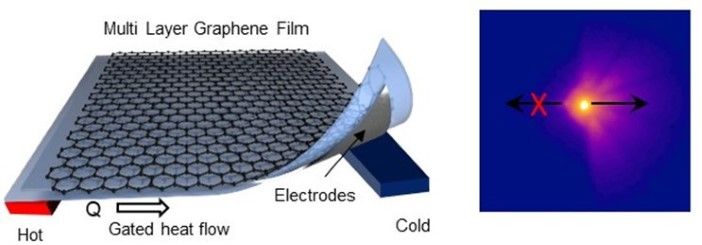
An international team, spearheaded by scientists at the University of Manchester’s National Graphene Institute, utilized graphite films with exceptional thermal conductivity to create this novel switch. The core mechanism involves ion insertion between graphite layers when a voltage is applied.
This ionic intercalation disrupts the movement of phonons, the primary carriers of heat in solids, leading to a dramatic reduction in thermal conductivity—up to a 1,300% decrease. Removing the electrical voltage reverses the process, restoring the material’s full heat-carrying capacity.
Transformative Potential for Extreme Environments
“What makes our device truly transformative is its ability to operate reliably in extreme environments such as space,” stated Dr Pietro Steiner, lead author and technology lead for graphene-based thermal technologies at SmartIR, a University of Manchester spinout.
“The solid-state nature and absence of mechanical parts make it particularly attractive for aerospace applications, where reliability, weight, and efficiency are critical.”
—Dr Pietro Steiner, Technology Lead, SmartIR
The team also demonstrated the device’s ability to direct heat flow. By carefully patterning electrodes and controlling voltages, they created pathways for anisotropic thermal conduction, paving the way for programmable thermal management systems.
Revolutionizing Spacecraft Thermal Regulation
Professor Coskun Kocabas, the study’s lead author, highlighted the technology’s potential impact. “This thermal switching technology could revolutionise spacecraft thermal regulation, offering dynamic and reconfigurable solutions to manage excess heat without complex moving mechanisms or bulky radiators.”
Current spacecraft often rely on radiators or mechanical valves to dissipate excess heat. These systems can add significant weight and pose a risk of mechanical failure due to vibrations encountered during launch and operation. A thin, solid-state switch eliminates these drawbacks.
The new device is designed to function reliably in ultra-high vacuum conditions and withstand the high radiation levels present in orbit. For comparison, the global satellite market is projected to reach over $1 trillion by 2030, highlighting the critical need for efficient and reliable components (Source: Northern Star, 2024).
Future Testing and Applications
Further research will focus on evaluating the switching speed under significant thermal loads and integrating the switch into prototype electronics. Innovations in ion mobility and the exploration of alternative intercalating materials are expected to enhance performance further.
This research, published in Science Advances, establishes a foundational step towards programmable thermal management systems applicable across aerospace, advanced electronics cooling, and adaptive insulation technologies.
