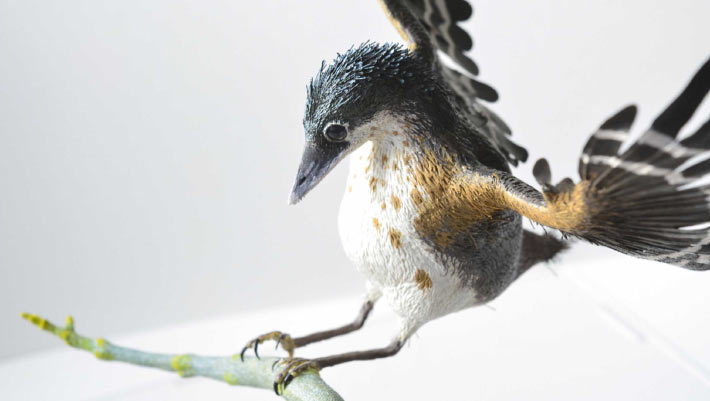
Researchers Reconstruct Prehistoric Bird Concornis Lacustris in 3D
Reconstructing Concornis lacustris
Researchers have built the first life-size, three-dimensional reconstruction of Concornis lacustris, a small enantiornithine bird that lived in what is now Europe approximately 125 million years ago during the Early Cretaceous epoch.
The Tech TL;DR:
- Researchers combined fossil data from Las Hoyas, Spain, digital modeling in Blender, and 3D printing to create a physical model of the extinct bird.
- The finished sculpture features a 30-centimeter wingspan, sculpted epoxy putty, oil paint, and plastic filaments representing downy and flight feathers.
- The study detailing the methodology was published September 26 in the journal Earth History and Biodiversity.
Fossil Evidence and Anatomy from Las Hoyas
The holotype specimen of Concornis lacustris was found at the Las Hoyas site in Cuenca, Spain, and initially described in 1992. Dr. Víctor Peco of the Universidad Complutense de Madrid and Dr. Sergio Nebreda, whose academic affiliations include Johns Hopkins University, the Natural History Museum of Los Angeles County, and the Universidad Autónoma de Madrid, noted that the fossil has long provided fundamental anatomical data for understanding small Mesozoic birds.
“The holotype of Concornis lacustris provided fundamental anatomical data for understanding the evolution of small Mesozoic birds,” said Universidad Complutense de Madrid’s Dr. Víctor Peco and Dr. Sergio Nebreda, who is affiliated with Johns Hopkins University, the Natural History Museum of Los Angeles County and the Universidad Autónoma de Madrid. “Furthermore, this species has been instrumental in detailing the active flight capabilities of these birds, revealing key aspects of their behavior and paleobiology.”
Because the original fossil lacks a skull and parts of the skeleton, the researchers incorporated anatomical data from other early birds, including a well-preserved skull from Brazil and another from Las Hoyas. They built a digital model in Blender based on published drawings and photographs, 3D-printed it in plastic, covered it with sculpted epoxy putty, and finished it with oil paint. Fine plastic filaments stand in for downy feathers, while wing feathers were printed separately.
Feather Arrangement and Depiction of Flight
The researchers based the feather count and shape on fossils discovered in China and Spain, alongside observations of a modern counterpart, the wallcreeper (Tichodroma muraria), which exhibits a similar flight style. Given that the holotype specimen retains no coloration, the scientific team drew upon related fossils to recreate its appearance, featuring a dark brown back and wings complete with banded flight feathers, a lighter underside, and an iridescent blue-green sheen on the head.
The resulting sculpture possesses a wingspan of about 30 centimeters and a body approximately 13 centimeters long. The model depicts the bird landing on a branch of Frenelopsis, an abundant conifer in the ancient Las Hoyas ecosystem, with its wings extended and feathers swept forward as it slows down.
“Our work seeks to deepen our understanding of Enantiornithes by integrating osteological, myological, and integumentary data derived from exceptionally preserved fossils,” the researchers stated in their paper published in Earth History and Biodiversity.
Disclaimer: The technical analyses and security protocols detailed in this article are for informational purposes only. Always consult with certified IT and cybersecurity professionals before altering enterprise networks or handling sensitive data.