
Astronomers Discover Ancient Cosmic ‘Mini-Halo’ Shaping Galaxies
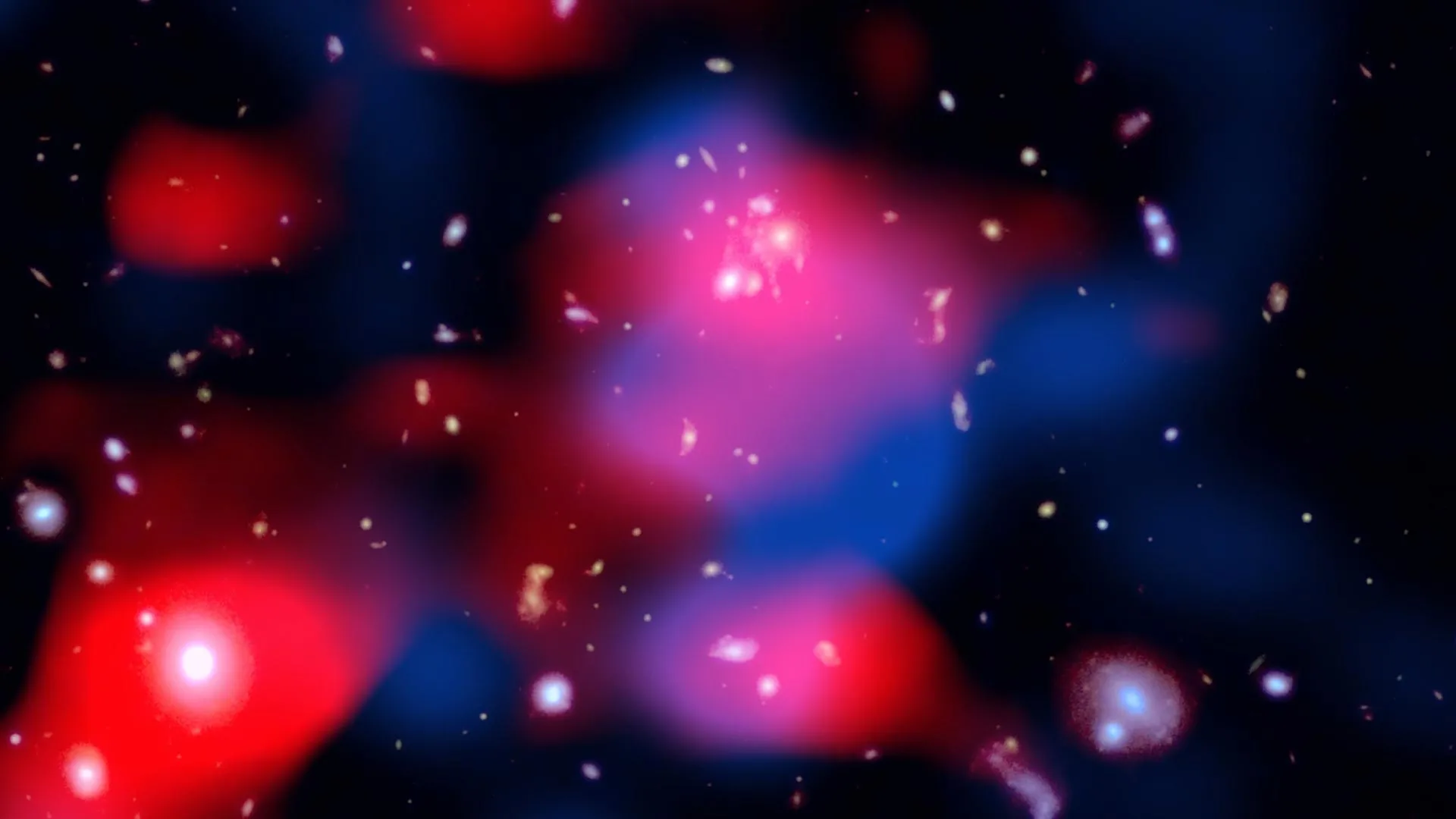
Scientists have made an extraordinary discovery, spotting an immense cloud of energetic particles around a distant galaxy cluster. This “mini-halo” provides unprecedented insight into the powerful forces that sculpt the universe, pushing the boundaries of our cosmological understanding.
Unveiling the Distant Halo
The mini-halo is located at a staggering distance, with light from it taking 10 billion years to reach Earth. This makes it the most remote example ever observed, doubling the previous distance record. The findings, published in The Astrophysical Journal Letters, reveal that even in the early cosmos, galaxy clusters were significantly shaped by energetic processes.
Astronomers have uncovered a vast cloud of energetic particles — a ‘mini halo’ — surrounding one of the most distant galaxy clusters ever observed, marking a major step forward in understanding the hidden forces that shape the cosmos. https://t.co/jXgJzK7H5R
— World Today News (@worldtodaynews) April 10, 2024
These mini-halos comprise high-energy, charged particles in the void between galaxies within a cluster. These particles then emit radio waves that can be detected from Earth. The international team of researchers was co-led by Julie Hlavacek-Larrondo from Université de Montréal and Roland Timmerman of Durham University’s Institute for Computational Cosmology.
“It’s as if we’ve discovered a vast cosmic ocean, where entire galaxy clusters are constantly immersed in high-energy particles,”
—Hlavacek-Larrondo
The study analyzed data from the Low Frequency Array (LOFAR) radio telescope. The team concentrated on a galaxy cluster called SpARCS1049, detecting a weak, widespread radio signal. A recent report from the European Space Agency indicates that the James Webb Space Telescope has found evidence of a galaxy cluster from 13.2 billion years ago, showing that early universe clusters were already forming and evolving.
Possible Explanations
Two primary explanations are offered for the formation of these mini-halos. One suggests supermassive black holes, positioned at the centers of galaxies, could eject high-energy particles into space. However, how these particles migrate from the black hole while maintaining their energy remains a topic of debate.
The alternative explanation involves cosmic particle collisions. Charged particles within a galaxy cluster’s hot plasma collide at near-light speeds. These collisions then shatter, producing the high-energy particles detectable from Earth. “It means these energetic particles and the processes creating them have been shaping galaxy clusters for nearly the entire history of the universe,” Timmerman noted.
Implications for Future Research
This research offers a rare glimpse into the early stages of galaxy cluster formation. The findings highlight that these clusters have been infused with high-energy particles for far longer than previously understood. This opens doors for astronomers to study the origins of these energetic particles.
Newer instruments, like the Square Kilometer Array (SKA), are being developed. They will enable scientists to detect even fainter signals. The goal is to further explore the influence of magnetic fields, cosmic rays, and energetic processes in shaping the universe. “We are just scratching the surface of how energetic the early Universe really was,” Hlavacek-Larrondo stated. “This discovery gives us a new window into how galaxy clusters grow and evolve, driven by both black holes and high-energy particle physics.”
