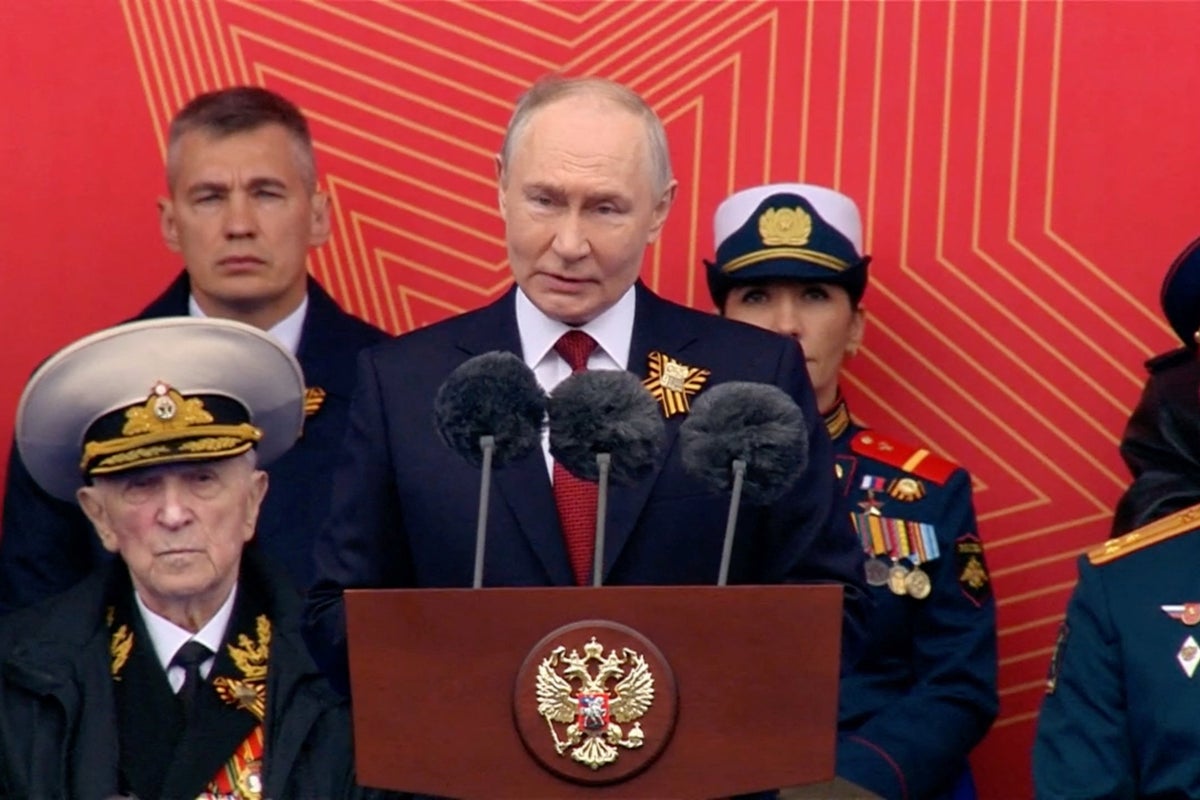
Putin Signals End of Ukraine War: What’s Behind the Sudden Shift?
Russian President Vladimir Putin declared on Monday that the war in Ukraine is “coming to an end,” marking a rare public signal from Moscow that the conflict—now in its fifth year—may be nearing a resolution. Speaking after Victory Day celebrations in Moscow, Putin framed the statement as a reflection of Russia’s strategic position, though he insisted any peace agreement would require pre-negotiated terms before direct talks with Ukrainian President Volodymyr Zelensky.
The remarks came as both sides observed a three-day U.S.-brokered ceasefire, which saw limited but persistent violations. Ukrainian officials reported at least three civilian deaths and nearly 150 combat engagements in the prior 24 hours, underscoring the fragile nature of the truce. Putin’s comments, delivered hours after his Victory Day address where he reaffirmed Russia’s “just war” narrative, introduced a stark contrast: while Moscow’s public rhetoric has long emphasized victory, the scaled-back nature of this year’s parade—omitting tanks and missiles—suggested a recognition of military and economic strain.
Putin’s willingness to entertain negotiations, however conditional, reflects mounting pressure on both Russia and Ukraine. The war, which began with Russia’s full-scale invasion in February 2022, has devastated Ukrainian infrastructure, displaced millions, and imposed crippling sanctions on Russia’s economy. The Kremlin has long blamed Western military aid to Kyiv for prolonging the conflict, a position Putin reiterated, accusing the U.S. And its allies of “fuelling confrontation.” Yet his acknowledgment that the war may be nearing its conclusion—without specifying a timeline or terms—introduces an element of uncertainty.
Ukraine’s response to Putin’s remarks has been muted but pointed. While Kyiv has not publicly dismissed the possibility of negotiations, officials have repeatedly stressed that any peace deal must include Russia’s full withdrawal from occupied territories, including Crimea and regions of eastern Ukraine seized in 2014. The current ceasefire, though fragile, has provided a rare window for prisoner exchanges and indirect diplomacy. However, broader peace talks remain stalled, with neither side willing to cede core demands.
Diplomatic observers note that Putin’s shift in tone may be tactical, aimed at testing Western resolve or leveraging internal pressures. The Russian economy, though resilient, faces long-term challenges from sanctions, while Ukraine’s military, bolstered by Western support, has in recent months reversed some of Russia’s territorial gains. Yet the absence of concrete proposals or a clear path to negotiations leaves the significance of Putin’s statement open to interpretation.
For now, the focus remains on the ceasefire’s duration and whether it can be extended into a framework for sustained talks. Ukrainian officials have warned that any pause in hostilities must be verifiable and accompanied by tangible concessions from Russia. Meanwhile, Western leaders, who have framed their support for Kyiv as essential to preventing further escalation, have yet to respond directly to Putin’s remarks, leaving the diplomatic next steps unclear.
The last confirmed direct contact between Putin and Zelensky occurred in 2022, before Russia’s full-scale invasion. Putin’s offer to meet—only after a peace deal is finalized—suggests a deliberate strategy to control the terms of any potential dialogue. With no immediate signs of a breakthrough, the war’s trajectory hinges on whether the current pause can evolve into a structured process, or if the front lines will once again define the conflict’s direction.