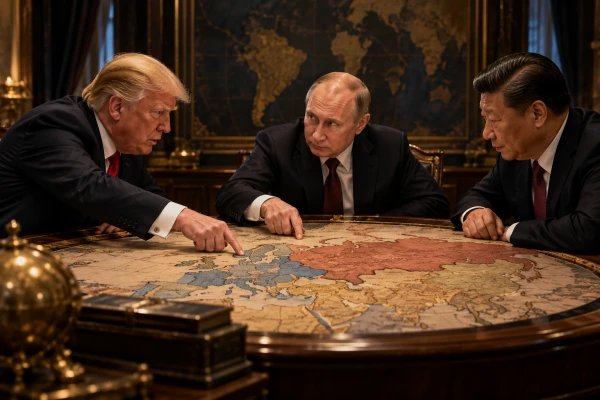
Putin Proposed Trilateral Summit with Trump and Xi Jinping
As the final two years of a U.S. presidency erode domestic legislative power and sink approval ratings, outgoing leaders historically turn their remaining authority toward international affairs, a legacy-shaping pattern that The Guardian reported. This dynamic risks leaving behind a world divided into distinct spheres of influence.
Putin Proposes Trilateral Summit with Trump and Xi
Bloomfield outlined that Vladimir Putin proposed a summit involving himself, Donald Trump, and Chinese leader Xi Jinping to take place in China. Such an unprecedented gathering carries potentially devastating consequences for global governance by attempting to divide the world into spheres of influence. While a single meeting will not instantly fracture international alliances, it could ignite a dangerous, irreversible trend.
Past presidential terms saw similar attempts to cement political legacies through major foreign interventions. In the final weeks of his presidency in 1992, George H.W. Bill Clinton attempted to resolve the Israeli-Palestinian conflict, and Barack Obama moved toward normalizing relations with Cuba while securing a nuclear agreement with Iran. Yet the current diplomatic trajectory risks dismantling the rules-based international order entirely.
Global Repercussions Across Europe and Asia
The weakening of American security guarantees threatens multiple regions simultaneously. According to Bloomfield’s commentary, if Washington withdraws support from European nations facing Russian aggression, the entire continent will feel the impact. Concurrently, reduced security commitments in Asia heighten strategic risks for Taiwan, South Korea, Japan, and Australia.
Veteran political journalist Adam Boulton expressed alarm during a conversation with John Pienaar on Times Radio, as reported. Boulton characterized the administration’s approach as incompetent, misguided, and selfish, warning that these traits could plunge the world into a hot third world war amid persistent hostilities in Ukraine and the Middle East.

Strategic Competition in Technology and Space
Beyond traditional territorial security, the intersecting interests of the United States, Russia, and China span advanced technologies, supply chain control, energy resources, and space programs. Xi Jinping has welcomed a rhetorical retreat from East Asia, allowing China greater maritime control in regional seas. Meanwhile, traditional allies find themselves sidelined from emerging international agreements, intensifying concerns regarding the end of Western cohesion.
Despite these shifting alignments, political analysts note that this trilateral framework may not solidify into a permanent alliance. Future administrations could choose to distance themselves from authoritarian leaders. However, the visual and diplomatic weight of the proposed summit threatens to strengthen the international standing of Putin and Xi Jinping as the post-Cold War consensus fades.
Russian President Vladimir Putin has proposed that he, President Trump and Chinese leader Xi Jinping meet next month to attempt to negotiate an end to the war in Ukraine that would favor Moscow, said people familiar with the discussions. https://t.co/F43ytZwD6o