Proteomic Risk Score Predicts Early Kidney Disease Progression in APOL1 High-Risk Genotypes
The window for intervening in chronic kidney disease has historically been dangerously narrow, often closing only after irreversible damage is detected. A breakthrough published in Nature Medicine on April 15, 2026, now offers a way to identify high-risk patients years before the onset of failure.
Key Clinical Takeaways:
- A new nine-protein proteomic risk score can predict kidney disease progression in individuals with high-risk APOL1 genotypes.
- This blood-based diagnostic tool identifies risk years before traditional clinical markers of kidney failure appear.
- The tool is specifically designed for individuals of African ancestry, who carry a higher prevalence of these genetic variants.
For decades, the medical community has recognized the significant role of the APOL1 gene in the pathogenesis of kidney disease. Individuals of African ancestry are more likely to carry high-risk APOL1 genotypes, which are strongly associated with an increased susceptibility to kidney failure. But, the presence of these genotypes does not guarantee the development of disease. many carriers remain healthy throughout their lives, while others progress rapidly to end-stage renal disease. This inconsistency created a critical clinical gap: clinicians knew who was at risk genetically, but they could not predict who would actually progress to failure or when that progression would occur.
Bridging the Gap Between Genotype and Phenotype
The fundamental challenge in nephrology has been the disconnect between a patient’s genetic blueprint (the genotype) and the actual manifestation of the disease (the phenotype). While genetic testing can identify the APOL1 risk, it lacks the temporal precision required for preventative medicine. The research published in Nature Medicine addresses this by shifting the focus from the genome to the proteome—the entire set of proteins expressed by a genome, cell, or tissue.

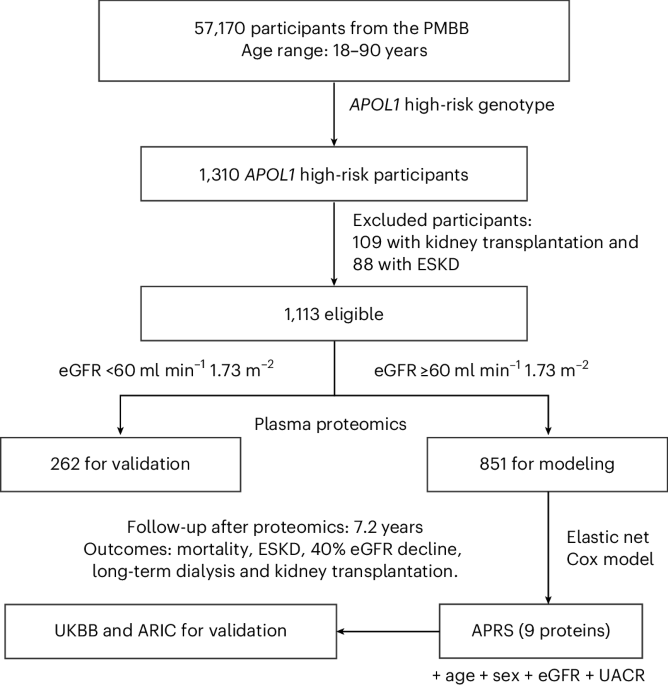
By analyzing a specific nine-protein proteomic risk score, researchers have developed a method to monitor the active biological processes driving kidney decline. Unlike DNA, which is static, proteins are dynamic indicators of current physiological stress and cellular dysfunction. This proteomic signature acts as a molecular early-warning system, signaling the transition from a high-risk genetic state to active disease progression long before creatinine levels rise or glomerular filtration rates (GFR) drop significantly.

The implementation of a nine-protein proteomic risk score enables the early prediction of kidney disease progression, potentially transforming the standard of care for individuals with APOL1 high-risk genotypes by facilitating early intervention.
This transition toward precision nephrology is essential because the morbidity associated with kidney failure is profound. Once a patient reaches the stage of dialysis or requires a transplant, the clinical objective shifts from prevention to maintenance. By identifying the progression years in advance, healthcare providers can implement aggressive blood pressure management, dietary interventions, and emerging pharmacological therapies to delay or prevent the onset of failure.
Clinical Implications for Public Health and Equity
The disproportionate impact of kidney disease on Black Americans is a well-documented public health crisis. The enrichment of APOL1 high-risk genotypes in this population has historically led to higher rates of kidney failure and shorter wait times for transplants. The ability to forecast failure years before onset is not merely a technical achievement; it is a tool for health equity.
Integrating this proteomic score into routine screenings for high-risk populations allows for a triage-based approach to care. Patients identified as “rapid progressors” by the proteomic score can be fast-tracked to specialized care, while those with the genotype but a low proteomic risk score can be monitored less aggressively, reducing unnecessary patient anxiety and healthcare costs.
For those identified as high-risk, immediate clinical coordination is vital. It is highly recommended that these individuals consult with board-certified nephrologists who specialize in genetic kidney diseases to develop a personalized mitigation strategy. Because the APOL1 genotype is hereditary, the discovery of a high-risk score often necessitates a broader family screening. In these instances, collaborating with certified genetic counselors is essential to navigate the psychological and familial implications of genetic risk.
The Path Toward Early Intervention
The ultimate value of the proteomic risk score lies in its ability to expand the therapeutic window. In traditional practice, the “standard of care” often begins after the kidney has already lost significant function. With this new diagnostic precision, the clinical focus shifts toward the pre-symptomatic phase. This allows for the deployment of nephroprotective agents at a stage where the kidney’s architecture is still largely intact.
As this research moves toward broader clinical adoption, the infrastructure for testing must evolve. The complexity of proteomic analysis requires high-sensitivity assays that are not available in every local clinic. This creates a necessity for partnerships between primary care providers and advanced diagnostic laboratories capable of performing high-throughput proteomic profiling.
While the full financial disclosures and funding sources are detailed within the primary Nature Medicine publication, the scientific community views this as a pivotal step in eliminating the “wait and see” approach to kidney disease. The shift from reactive treatment to proactive prevention represents the highest ideal of precision medicine.
The trajectory of this research suggests a future where kidney failure is no longer an inevitable consequence of genetic predisposition. By leveraging the dynamic nature of the proteome, medicine is moving closer to a reality where the progression of chronic kidney disease can be intercepted and halted. For patients and providers alike, the goal is no longer just to manage failure, but to prevent it entirely through the intersection of genetics, proteomics, and timely clinical action.
Disclaimer: The information provided in this article is for educational and scientific communication purposes only and does not constitute medical advice. Always consult with a qualified healthcare provider regarding any medical condition, diagnosis, or treatment plan.