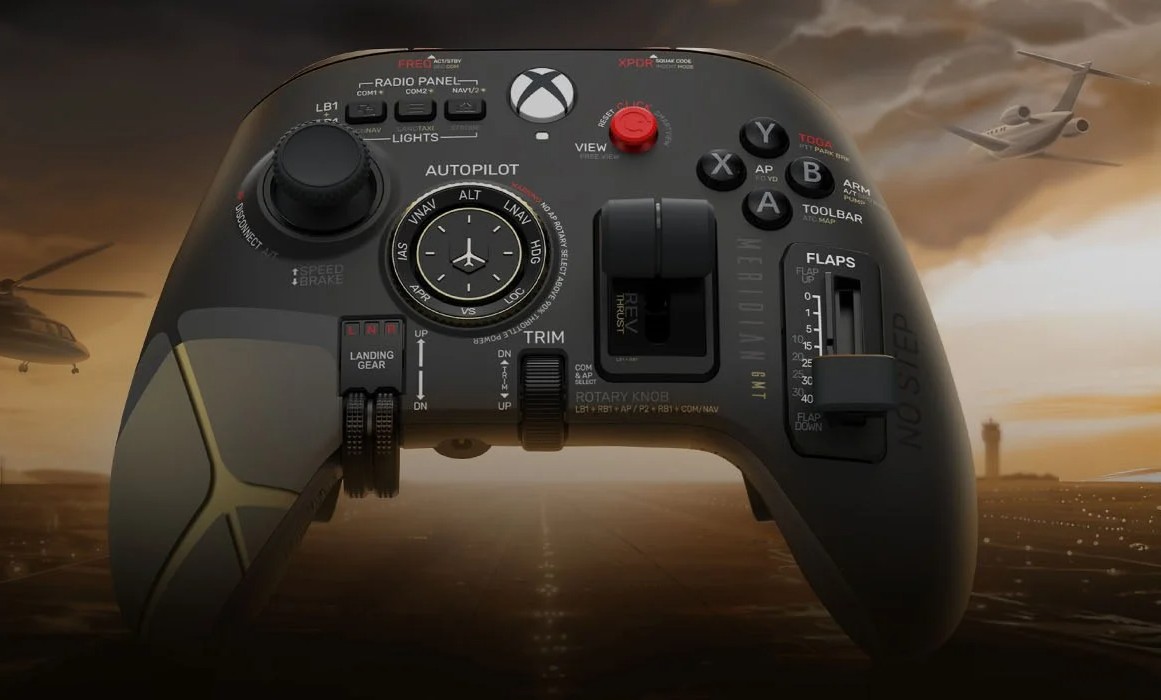
PowerA and Meridian GMT Unveil Project X-Ray Xbox Flight Simulation Controller
PowerA has confirmed the development of the “Project X-Ray” Flight Deck, a specialized wireless controller for the Xbox ecosystem designed specifically for high-fidelity flight simulation titles. According to technical documentation surfaced via Notebookcheck, the peripheral utilizes a proprietary low-latency wireless protocol to interface with Xbox Series X|S hardware, aiming to bridge the gap between consumer-grade gamepads and dedicated flight-stick peripherals.
The Tech TL;DR:
- Latency Optimization: The device utilizes a custom 2.4GHz wireless stack to bypass standard Bluetooth polling delays, critical for flight sim responsiveness.
- Input Mapping: The architecture supports deep integration with flight-specific APIs, allowing for granular control mapping beyond standard XInput limitations.
- Enterprise Utility: While consumer-focused, the modular nature of the hardware suggests potential for custom HID profile configurations in professional training environments.
Architectural Constraints of the Xbox Wireless Protocol
The core challenge in engineering a flight-specific controller for the Xbox platform lies in the constraints of the Microsoft-proprietary wireless handshake. Standard controllers operate on a standard HID (Human Interface Device) profile with polling rates often capped at 125Hz to 250Hz. For flight simulation, where precise pitch, roll, and yaw inputs are required, this polling rate can introduce perceptible input lag. According to Microsoft’s official XInput documentation, developers are often forced to work within narrow data packet constraints.
Project X-Ray appears to circumvent these limitations by employing an auxiliary dongle or a high-bandwidth proprietary link. For enterprise-level deployments where simulation precision is non-negotiable, teams often look toward specialized hardware integration firms to ensure that peripheral polling does not bottleneck the simulation engine’s frame delivery. Below is a simplified representation of how custom HID data packets are typically structured for high-fidelity flight controllers:
// Example structure for a 16-bit high-precision axis input
struct FlightAxisPacket {
    uint8_t reportID;
    uint16_t pitch;
    uint16_t roll;
    uint16_t yaw;
    uint16_t throttle;
    uint8_t checksum;
};
Comparative Analysis: Project X-Ray vs. Industry Standards
Evaluating Project X-Ray requires placing it against established hardware from companies like Thrustmaster and Logitech. Unlike traditional HOTAS (Hands-On Throttle-And-Stick) systems, which often require complex USB passthrough, PowerA’s approach prioritizes wireless convenience without sacrificing the requisite multi-axis inputs needed for titles like Microsoft Flight Simulator 2024.
| Feature | Standard Xbox Controller | Project X-Ray (Reported) | Dedicated HOTAS (Wired) |
|---|---|---|---|
| Polling Rate | 125Hz | 500Hz+ (Estimated) | 1000Hz |
| Connectivity | Wireless/USB-C | Proprietary Wireless | Wired USB-A |
| Axis Resolution | 8-bit | 12-bit / 16-bit | 16-bit |
“The shift toward high-fidelity wireless peripherals in simulation is limited primarily by battery-to-latency trade-offs. If PowerA manages to maintain a sub-5ms input latency while offloading the heavy processing of flight kinematics to the console, they have effectively solved the ‘wireless bottleneck’ that has plagued sim-enthusiasts for a decade,” notes Marcus Thorne, a Senior Systems Architect specializing in low-latency input hardware.
Cybersecurity and Firmware Integrity
Integrating third-party wireless hardware into the Xbox ecosystem introduces a discrete attack vector: firmware-level vulnerabilities. Because these controllers often require custom drivers or firmware updates, they represent a potential entry point for malicious code execution if the update mechanism is not properly signed. Organizations managing sensitive simulation environments should engage vetted cybersecurity auditors to verify that peripheral firmware adheres to modern SOC 2 compliance and secure boot standards.
The reliance on proprietary wireless protocols also necessitates that developers ensure robust encryption during the handshake process. Without end-to-end encryption between the stick and the console, there is a theoretical risk of input spoofing, where a malicious actor could intercept and inject commands into the control stream. While rare in a home environment, this is a significant concern for defense-contracted simulation rigs.
Future Trajectory and Implementation
The success of Project X-Ray will depend on how effectively PowerA exposes its API to third-party developers. If the controller remains a “walled garden” device, its utility will be limited to official Xbox titles. However, if PowerA follows the trend of open-source hardware support, we may see it integrated into broader simulation stacks, including PC-based flight training software. For firms currently managing large-scale pilot training fleets, the transition to wireless hardware represents a significant reduction in cable-management overhead, provided the firmware remains stable under continuous load.
As the industry moves toward more sophisticated simulation environments, the focus on hardware reliability will only intensify. Ensuring that these peripherals are audited and integrated by managed IT service providers remains the most effective strategy for maintaining high availability and security in simulation-heavy workflows.
*Disclaimer: The technical analyses and security protocols detailed in this article are for informational purposes only. Always consult with certified IT and cybersecurity professionals before altering enterprise networks or handling sensitive data.*