
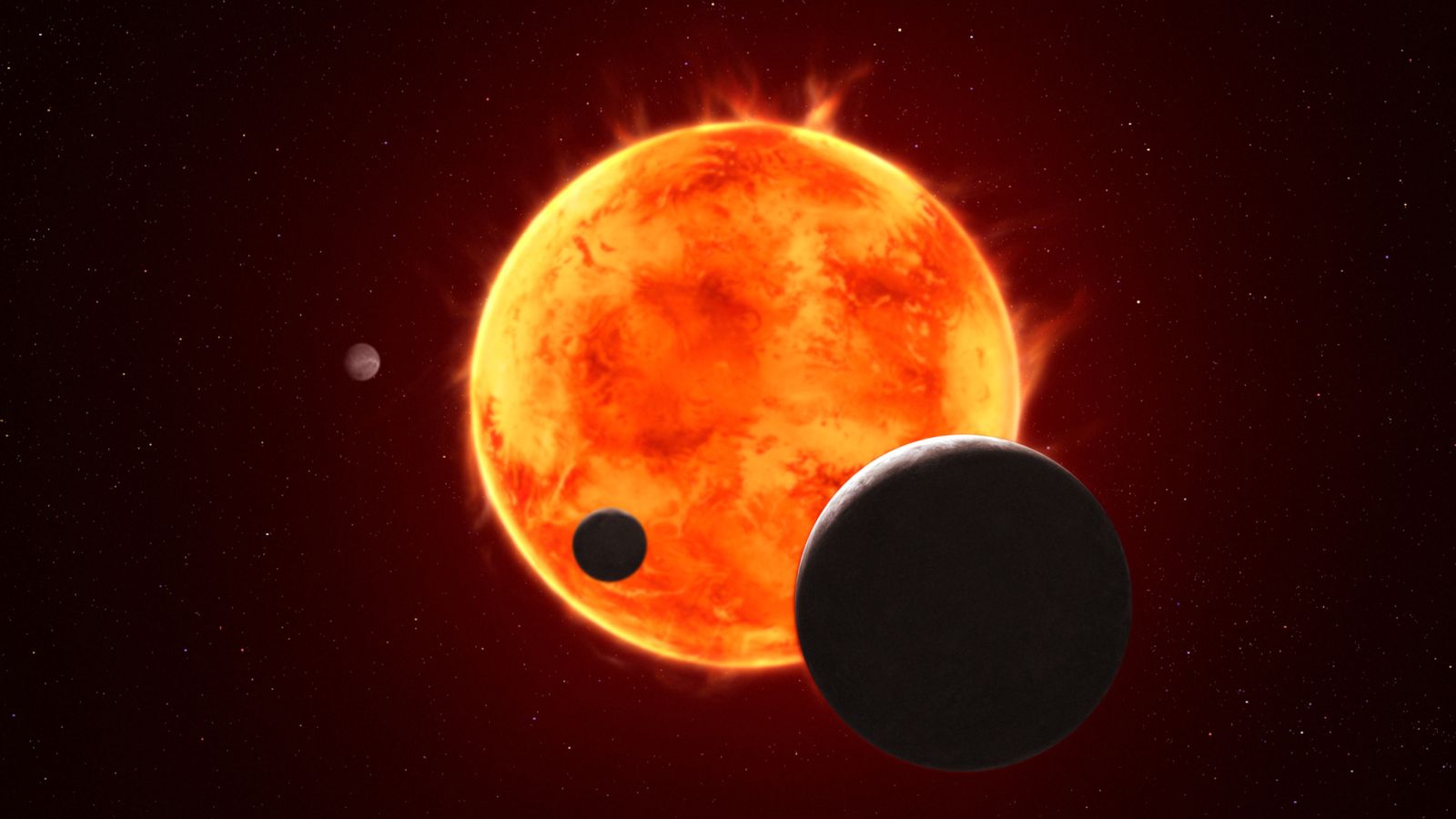
Possible Atmosphere Detected Around Earth-Like Exoplanet TRAPPIST-1e
St Andrews, UK – Astronomers are cautiously optimistic about the potential discovery of an atmosphere around TRAPPIST-1e, a planet long considered a prime candidate for habitability. New data from the James Webb space Telescope (JWST) suggests the exoplanet may possess a secondary atmosphere containing heavy gases like nitrogen, though researchers emphasize a bare-rock scenario remains possible.
The findings, a significant step in the search for life beyond Earth, where complex by interference from the host star, a red dwarf. the team spent over a year correcting data for starspots – magnetic field disturbances on the star’s surface – before analyzing the planet’s spectrum.
Researchers aimed JWST’s NIRSpec (Near-Infrared Spectrograph) instrument at TRAPPIST-1e as it passed in front of it’s star.Analyzing changes in the starlight spectrum reveals the potential chemical composition of any atmosphere present.
“TRAPPIST-1e has long been considered one of the best habitable zone planets to search for an atmosphere,” saeid Dr. Ryan MacDonald, lecturer in extrasolar planets at the University of St Andrews. “But when our observations came down in 2023, we quickly realised that the system’s red dwarf star was contaminating our data in ways that made the search for an atmosphere extremely challenging.”
Currently,the data allows for two interpretations.”We are seeing two possible explanations,” Dr. MacDonald explained. “The most exciting possibility is that TRAPPIST-1e could have a so-called secondary atmosphere containing heavy gases like nitrogen. But our initial observations cannot yet rule out a bare rock with no atmosphere.”
The team is continuing to gather data, with plans to analyze nearly 20 JWST observations of TRAPPIST-1e in the coming years. Each transit of the planet will refine the understanding of its atmospheric composition.
“We finally have the telescope and tools to search for habitable conditions in other star systems, which makes today one of the most exciting times for astronomy,” Dr. MacDonald added.
