
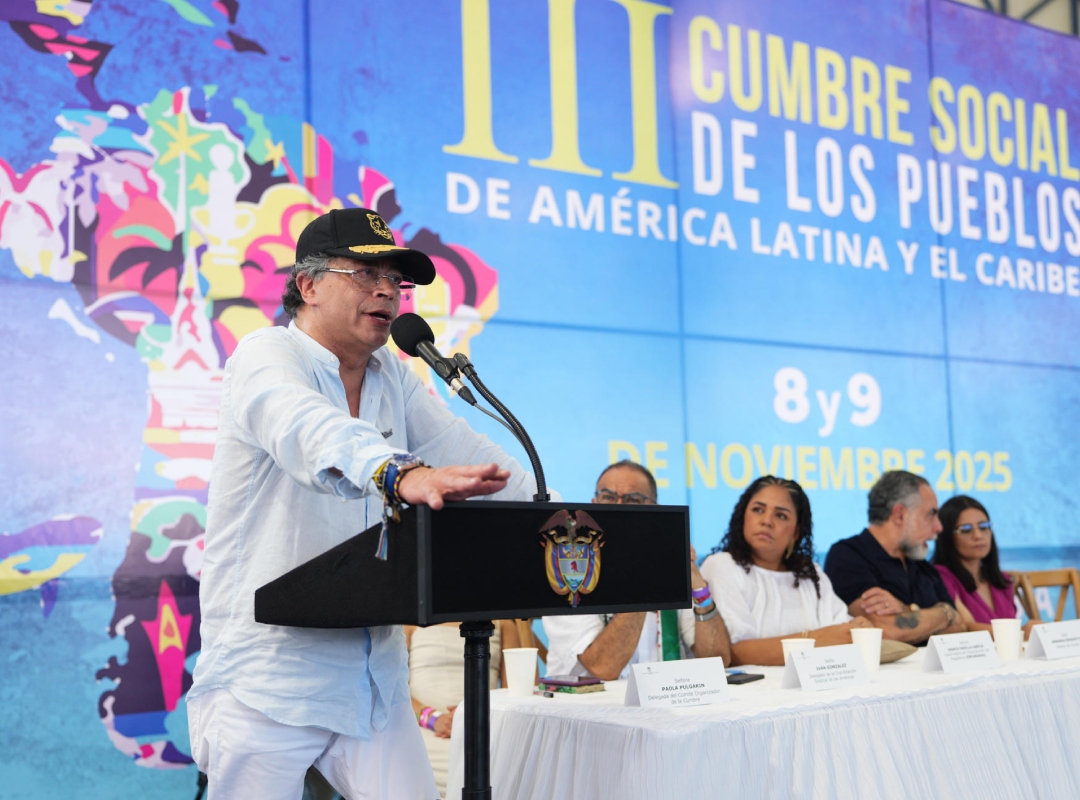
Petro Warns US Against Escalation in Caribbean, Cites Regional Unity
Colombian President Gustavo Petro delivered a strong rebuke of recent U.S. military actions in the Caribbean and Pacific, warning against further intervention and advocating for strengthened regional cooperation. Speaking at the III Social Summit of the People of Latin America and the Caribbean in Santa marta,held alongside the IV CELAC-EU Summit,Petro responded to U.S. attacks on boats suspected of drug trafficking.
Petro cautioned the U.S., specifically referencing former President Donald Trump and Senator Marco Rubio, against escalating tensions in the region. He invoked the phrase,”Don’t wake the jaguar,” emphasizing the potential for a strong response should the U.S. continue to operate aggressively in the Caribbean. “Be careful, they are crossing the Caribbean of the liberators. They are messing with Bolívar’s homeland,” he stated.
The President asserted that the recent U.S. operations, resulting in over 70 deaths, did not target drug traffickers, but rather “poor people, workers in an illicit trade that determines the world.” He called for a revival of the concept of Gran Colombia – a unified nation encompassing territories of present-day Colombia, Venezuela, Ecuador, and Panama – as a means to bolster regional power and address shared challenges. He proposed forming “committees of the Constituent assembly” across these nations, operating independently of existing political structures.
Petro also accused the U.S. government of attempting to dissuade European and latin American leaders from attending the IV CELAC-EU Summit, scheduled to take place in Santa Marta. He stressed the importance of dialog with the U.S., but insisted it must be conducted “one to one, between equals and without kneeling.”
Shifting to the ongoing conflict in Gaza, Petro reiterated his strong criticism of Israel’s actions. He highlighted what he perceived as the isolation of former President Trump and Israeli Prime Minister Benjamin Netanyahu at the recent United Nations General Assembly, attributing it to growing international support for Palestine. He further stated his belief that “democracy has died,” replaced by a ”crisis of a productive system called capitalism,” and warned that the violence unfolding in Gaza foreshadows potential future conflicts in other regions, specifically “the south.”
