
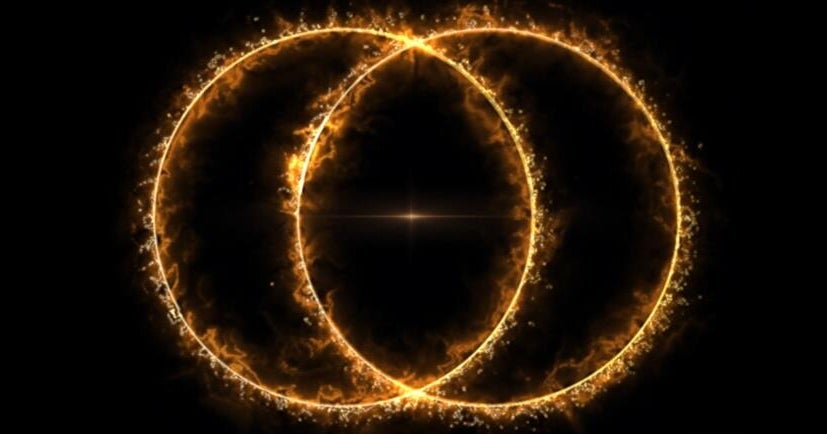
Astronomers Detect Most Powerful Twin “Odd Radio Circle” to Date
MUMBAI, INDIA - Astronomers have identified the most distant and powerful “odd radio circle” (ORC) ever observed, a phenomenon characterized by enormous, unexplained rings detectable only with radio telescopes. The newly discovered ORC is particularly unusual,presenting as two intersecting rings - a rare configuration among the handful of these structures identified to date.
The discovery, published in the October issue of Monthly Notices of the Royal Astronomical society, was made by a team at the University of Mumbai in India, with crucial contributions from citizen scientists and data from the worldS largest low-frequency radio telescope. ORCs were first detected in recent years and remain a cosmic mystery, prompting ongoing research into their origins.
while previous theories suggested ORCs might be caused by shockwaves from merging supermassive black holes or galaxies, the latest findings propose a link to “superwind” emanating from the host galaxies. “ORCs are among the most bizarre and beautiful cosmic structures we’ve ever seen – and they may hold vital clues about how galaxies and black holes co-evolve, hand-in-hand,” said Ananda Hota, founder of the RAD@home Astronomy Collaboratory, a platform that facilitated the citizen science involvement.
The identification of this ORC underscores the value of human pattern recognition in astronomical research. “the fact that citizen scientists uncovered them highlights the continued importance of human pattern recognition, even in the age of machine learning,” noted Pratik Dabhade, of the National Center for Nuclear Research in warsaw, Poland, a co-author of the study. “These discoveries show that ORCs and radio rings are not isolated curiosities – they are part of a broader family of exotic plasma structures shaped by black hole jets, winds, and their environments.”
