NVIDIA Vera: Powering the Agentic AI Era with Max Single-Threaded CPU Performance
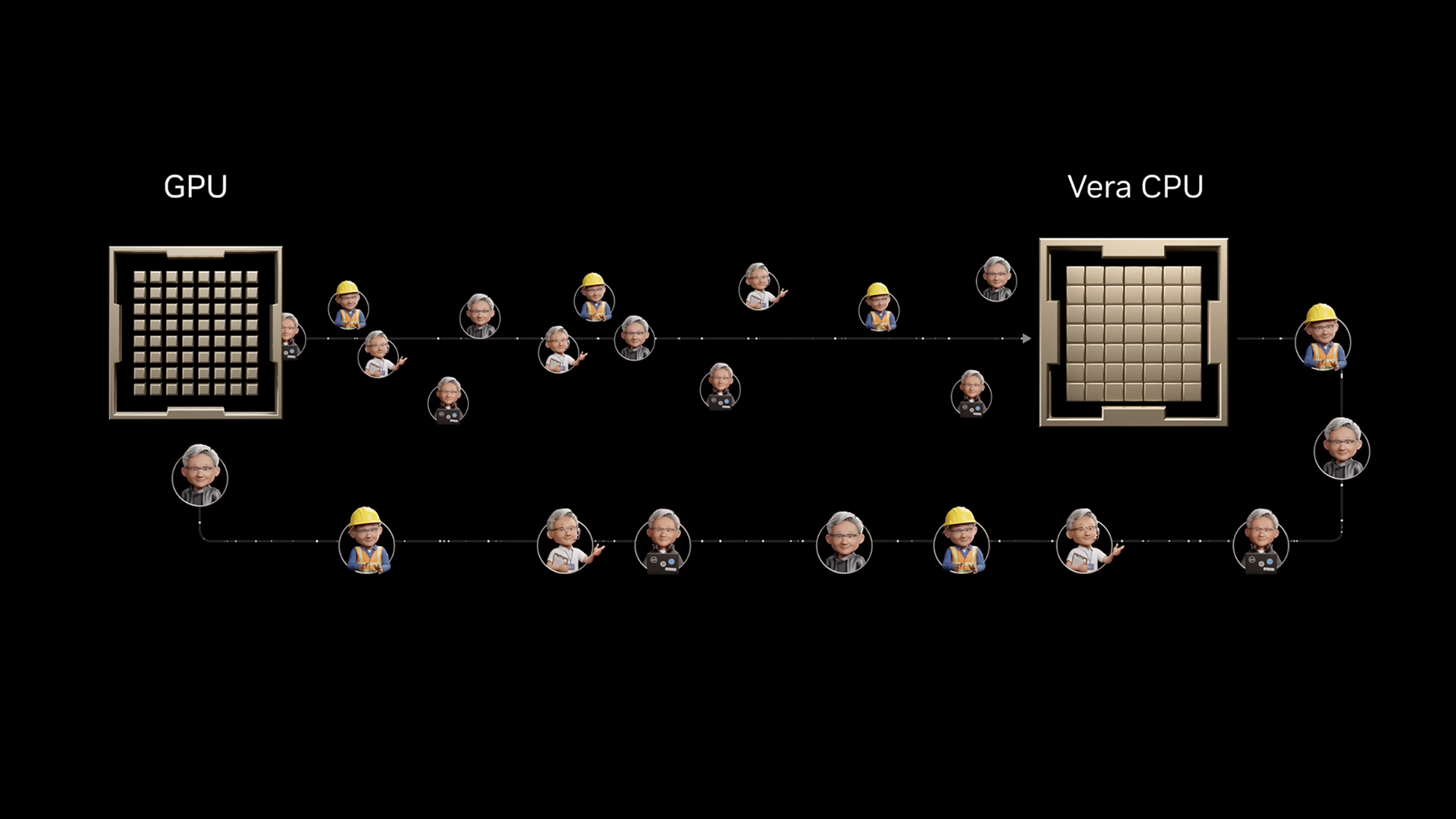
NVIDIA has launched the Vera CPU, a new class of “max single-threaded” processor designed to eliminate latency in the agentic AI loop. According to NVIDIA, the Vera architecture targets the specific bottleneck where GPUs sit idle while waiting for CPUs to execute tool calls, code, and data processing, delivering 1.8x the sustained per-core performance of x86 in agentic workloads.
- Hardware Shift: Moves away from high-core-count “cloud” CPUs toward max single-threaded performance to accelerate sequential AI agent steps.
- Key Specs: Features the Olympus core (50% higher IPC than Grace), 1.2TB/s LPDDR5X bandwidth, and 3.4TB/s core-to-core bandwidth.
- Real-World Gain: Perplexity reports 1.5x faster coding workflows and 1.9x faster concurrent sandbox initialization compared to x86.
The Architecture Gap: Why Core Count Fails Agentic Loops
Modern data center CPUs evolved for the cloud era, prioritizing “rentable cores” over raw per-core speed. This shift toward chiplet architectures reduced costs but introduced a “chiplet tax,” where cores compete for memory access, increasing latency. While this works for parallel web requests, it fails the agentic AI loop.

An AI agent operates in a sequential chain: the model reasons, the CPU executes a tool or code, and the result feeds back into the model. Because each step depends on the previous one, adding 128 slow cores doesn’t make a single agent run faster; it only allows more agents to run slowly. In an AI factory, this creates a critical efficiency leak. When the CPU lags, the GPU—the most expensive resource in the stack—remains underutilized, directly constraining revenue.
NVIDIA Vera Technical Specifications and Benchmarks
Vera replaces the general-purpose approach with the Olympus core. This custom CPU core delivers 50% higher instructions per cycle (IPC) than the previous NVIDIA Grace architecture. By focusing on the “max single-threaded” profile, NVIDIA ensures that every core maintains peak performance even under full system load.
| Metric | NVIDIA Vera (Olympus) | Standard Data Center x86 (Typical) | Impact |
|---|---|---|---|
| Sustained Per-Core Perf | 1.8x | 1.0x (Baseline) | Faster sequential agent steps |
| LPDDR5X Bandwidth | 1.2 TB/s | Variable/Lower | Prevents data starvation |
| Core-to-Core Bandwidth | 3.4 TB/s | ~1.1 TB/s (est.) | 3x higher predictability |
| Memory Power | < 40 Watts | Higher | Improved thermal efficiency |
The monolithic compute die is the architectural anchor here. By avoiding the fragmented nature of some chiplet designs, Vera provides 3.4TB/s of core-to-core bandwidth.
Production Implementation: Perplexity and Data Workloads
The shift from synthetic benchmarks to production reality is evident in Perplexity’s testing. When executing a coding workflow—specifically cloning a repository and running test suites in sandboxes—Vera completed the task 1.5x faster than x86. The startup time for concurrent sandboxes saw an even larger jump, hitting 1.9x speed increases.

Beyond coding, the CPU-side data processing required for Retrieval-Augmented Generation (RAG) showed significant gains. Partners reported 3x faster large-scale SQL analytics via Starburst and up to 6x lower latency on real-time streaming using Redpanda. This indicates that Vera isn’t just for “reasoning” but for the heavy lifting of continuous integration and data retrieval.
curl -X POST https://agent-executor.internal/v1/execute
-H "Content-Type: application/json"
-d '{
  "agent_id": "vera-test-01",
  "runtime": "python3.11",
  "code": "import pandas as pd; df = pd.read_csv("data.csv"); print(df.describe())",
  "timeout": 30,
  "resource_limit": "high-perf-single-thread"
}'
The Roadmap: From Olympus to Rigel
NVIDIA is treating Vera as the baseline, not the ceiling. The company has already detailed the next-generation Rosa CPU, which will utilize the Rigel core. Based on the Arm v9.2 architecture, Rigel aims to increase per-core performance further while maintaining the same silicon footprint. Expected improvements include a larger L2 cache and more efficient instruction delivery, further tightening the agentic loop.
Because Vera integrates with the NVIDIA BlueField-4 STX storage processor and hosts GPUs in the Vera Rubin systems, it creates a unified toolchain. This architectural convergence reduces the "impedance mismatch" between storage, CPU, and GPU.
The trajectory is clear: as agents move from simple chatbots to autonomous workers, the CPU is no longer just a “manager” for the GPU. It is the critical path. The industry is moving away from “more cores” toward “faster cores,” and the winner will be whoever can shrink the nanoseconds between a model’s thought and the CPU’s action.
Disclaimer: The technical analyses and security protocols detailed in this article are for informational purposes only. Always consult with certified IT and cybersecurity professionals before altering enterprise networks or handling sensitive data.