Non-Linear Volume-Outcome Relationships in Total Knee Arthroplasty: Germany Study
The correlation between a surgeon’s experience—often measured by annual case volume—and patient outcomes is a cornerstone of surgical quality assurance. In the realm of total knee arthroplasty (TKA), the question is no longer whether volume matters, but exactly where the threshold of safety lies and how that risk curve actually behaves.
Key Clinical Takeaways:
- A massive analysis of over 64,000 German TKA cases reveals a strong, non-linear relationship between hospital volume and surgical success, meaning risk drops sharply at low volumes before stabilizing.
- Current German minimum volume thresholds (ranging from 50 to 150 cases per year) may not fully capture the complexity of this risk curve.
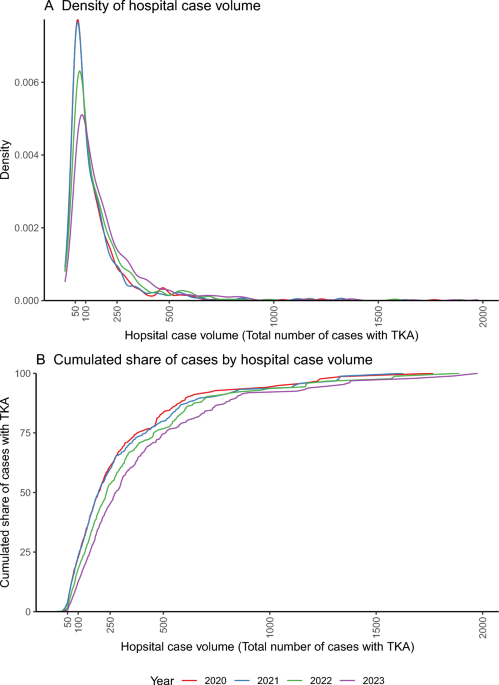
- Low-volume hospitals (under 250 cases) still handle a significant portion of the patient population, despite higher predicted probabilities of revision surgery.
The pursuit of reducing surgical morbidity has led many healthcare systems to implement minimum volume requirements. The logic is straightforward: surgeons who perform more procedures are generally more proficient, leading to fewer complications. But, applying a flat numerical threshold—such as requiring a hospital to perform 150 primary TKAs annually—assumes a linear relationship where every additional case incrementally improves the outcome. New data suggests this is a clinical oversimplification.
The Non-Linear Reality of Surgical Volume and Risk
According to a comprehensive study published in Nature, researchers analyzed statutory health insurance data from Germany covering the period between 2020 and 2023. This longitudinal analysis encompassed 64,911 TKA cases across 964 different hospitals, providing a robust dataset to examine how case volume influences revision rates and surgical complications.
The research team utilized logistic regression models paired with natural cubic splines to move beyond linear assumptions. By selecting models based on the Akaike information criterion (AIC), they were able to map the actual “curve” of risk. The results indicate that the relationship is non-linear, particularly at the lower end of the volume spectrum. For a representative patient, the predicted probability of needing a revision TKA was 3.6% at a hospital volume of 50 cases per year, dropping to 2.6% as volume increased.
“Spline-based regressions revealed strong, nonlinear volume-outcome relationships at low hospital case volumes.”
This finding suggests that the steepest decline in risk occurs during the transition from exceptionally low volume to moderate volume. Once a certain threshold is reached, the marginal benefit of additional volume diminishes. For patients, this means that the difference between a hospital performing 10 procedures and one performing 100 is far more clinically significant than the difference between one performing 500 and one performing 600.
Regulatory Hurdles and the German Healthcare Model
Germany has historically struggled with the appropriateness of its minimum volume thresholds. Past regulations set the bar at 50 cases per year for TKA, while current standards for primary TKA have moved toward 150 cases. The Nature study highlights a systemic tension: while higher volumes correlate with better outcomes, a vast majority of German hospitals still operate at lower capacities. In 2023, 76.6% of all hospitals had a case volume of fewer than 250, yet these facilities treated 45.3% of all TKA patients.
This distribution creates a public health paradox. To ensure the highest standard of care and minimize the 2.9% overall revision rate and 1.5% complication rate observed in the study, there is pressure to centralize surgeries in high-volume centers. However, doing so may create geographic barriers to access for patients in rural areas.
For healthcare administrators and facility managers, navigating these shifting regulatory requirements is a complex legal and operational challenge. Many institutions are now engaging healthcare compliance attorneys to ensure their surgical departments meet national mandates without compromising patient access or incurring regulatory penalties.
Clinical Implications for Patient Triage
The data underscores the importance of patient selection and the choice of surgical facility. When the probability of revision surgery is tied so closely to hospital volume at the lower end of the scale, the “standard of care” must evolve to include volume-based transparency. The risk of surgical complications—which occurred in 1.5% of all analyzed cases—is not distributed evenly across the healthcare system.
Patients presenting with complex comorbidities or high-risk profiles should be steered toward high-volume centers where the non-linear risk curve has plateaued at its lowest point. For those seeking a primary joint replacement, It’s critical to consult with board-certified orthopedic surgeons who operate within facilities that meet or exceed these evidence-based volume benchmarks.
Beyond the surgery itself, the long-term success of a TKA depends on the postoperative trajectory. The reduction of morbidity is not achieved in the operating room alone but through rigorous rehabilitation. To avoid the 2.9% revision rate noted in the German data, patients are encouraged to integrate specialized physical therapists into their recovery plan to ensure optimal implant integration and functional mobility.
The Future of Volume-Outcome Modeling
This research signals a shift toward more sophisticated statistical modeling in healthcare policy. By using natural cubic splines rather than simple linear regressions, the medical community can identify the “sweet spot” of surgical volume—the point where the risk of complication is minimized without unnecessary over-centralization of care. This approach allows for a more nuanced understanding of how surgical proficiency is acquired and maintained.
As we look toward the future of joint arthroplasty, the integration of global registry data—similar to the trends tracked in systematic registry reviews and OECD health indicators—will likely lead to more dynamic, data-driven volume regulations. The goal is a healthcare infrastructure where the probability of a successful outcome is not a matter of geographic luck, but a guaranteed result of systemic quality control.
The transition toward high-volume centers of excellence is inevitable, but it must be managed with clinical precision. For patients and providers alike, the priority remains the reduction of revision rates through the alignment of surgical volume with proven clinical outcomes. Finding a vetted provider who operates within these high-performance parameters is the most effective way to mitigate the risks identified in this large-scale analysis.
Disclaimer: The information provided in this article is for educational and scientific communication purposes only and does not constitute medical advice. Always consult with a qualified healthcare provider regarding any medical condition, diagnosis, or treatment plan.