
July 2025 Weather Forecast: NOAA Predicts Hot and Dry West, Wet East
Table of Contents
The National Oceanic and Atmospheric Administration (NOAA) has released its July 2025 weather outlook, providing insights into the expected temperature and precipitation patterns across the United States. The forecast indicates a stark contrast between the western and eastern regions of the country.
Temperature Predictions for July 2025
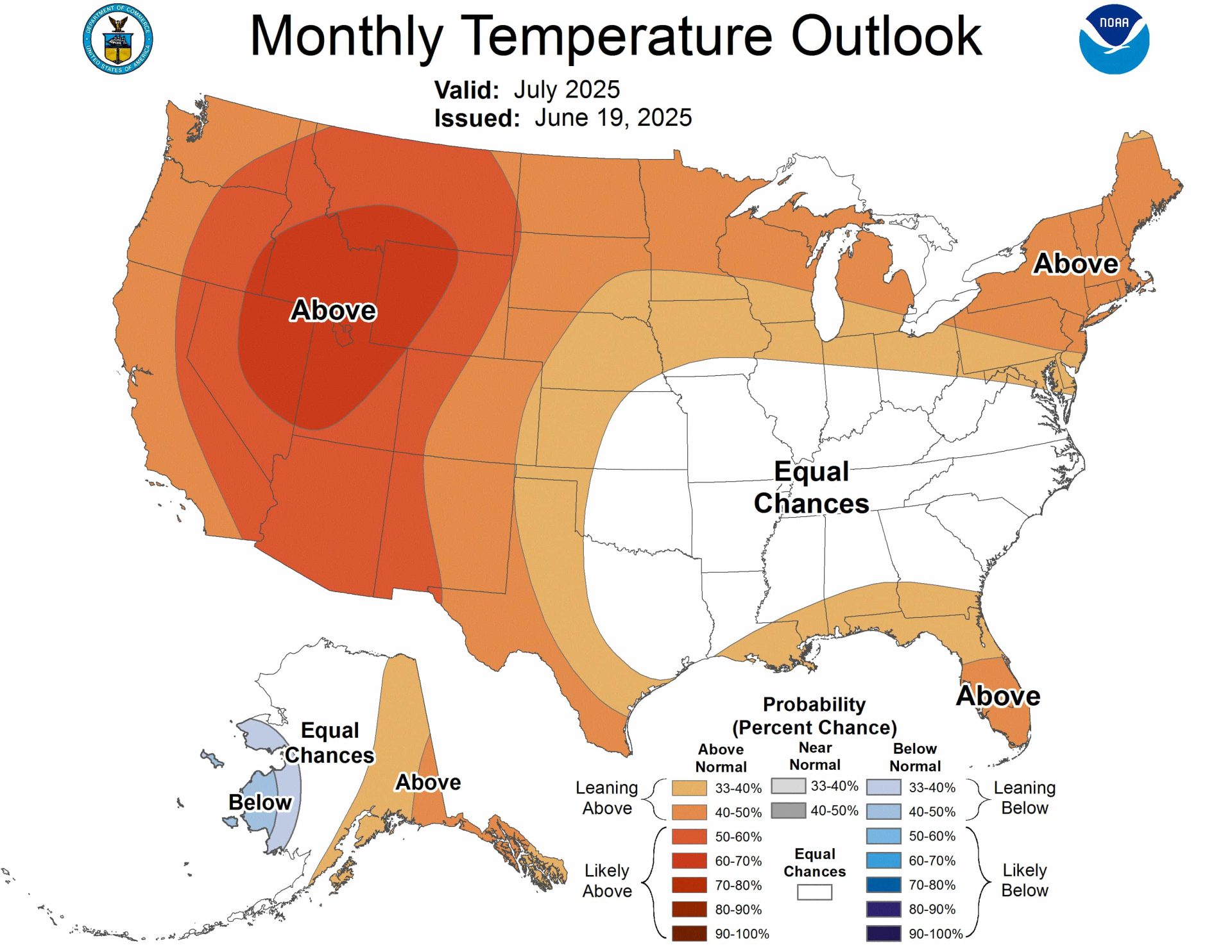
The NOAA’s temperature outlook suggests important regional variations. The western U.S. is bracing for a hotter-than-average July, while the eastern U.S. anticipates warmer and potentially wetter conditions. Central regions face a mixed bag, with no clear indication of temperature trends.
Regional Temperature Breakdown
- Western U.S., Rockies, and Northern Plains: Expect above-average temperatures. Computer models and dry conditions support this forecast.
- Gulf Coast, Florida, and Southeast: Warmer-than-usual conditions are likely, influenced by warm ocean waters.
- Southeast Alaska: Anticipates warmer-than-normal temperatures.
- Southwest Mainland Alaska: Cooler-than-normal temperatures are expected, especially early in the month, due to cool ocean temperatures.
- Central U.S.: No strong signal for above or below normal temperatures, leading to equal chances for any outcome.
Did You Know? The summer of 2024 was the hottest on record globally, according to Copernicus Climate Change Service.
Precipitation Forecast for July 2025
The precipitation outlook mirrors the temperature forecast’s regional disparities. The Pacific Northwest and Northern Plains are predicted to be drier than usual, while the Southeast and Northeast are expected to experience wetter conditions.
Regional Precipitation Details
- Pacific Northwest, Northern Rockies, and Northern Plains: drier-than-normal conditions are anticipated.
- Southeast, Ohio Valley, Mid-Atlantic, and Northeast: These regions are likely to see more rain than usual.
- Western Mainland Alaska: Higher-than-usual rainfall is expected.
- Southwest and much of the central U.S.: No firm indication of wetter or drier conditions,resulting in equal chances for any outcome.
pro Tip: Stay updated with local weather alerts and advisories to prepare for potential extreme weather events.
Southwest Monsoon Region Uncertainty
The forecast for the Southwest monsoon region remains highly uncertain. Forecasters indicate that any of the three categories-above, below, or near-normal precipitation-are equally likely. This uncertainty highlights the challenges in predicting weather patterns in this area.
The NOAA’s Climate Prediction Center (CPC) relies on climatic normals based on conditions between 1991 and 2020, following the World Meteorological Organization convention. These updated normals provide a more accurate portrayal of shorter-term climatic anomalies.
An updated monthly outlook for July will be issued on June 30, 2025, providing further insights as new data becomes available.
| Region | Temperature | Precipitation |
|---|---|---|
| Western U.S. | Above Average | Below Average |
| Eastern U.S. | Warmer | Above Average |
| Central U.S. | Equal Chances | Equal Chances |
| Alaska (Southwest Mainland) | Below Average | Above Average (Western) |
Understanding Weather Forecasts
Weather forecasts are based on complex computer models that analyze various atmospheric factors, including temperature, pressure, humidity, and wind patterns. These models use historical data and current observations to predict future weather conditions. However,due to the chaotic nature of the atmosphere,forecasts become less accurate as the time horizon extends.
The NOAA’s Climate prediction Center provides monthly and seasonal outlooks to help individuals and organizations plan for potential weather-related impacts. These outlooks are not a guarantee of specific weather events but rather an indication of the likelihood of certain conditions occurring.
Frequently Asked Questions About Weather Forecasting
- How are long-range weather forecasts created?
- Long-range weather forecasts are created using complex computer models that analyze historical data, current observations, and various atmospheric factors to predict future weather conditions.
- What does “above average” temperature mean in a weather forecast?
- “Above average” temperature means that the expected temperature is higher than the average temperature for that time of year, based on historical data.
- How reliable are monthly weather outlooks?
- Monthly weather outlooks provide an indication of the likelihood of certain conditions occurring, but they are not a guarantee of specific weather events due to the chaotic nature of the atmosphere.
- What factors influence precipitation patterns?
- precipitation patterns are influenced by various factors, including atmospheric pressure, temperature, humidity, wind patterns, and geographic features.
- How can I stay updated on the latest weather forecasts?
- You can stay updated on the latest weather forecasts by following reputable weather sources such as the national Weather Service, NOAA, and local news outlets.
Are you prepared for the predicted weather conditions in your region? what steps will you take to mitigate potential impacts?
