Newly Discovered Star S301 Offers New Insights Into Milky Way’s Black Hole Spin
<>
Astronomers Identify S301 as Fastest Star Orbiting Sagittarius A*
Researchers have identified S301, a star traversing the intense gravitational field of the Milky Way’s central supermassive black hole, Sagittarius A* (Sgr A*), at velocities reaching 25,000 kilometers per second. Published August 19, 2026, in the journal Nature, the findings detail an object that completes an orbit in approximately 8.7 years—the shortest known orbital period for a star in this region. This discovery, facilitated by the European Southern Observatory’s Very Large Telescope Interferometer (VLTI), provides a unique laboratory for testing Einstein’s general theory of relativity, specifically regarding the spin of the black hole.
The Tech TL;DR:
- Precision Astrophysics: S301’s extreme orbital velocity (8% the speed of light) and proximity—approaching within the distance of Saturn’s orbit—allow for high-fidelity measurements of spacetime distortion.
- Spin Measurement Potential: Data from the next periapsis passage in 2031 could enable researchers to calculate the spin of Sgr A* within a decade, significantly accelerating previous multi-decadal timelines.
- Infrastructure Requirements: Capturing these dynamics requires high-resolution interferometry and sophisticated noise-reduction algorithms to isolate faint stellar signatures from the intense radio emission of Sgr A*.
Architectural Challenges in Galactic Observation
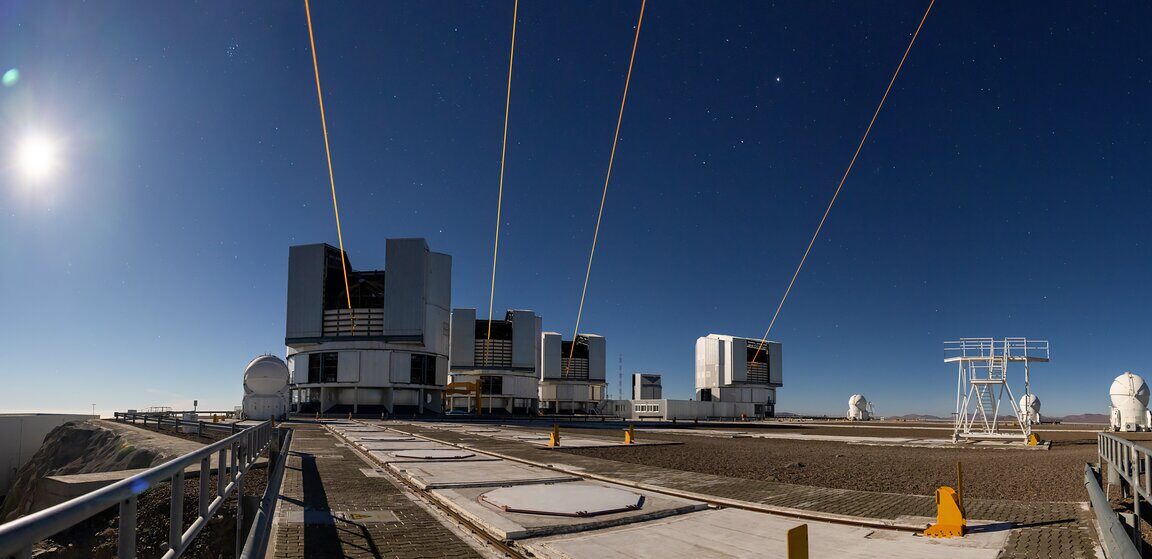
Observing the immediate vicinity of Sgr A* is an exercise in signal processing. The region is heavily obscured by dust and dominated by the high-intensity radio output of the black hole itself. According to research from the National Radio Astronomy Observatory (NRAO), extracting meaningful data—such as the recently discovered “breathing” wind of the black hole—requires specialized modeling to subtract the primary radio glow. The team behind the S301 discovery utilized the VLTI at the Paranal Observatory in Chile, which functions by combining light from four 8-meter telescopes to achieve the necessary angular resolution.
Frame-Dragging and the Quest for Black Hole Spin
General relativity predicts that a spinning mass drags the fabric of spacetime around it, a phenomenon known as frame-dragging. S301 is an ideal probe for this effect due to its highly eccentric orbit. Stefan Gillessen, a senior scientist at the Max Planck Institute for Extraterrestrial Physics, noted that the star’s motion serves as a critical test for these predictions. While previous models suggested that confirming the spin of Sgr A* would require monitoring multiple stars over several decades, the proximity and velocity of S301 condense this timeline. If the current trajectory holds, the 2031 close approach will yield sufficient data points to constrain the spin parameters of the 4-million-solar-mass black hole.
Data Modeling and Computational Implementation
import numpy as np

def calculate_orbital_position(t, semi_major_axis, eccentricity, period):
    # Mean motion
    n = 2 * np.pi / period
    # Mean anomaly
    M = n * t
    # Solving Kepler's equation for Eccentric Anomaly (E)
    # Using Newton-Raphson iteration for high-eccentricity orbits
    E = M
    for _ in range(10):
        E = E - (E - eccentricity * np.sin(E) - M) / (1 - eccentricity * np.cos(E))

    # Return cartesian coordinates
    x = semi_major_axis * (np.cos(E) - eccentricity)
    y = semi_major_axis * np.sqrt(1 - eccentricity**2) * np.sin(E)
    return x, y
Systemic Reliability and Future Trajectories
Unlike transient orbital phenomena that lead to tidal disruption, S301 remains on a stable path. It does not cross the event horizon, ensuring its utility as a long-term observational instrument. This stability is essential for ongoing research efforts, including those by ALMA partners who recently mapped the “breathing” winds of Sgr A*. As these observational datasets grow, the integration of multi-spectral data—combining the X-ray observations from NASA’s Chandra Observatory with the radio interferometry of ALMA and VLTI—will be required.


Disclaimer: The technical analyses and security protocols detailed in this article are for informational purposes only. Always consult with certified IT and cybersecurity professionals before altering enterprise networks or handling sensitive data.