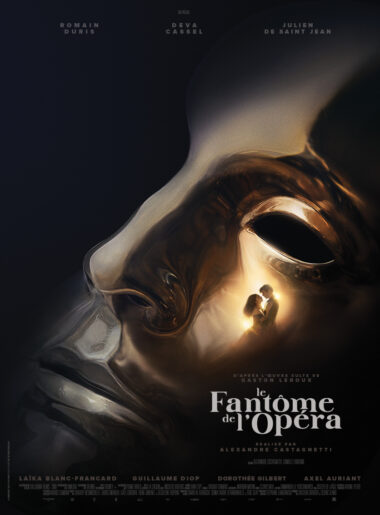
New Phantom of the Opera Film Shot on Location at Palais Garnier
Opening in French cinemas on October 28, director Alexandre Castagnetti releases a new film adaptation of Gaston Leroux’s 1910 novel, titled Le Fantôme de l’Opéra, marking the first time a cinematic version of the story has been filmed on location inside the Palais Garnier.
Filming Inside the Palais Garnier
The production utilized the historic Paris monument as an active shooting location, incorporating the grand staircase, the underground cellars, and the private box number 5 into the narrative structure. The opening sequence reconstructs the building’s 1875 exterior via 3D technology to match the date of the fictional opera Orpheus‘s premiere. Castagnetti notes that having access to the venue allowed the crew to traverse the landmark extensively, framing the historic architecture as an active participant in the story rather than a mere backdrop.
Modern Ballet Dancer Faces Spectral Composer in Paris
The narrative shifts the source material into a modern setting, following a young Romanian ballet dancer named Anastasia Marescu within the Paris Opera ballet corps. Played by Deva Cassel, the character faces intense competition alongside an invisible composer entity—the ghost of Ernest Dupré, a pianist in love with a dancer who died in the 1873 Le Peletier opera house fire. Julien de Saint-Jean portrays the spectral composer, who created the fictional cursed opera Orpheus. Romain Duris appears as James Figueras, the stage director tasked with mounting the production.

Clip-Style Editing Meets Traditional Orchestral Textures
In a review, the film is characterized as a heavily edited clip-style production featuring rapid cuts and modern needle-drops alongside traditional orchestral textures. Dan Levy composed the musical score, which integrates contemporary tracks alongside references to classical compositions by Tchaikovsky and Brahms. The choreography, designed by Marion Motin, incorporates sequences across the grand staircase and underground sets, featuring cameos by real artists from the Paris Opera such as Guillaume Diop, Dorothée Gilbert, and Loup Marcault-Derouard alongside actors Angela Molina and Mounir Margoum.
Stylized Approach Faces Uncertainty over Commercial Reach
Despite securing unprecedented access to the Palais Garnier, the film faces questions regarding its commercial trajectory and audience reach. The production employs a high-tempo, stylized approach that departs significantly from prior screen adaptations, such as Brian De Palma’s 1974 Phantom of Paradise and Joel Schumacher’s 2004 film version. Industry observers await box office returns to determine how contemporary audiences respond to this latest variation of Leroux’s century-old property.
Disclaimer: The views and cultural analyses presented in this article are for informational and entertainment purposes only. Information regarding legal disputes or financial data is based on available public records.