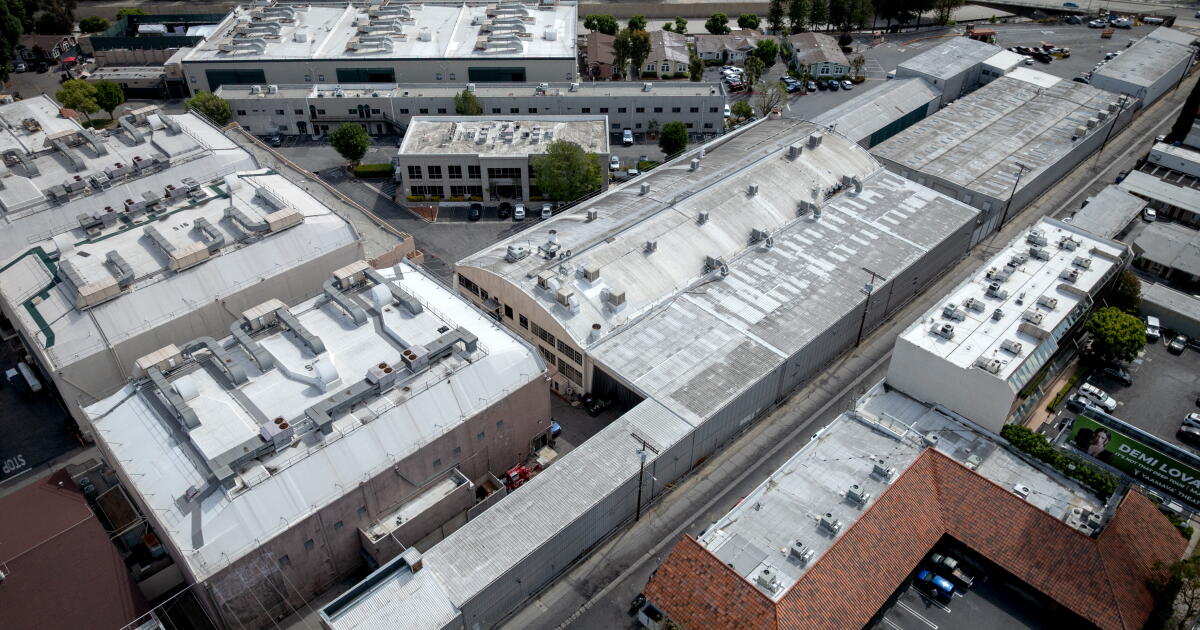
Netflix Acquires Historic Radford Studio Center in Los Angeles for $380 Million
Netflix has acquired the historic Radford Studio Center for $380 million, marking the streamer’s first ownership of a studio lot in the Los Angeles area.
The deal, which officially closed on Tuesday, follows a foreclosure auction where a Goldman Sachs-led lender syndicate took control of the 55-acre property after previous owner Hackman Capital Partners defaulted on its $1.1 billion mortgage in January, the Los Angeles Times reported.
The purchase price represents a sharp decline in value for the Studio City lot, which Hackman and Square Mile Capital Management bought for $1.85 billion in 2021. The $380 million figure is roughly 20 percent of that earlier acquisition cost, according to The Hollywood Reporter, reflecting a broader downturn in local production that has pressured studio real estate owners across Southern California.
This acquisition comes as the industry faces a production slump that has seen more than 50,000 workers lose their jobs since 2020. In an email statement regarding the loss of the asset, a spokesperson for Hackman said, “While we are disappointed in the outcome at Radford for our investors and partners, we welcome the prospect of the property continuing as a working production campus under new ownership.”
Netflix had alluded to the impending acquisition in an October shareholder letter, which noted the company had lowered its 2026 free cash flow estimate from $12.5 billion to $12 billion “due primarily to the expected closing of a real estate transaction” in the fourth quarter.
In an internal memo to staff, the company stated that the goal of the purchase is to “maintain operational continuity, retain the existing studio team and strengthen Radford’s position as a premier production destination.”

“There’s still a long way to go, but we are hopeful that with the partnership of the State of California and the City of Los Angeles, this will be the start of a meaningful new investment in California’s film industry,” Netflix said in a blog post. “This city is home to us.”
A Legacy of Production
Opened in 1928 at the end of the silent film era by Mack Sennett, the 98-year-old property has long served as a hub for television production.
Once dubbed Republic Studios, the campus was a filming site for classics including “Gunsmoke,” “Gilligan’s Island,” “Leave It to Beaver,” “The Mary Tyler Moore Show,” “Will & Grace” and “That ‘70s Show.” According to its technical specifications, the 1.14 million-square-foot lot features 22 stages, 210,000 square feet of office space, 172,737 square feet of support space, and 20 bungalows.
| Property | Transaction Year | Price |
| Radford Studio Center | 2021 | $1.85 Billion |
| Radford Studio Center | 2026 | $380 Million |
The acquisition provides Netflix with greater control over its production pipeline, as the company has historically relied on leasing facilities throughout Hollywood. While Netflix currently holds significant leases at sites like those owned by Hudson Pacific Properties—where it pays $27 million annually for over 720,000 square feet—those agreements are scheduled to expire in 2031.
Addressing these ongoing relationships in November, Hudson Pacific CEO Victor Coleman told analysts, “We have and continue to have very fruitful, very productive conversations with them.” He added that the company expects to see a resolution on lease extensions beyond 2031 by the end of the year.
“A lot of the high-level talent is here in Los Angeles, so having some Los Angeles space provides them an opportunity to be close to some top-tier showrunners and some of the postproduction talent, and having a turnkey lot in Studio City gives them some pricing power and control,” said David Smith, interim dean at Pepperdine Graziadio Business School.
Smith further characterized the move, noting, “They’re stepping at the bottom of the cycle to buy some significant L.A. infrastructure.”
By securing the Radford Studio Center, Netflix aims to stabilize its long-term production infrastructure while evolving from a tenant to a property owner. This strategic shift allows the streamer to leverage its massive scale—boasting 325 million paid memberships globally as of 2026—to gain operational autonomy in its primary content hub.
By integrating the lot into its portfolio, the company reduces reliance on external leasing agreements that currently support its vast library, which by 2022 saw “Netflix Original” productions account for half of its domestic content.
The acquisition also reflects Netflix’s maturation into a vertically integrated media powerhouse. Having transitioned from its origins as a DVD-by-mail service to the world’s most-subscribed streaming platform, the company now prioritizes owning the physical stages necessary to maintain its high-volume output.

The deal also carries additional costs beyond the sale price. According to TheWrap, Netflix agreed to pay a ULA transfer tax, a 5.5 percent levy on transactions exceeding $10.9 million, bringing the total cost of the acquisition to approximately $400 million.
Despite recent company-wide layoffs and leadership changes, Netflix confirmed that more than 45 of its programs are slated to film across Los Angeles this year. Beyond its California investments, the streamer has also been expanding its production footprint in New Mexico, as well as in tax-incentive-rich New York and New Jersey.