Nature Review Asks If Brain Scaffolding Explains Treatment Resistance
When a schizophrenia patient does not respond to treatment, or when craving returns years after someone quits a drug, brain scientists have largely looked to neurons and their synapses for the answer.
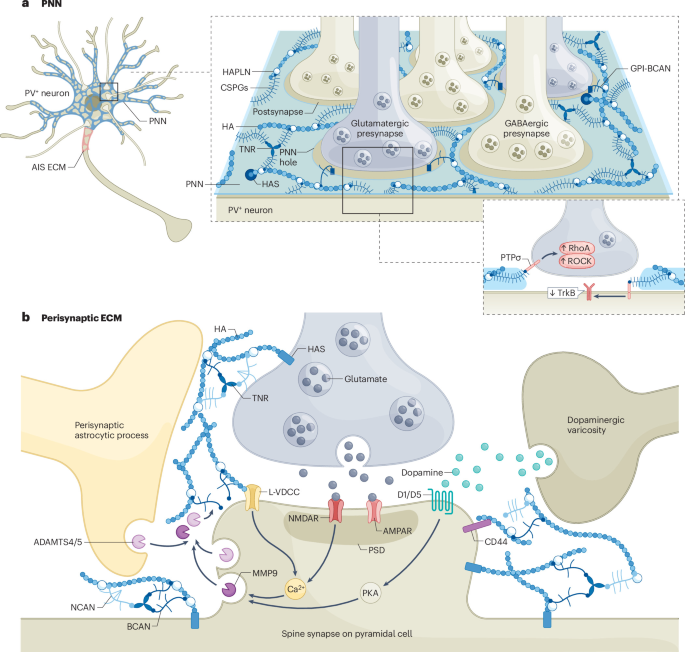
A new review article published in Nature argues that a third element deserves equal billing: the extracellular matrix, the molecular scaffolding that surrounds neurons and fills the space between synapses.
The article, titled “Brain extracellular matrix remodelling in health and neuropsychiatric disorders,” arrives at a moment when the field has spent two decades building the case that this scaffolding is not inert packing material.
The review’s own reference list traces that arc: a 2003 paper pairing extracellular matrix molecules with synaptic plasticity, a 2010 follow-up assigning the matrix a “dual role” in plasticity and homeostasis, and a 2011 paper introducing the “tetrapartite synapse” — the idea that a synapse involves neurons, glia and matrix together, not just two nerve cells meeting.
The list also shows where the clinical interest comes from. One cited 2015 paper examines how extracellular matrix remodeling contributes to corticoaccumbens plasticity underlying drug addiction. Another, from 2012, catalogs extracellular matrix abnormalities in schizophrenia, and a 2016 paper with the memorable title “In sickness and in health” weighs perineuronal nets against synaptic plasticity in psychiatric disorders.
A 2022 review in Molecular Psychiatry covers the matrix and perineuronal nets in memory, and a 2018 study reports that removing perineuronal nets disrupts recall of a remote fear memory.
The scaffolding runs through the rest of the bibliography as well. A 2004 study measured diffusion parameters of the extracellular space and described extrasynaptic volume transmission, the route by which signals move outside the synapse altogether.
A 2013 paper asked whether the neural extracellular matrix could be targeted as a treatment in neurological disorders, and a 2014 review continued that line. A 2022 paper in Frontiers in Synaptic Neuroscience characterized the synaptic extracellular matrix as long-lived, stable, and still remarkably dynamic — a reminder that the scaffolding is itself an active player rather than a fixed frame.
Glia, too, run through the list. A 2018 paper examined crosstalk between glia, the extracellular matrix and neurons, and a 2019 review in Cell Stem Cell connected adult neurogenesis and glia to the matrix.
Two more recent entries — a 2022 glial perspective on extracellular matrix and perineuronal net remodeling in the central nervous system, and a 2023 paper on the role of glia and the matrix in controlling neuroplasticity — carry that thread to the present.
Nature, the journal carrying the new review, was founded in the autumn of 1869 by Norman Lockyer and Alexander MacMillan as a public forum for scientific innovations, and it now operates editorial offices in London, the United States, continental Europe, and Asia under the publishing company Springer Nature. Its selectivity is a matter of record: fewer than 8% of submitted papers are accepted for publication.
The journal’s reach extends beyond research articles to commentary, news, and features on science policy and ethical issues, and as of 2012 it claimed an online readership of about three million unique readers per month. In 2007, Nature together with Science received the Prince of Asturias Award for Communications and Humanity.
What the reference list makes plain is that the tetrapartite synapse is no longer a newcomer’s framing. Twelve years after it was coined, it sits at the center of an article asking whether the brain’s scaffolding can explain why neuropsychiatric disorders resist treatment.